
SHE SLAPPED A GUEST FOR USING THE GUEST LINE. THE CERTIFICATE ON THE BARN WALL LISTED HIM AS THE OWNER.
Deputy Marlene Cho put the tip of her pen against the glass and read the frame out loud, because there were two hundred and forty people behind her and a frame on a wall is not evidence until somebody says what is in it.
"Harlow Ridge Orchard, limited liability company. Owner of record, R. Odell." She moved the pen down. "Assembly permit, two hundred and forty persons. Issued January ninth. Site plan approved by signature of the owner."
Nobody made a sound.
"The signature's on the plan behind the certificate," Cho said. "Dated the ninth. Initialed R.O."
Deborah Kessler laughed. It came out wrong — too high, too quick, a laugh that had to be pushed.
"That's a permit for the tent," she said. "That's the tent company's permit. Adrienne, tell her. Adrienne."
Adrienne Lusk, who had been paid eleven thousand dollars to keep this evening on schedule, was standing three feet away with a stack of unused menus in her hands and her face turned toward the barn door.
"The site plan's the property, Mrs. Kessler," Adrienne said, to the door. "The property owner signs it. That's how the county does it."
"Then he's the groundskeeper."
"He's the owner," Cho said. "It's on the certificate."
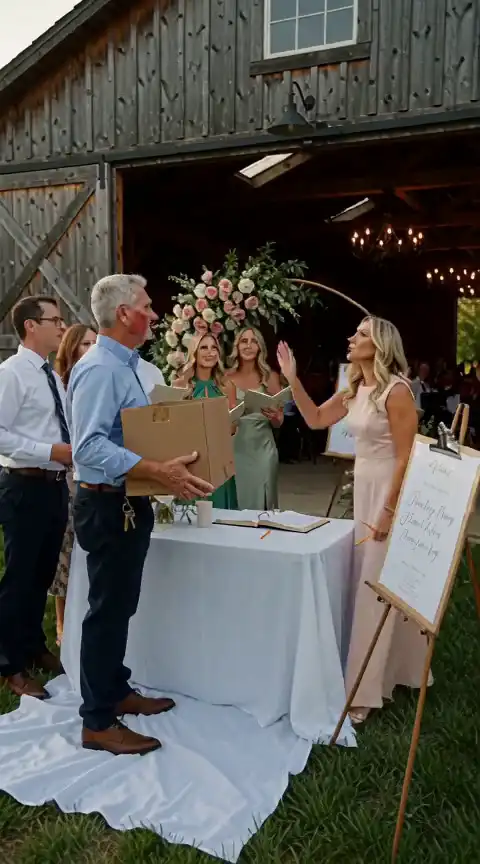
Ray Odell had not moved from the middle of the runner. There was a red bloom on his cheekbone the shape of four fingers, and forty printed programs fanned out around his boots, and he was holding the empty box against his chest with both hands as if it still weighed something.
He had not said one word since she hit him.
Gene Kessler came up the path at four fifty-two with his tie already loosened and his jacket over his arm, because his wife had sent him a text that said COME OUT HERE.
He was the father of the bride. He had been in a barn kitchen since noon, doing what he was told, staying out of the way of the thing his wife had spent fourteen months building.
He stopped at the edge of the runner and looked at the programs on the ground first, then at the mark on Ray's face, then at his wife, and something in his expression closed like a door.
"Deb."
"Don't." She had the guest book open against her forearm. "Do not do this in front of them. He walked through the line. There are rules. There is a process—"
"I asked him in January." Gene's voice was quiet and it carried anyway, because a quiet voice in a stopped crowd always does. "I drove out here on a Sunday in January and I stood in his kitchen and I asked him if we could have our daughter's wedding on his property, and he said yes, and then he said what it would cost, and I said that's too low, and he said that's the number."
Deborah's mouth was open.
"He would not take another dollar," Gene said. "I tried four times. He said the orchard's been in the family since 1911 and it doesn't need our money, and then he asked whether Nora still liked the cider donuts, because she came out here on a school trip in second grade and he remembered her."
"He didn't tell me that."
"No," Gene said. "He wouldn't."
Somebody in the line said oh, quietly, out loud, the way people do when a thing has crossed a line they did not know was there.
That was the second the room changed its mind, and everybody in the front of the line felt it happen at the same moment.
The whispering that had started at the far end ten minutes earlier and come forward like water through a wall went suddenly the other way. It moved back through the queue, from the front to the rear, one person turning to the next, and by the time it reached the arch all two hundred and forty of them knew that the man in the work shirt on the white runner owned every square foot of ground they were standing on, including the gravel under their shoes.
A phone had gone up near the arch and stayed up.
The woman in the green dress who had stepped back from the table earlier took her step back the other way, and stood where she had been standing before, and looked at Deborah while she did it.
Inside the barn the quartet was sitting with their instruments in their laps, waiting for a signal that was not going to come from the woman who usually gave it.
Marcus Iyer's mother came out of the barn at four fifty-six because she had heard the music stop.
She was from Oak Park, she had met Deborah Kessler exactly once, at a tasting in March, and she had spent the last two days being politely told where to stand. She walked to the edge of the runner, took in the programs on the gravel and the mark on Ray's face and the deputy with her notebook, and asked one question, in a low voice, of the nearest usher.
"Who is he?"
The usher was nineteen and had been told, that morning, that the man in the work shirt was the guy who does the grounds.
"He's the grounds," the usher said. "I think."
"He's the grounds," Mrs. Iyer repeated.
She turned around, walked back into the barn, and came out four minutes later with her husband and her sister and a chair from the head table, and set the chair down at the end of the white runner, and sat in it, facing the check-in table, with her pocketbook on her knees.
She did not say anything to Deborah Kessler. She sat there for twenty minutes with a mark of her own coming up on her jaw from the pressure of her own teeth, and every guest who came up the path had to walk past her, and every one of them understood the situation before they reached the guest book.
"Ma'am." Cho had her notebook open. "I need to ask you a question and I need you to answer it straight. Did you strike this man?"
"He was walking at me."
"Did you strike him."
"I put my hand up. That's not—"
"Mrs. Kessler." Cho's voice did not get louder. It got slower. "I watched it from the end of the path with a clear line of sight, and there are two hundred people behind you, and that young man by the arch has been recording since before it happened. So I'm going to ask you one more time, and then I'm going to write down whatever you say. Did you strike this man?"
Deborah's hand went to the pencil behind her ear and took it out, and she held it in front of her like a small stick.
"Yes," she said.
"Thank you." Cho wrote for a while. "This is a citation for simple assault, fourth degree. It's not an arrest. You'll appear, you'll get a date in the mail, and you'll want a lawyer. In the meantime."
She turned to Ray.
"In the meantime," she said, "the permit on that wall is in his name, and under county ordinance I have to give the permit holder the option to have the event shut down pending a review of any reported assault on permitted premises." She said it to Deborah, but she was looking at Ray. "That's his call, not mine, and not yours."
Deborah's face went the color of the paper in Cho's notebook.
Two hundred and forty people waited.
Ray set the empty box down on the card table. He crouched, and picked up the programs one at a time, and squared them against the gravel until they were a stack again, and then he stood up with the stack under one arm and looked at the woman who had hit him.
"It's her daughter's wedding," he said.
Cho's pen stopped.
"I'm not shutting anything down." He wiped his palm on his trousers. "Write it up. I'll sign it. But the wedding goes on, and she stays, and nobody says a word about it to that girl today."
"That's your right," Cho said slowly.
"I know it's my right." Ray turned the stack of programs around in his hands. "That's why I said it."
Deborah was still holding the pencil.
Nora Kessler came out of the barn at five past five with her dress pinned at one shoulder and her shoes in her hand, because Adrienne had gone in and gotten her.
She stopped in the doorway and looked at her mother, and at the deputy, and then at the father of her childhood friend — no, that was not right either; at the man on whose ground she had learned to ride a borrowed pony in 2003, and who had put a hand on her head at her grandfather's funeral in 2016, and who had stood at the back of her engagement party in April for forty minutes without eating anything.
"Uncle Ray."
"Hi, sweetheart."
"What happened to your face."
"Nothing."
"Uncle Ray."
"Your mother and I had a disagreement about a door," he said. "It's handled. You need to go back inside and get that pinned properly, because Marcus is going to cry when he sees you and I don't want him crying at the wrong part."
Nora looked at her mother for three full seconds.
"Mom," she said. "Step away from the table."
"Nora, I am running your—"
"Step away from the table." She said it without heat and it worked better than heat would have. "I'll check people in myself."
Deborah walked eleven feet to the left and stood by the floral arch with the guest book still in her arms.
The next guest in the line did not step forward.
That was the strangest part, and the part that people who were there still bring up. Nobody had asked them to do anything. Nobody had organized it. The line simply did not move, and the woman at the head of it — a retired postal worker named Carol Denby who had taught Deborah's daughter in the fourth grade — stood holding her gift with both hands and looked past Deborah Kessler as if the table had become furniture.
"Ma'am?" Deborah said. "Name?"
"Odell first," Carol said.
Deborah blinked. "I'm sorry?"
"I'd like to shake his hand first." Carol smiled the way you smile at a stranger who has been rude to you. "Then I'll check in."
She walked around the card table, crossed the runner, and put out her hand. Ray wiped his palm on his trousers again before he took it.
"I'm sorry about your face," Carol said.
"I've had worse from a ladder."
"I'm sure you have." She held on a little longer than a handshake requires. "The cider donuts were his idea, weren't they. The ones in the box by the barn door."
"They were."
"I thought so. Nobody up there would think of a thing like that for a wedding."
After her, the line moved, but it moved the wrong way. Gene Kessler went next, and shook his hand, and said something into his ear that lasted four seconds and made Ray close his eyes. Then the groom's parents from Chicago. Then the bride's godmother. Then a man in a seersucker suit who said he had been buying apples here since 1988 and had no idea whose place this was and was embarrassed about it.
By twenty-five past five there were thirty people standing in a loose informal line that led away from the check-in table and toward a man holding a stack of programs, and the check-in table itself had become a place where nobody in the county wanted to be seen standing.
Deborah stayed at the arch with the guest book open in her arms, holding it the way you hold something you are about to be asked to give up.
At quarter to six Adrienne came out with the ice.
She came out with it too late, in a cloth folded into a bag, and offered it to Ray with both hands and an apology that she had clearly rehearsed in the barn — I should have said something, I have worked with her for nine years and I should have said something — and Ray took the ice and said thank you, and did not make her finish the apology, which somehow made her feel worse.
"You want me to take the guest book from her?" Adrienne asked. "I can take it. It's my job to take it."
"It's fine."
"It is not fine. She is standing under my arch holding my book."
"It's her daughter's wedding," Ray said, for the second time that afternoon.
At six o'clock the ceremony started seventeen minutes late, and the quartet played the thing the bride had asked for, and Nora came down the runner her mother had laid over his gravel with her shoes in her hand and her father on one side and nobody on the other, because her mother was standing at the back of the barn holding a guest book with a pencil through the pages and did not walk her down the aisle. Gene had asked her. She had said no.
The room stood. The room applauded when the officiant said the names. The applause was for the couple and it stayed with the couple, and when the last of it died out, nobody in that barn started anything for the woman at the back, and the silence where that would have gone was the loudest thing in the room.
At the reception, the caterer — Terrence Obi, who had been brought on in June and had spent the last hour quietly furious — served the head table first and then the back tables and got to Deborah Kessler's seat at table nine last, forty minutes after everyone else had been fed.
"We're a little short on the salmon," he said. "There's chicken."
"I ordered the salmon."
"I know," Terrence said, and put it down in front of her.
The citation was issued at nine forty-one by the light of the barn door.
Ray read the whole thing before he signed it, which irritated Cho, who had already written it out twice.
"You want to change anything?"
"No." He signed and handed the pen back. "You'll need to amend one line. It says the parties were unknown to each other."
"They were?"
"He's been buying tires from my brother-in-law for eleven years, and he came out here for a school board meeting in March, and I've shaken his hand at two funerals." Ray wiped his palm on his trousers for the last time. "But we were never introduced. So put unknown. It's accurate."
Cho amended the line, initialed it, and put the carbon in her book.
"This goes into the county file tonight," she said, not looking up. "And because it happened on permitted premises during a permitted assembly, a copy goes into the permit file too. Which means the permit holder's insurance carrier will have it by Wednesday, and the county will want an event statement from the permit holder within ten days whether he wants to give one or not."
"I'll give one," Ray said.
"I know you will." Cho closed the book. "I'm telling you because I have to tell you, not because I think you're going to enjoy it."
Deborah Kessler was twenty feet away, standing under the arch, and she heard every word of it, because Cho had said it at the volume Cho said everything, and because the barn had gone quiet again the way it went quiet every time somebody mentioned the word file.
Ray looked at the citation in his hand. There was a number at the top, and a date in November, and a box at the bottom where the officer had written the classification in handwriting so square it looked printed.
"November twelfth," he said.
"November twelfth. Nine a.m. Bring the shirt."
"The shirt?"
"Photographs of the injury are in the file. If you show up in a shirt that matches the one in the photographs, the judge doesn't have to think about it." Cho put her hat back on. "And Mr. Odell. If she calls you before the twelfth, do not take the call. If she sends somebody out here to talk to you, do not talk to them. I have seen forty of these and the only people who lose them are the ones who are polite in the middle."
Ray folded the citation along its own creases and put it in his shirt pocket.
"I'm going to be polite," he said. "I'm just not going to be polite on the phone."
At nine fifty the north gate was still chained, because the north gate was always chained after dark. Ray walked down the grass with the key on his steel clip and opened the padlock so the bride's car could get through to the road without going over the gravel, and stood at the gate holding it open while the car came across the field with its headlights off and its windows down and Nora's hand out the whole way.
She put her hand on his wrist when the car stopped.
"I'm sorry," she said.
"Don't be."
"I'm going to be sorry about this for the rest of my life."
"Well." He let go of the gate and stepped back. "Then be sorry in the morning. Tonight you're a married woman and it's twenty past nine."
The car went out through the gate and turned south.
Deborah Kessler came out of the barn at nine fifty-eight with the guest book in her arms and the pencil still through the pages, and stood in the dark on the edge of the white runner where her daughter had been slapped into a citation, and did not ask anybody for anything.
Ray chained the gate, put the key back on the clip, and walked up to the barn to turn out the lights.
[CLOSURE: COLD JUSTICE]
Disclaimer: Mention of any brand or trademark is for identification only and does not imply partnership or endorsement
THE BILLIONAIRE'S SON ATTACKED EVERY MAID WHO CAME NEAR HIM... UNTIL A POOR YOUNG WOMAN KNEELED BEFORE HIM AND UNCOVERED THE SECRET BEHIND HIS RAGE
SHE SLAPPED THE MAN WHO DESIGNED THE WATCH. THEN SOMEBODY TURNED THE CARD AROUND.
SHE SLAPPED THE CUSTODIAN OVER A LUNCH TRAY. THE SIGN SHE LAMINATED NAMED THE CUSTODIAN AS AUTHORIZED.