


SHE SLAPPED THE MAN WHO DESIGNED THE WATCH. THEN SOMEBODY TURNED THE CARD AROUND.
Ivo Bergman picked the card up out of its holder with two fingers, the way a lawyer picks up anything, and read it out loud in a voice built for depositions.
"Caliber R-9. Designed by Emil Rask."
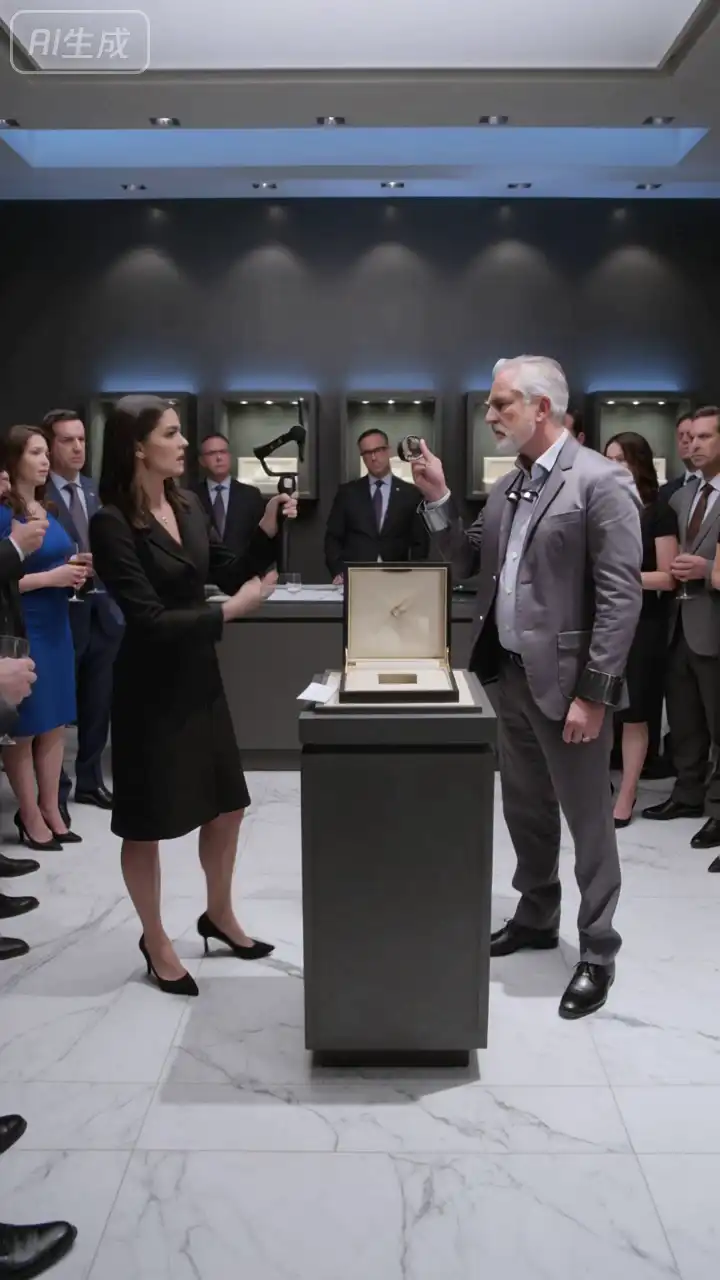
The room did not react. Forty collectors, six vitrines, one open case with a watch lying face-up on its cushion, and a woman in a black column dress with her phone still raised, and none of them had heard the sentence yet.
Bergman turned the card over, looked at the back, turned it back, and then set it down on the case ledge facing outward, toward the room.
"Ladies and gentlemen," he said, "the card is printed on both sides. That's usually a sign the information is meant to be read."
"He's a—" Talia Vance laughed. It came out thin. "He walked in through the service door. I have been here since five. I have been filming since five. Nobody came through that door."
"He came through it at twenty to six," Bergman said. "I watched him do it. I was standing at the press table, which is where the service door is, because that is where they put the press table."
"That doesn't make him the designer. That makes him a man who knows where the service door is."
Bergman reached into the open case, lifted the watch out by its strap, and turned it over. He held it up into the light from the vitrine, and turned it slightly, so that the sapphire back caught the beam.
"Miss Vance," he said. "Come here."
She did not come.
"Then I'll bring it to you." He walked it across the marble and held it up in front of her phone, and the live counter in the corner of her screen kept ticking, eleven thousand six hundred, eleven thousand nine hundred. "Read the rotor."
There was a weight of gold in the middle of the movement, cut with Geneva stripes, and engraved across it in a line so fine you had to be within two feet to see it: E. RASK — 2019.
"He built this," Bergman said. "Not the case, not the dial, not the marketing. The movement. The thing that makes it a watch instead of a bracelet. He built the first one in a workshop on Madison in 2019 and it took him three years and it is why forty of you are standing in this room tonight."
Somebody at the back said the name out loud, once, quietly, the way people say the name of a thing they already own.
"Emil Rask," a collector near the second vitrine said. "Rask. The R-9. It's on the—" He stopped. He had been about to say it's on the website, and then he understood how much worse that was.
The floor manager, a young man named Jules Adjei who had been in this job for eleven months, came out from behind the third vitrine with his hands half raised, doing the thing floor managers are trained to do, which is to make a shape in the air that means I am about to solve this.
He got four feet and stopped, because there was nothing on the floor to solve. The watch was on its cushion. The man who had been hit was standing with his hands at his sides. The woman with the camera was still filming.
"Sir," Jules said, to Emil. "Is there anything—"
"There's a cloth in the back office," Emil said. "The gray one, in the drawer under the polishing machine. Not the blue one, the blue one's got oil in it."
"The gray one."
"The gray one. And a loupe. Mine's at the bench, I came out without it."
Jules went and got the cloth and a loupe from the display repair kit, and brought them back, and Emil took the loupe first, screwed it into his eye socket, and bent over the open case with his hands behind his back.
"The balance is fine," he said. "It's the hairspring. It's been sitting in a magnetic field for four days."
"Should I take it out of the window?"
"You should take the winder out of the window." He straightened up and folded the cloth into a pad. "The watch is going to be fine. It's the winder that's ruining every piece in that display, and it's been doing it since Tuesday, and nobody's noticed because nobody's put a loupe on anything."
"Nobody's put a loupe on anything," Jules repeated, and then, quietly, to himself, "I have been telling them the window was running fast for a week."
Marguerite Vessier-Ochoa came out of the back office at ten to six.
She was sixty-eight, she had run this house since 2009, and she came out with her reading glasses on and a printed page in her hand, and she did not look at Talia Vance first. She looked at the mark on Emil Rask's face, and then she looked at the floor for a second, which for a woman like that was the same as shouting.
"Emil."
"Marguerite."
"Are you all right."
"I'm fine."
"Are you all right," she said again.
Emil touched his own cheekbone with two fingers, lightly, the way he would touch a balance wheel. "It'll be yellow by tomorrow and then it'll be nothing. I've had worse from a mainspring."
Marguerite turned, finally, to the woman with the phone.
"Do you know what you have done?"
"I did my job," Talia said. "There was a man with his hands in the display and nobody on the floor was stopping him. I stopped him. My audience saw me stop him."
"Your audience," Marguerite said, "saw you strike a sixty-one-year-old man across the face for picking up a watch that he made, in a room where he is the only person who has ever made anything."
"I didn't know who he was."
"No," Marguerite said. "You did not. That is the entire sentence. That is the whole of it."
Bergman had his folder open on the press table.
"Miss Vance," he said, "what time did you go live?"
"Five twenty-two."
"The embargo on this launch lifts at six o'clock. You were live for thirty-eight minutes inside an embargo, which is a breach of paragraph eleven of your creator agreement, and paragraph eleven is not a suggestion, it is twenty-five thousand dollars and immediate termination of accreditation. Now." He turned a page. "That was before. This is after. At five forty-one you struck a partner of this house in front of forty witnesses while broadcasting live. That is clause eight."
"What's clause eight."
"Clause eight says that if a creator makes a factual error about any guest, employee or partner of the maison, the creator shall publish a correction, in the same channel and in the same format, within twelve hours of notification." Bergman looked up. "You have been notified. It is five fifty-two."
"That's for factual errors. That's for saying the wrong price."
"You said a man was stealing," Bergman said. "He was designing. That is a factual error of the widest possible kind, and you made it with your hand."
The room had gone quiet in a way that Fifth Avenue does not usually allow.
Talia's phone was still up. Her gimbal was still on. Somewhere in the last four minutes the counter had crossed fourteen thousand, and the comments were moving so fast that the text had become a grey blur scrolling up the right edge of her screen, and she made the mistake of looking at it.
She turned the phone face-down against her chest.
"You can turn it off," Bergman said. "You were live when you hit him, so turning it off now doesn't undo anything, it just means fewer people watch you fix it. Which is your choice. Everything from here is your choice. I'm going to give you two of them and then I'm going to go back to my table."
"Fine. What."
"Option one. You leave now. We terminate the creator agreement tonight, we pull your accreditation, we pull the nine minutes of footage you shot in this room before you hit him, and my office sends the paragraph eleven invoice in the morning. You will not be invited to another launch in this city for as long as anybody in this industry remembers this, and this industry remembers everything, including what people's hands do."
"And option two."
"Option two. You put the phone back up, you record a correction, you read it from a page I write, you say the man's name correctly, you say what your hand did, and you post it before you leave this room. The maison does not terminate. The invoice for paragraph eleven still goes out, because that part has nothing to do with him."
"That's not a choice. That's a gun."
"It's a choice," Bergman said. "It's a bad one. You made it bad at five forty-one."
Emil had not said anything for four minutes.
He was standing beside the open case with his hands loose at his sides, and the red print of four fingers had come up across his cheekbone and was beginning to darken at the top edge. He looked like a man waiting for a bus.
"Emil." Marguerite's voice was quiet now. "Say something."
"Say what."
"Say what you want."
He thought about it. He looked at the woman with the phone against her chest, and he looked at the case, and he looked at the empty cushion where the R-9 had been lying face-up.
"I want my watch back on that cushion," he said. "It's running forty seconds fast. It's been on the window display since Tuesday and the field from that winder has magnetized the hairspring, and if it stays there another four days it'll be a minute and a half fast and somebody will buy it and think we can't regulate a movement."
Forty collectors stood very still.
"That's what you want," Marguerite said.
"That's what I want. The rest of it—" He moved one shoulder, the smallest gesture in the room. "The rest of it's not mine to decide. It's yours. It's his." He nodded at Bergman. "I've been hit before. Not like that, and not by a stranger, but I've been hit. It heals. The watch doesn't heal. The watch is the thing that has to be right."
Bergman closed his folder.
"Miss Vance," he said. "It's five fifty-six."
She called her agent from the corner by the elevator with her hand cupped around the phone.
Danny Corliss answered on the first ring, which meant he already knew.
"Are you live?"
"No."
"Are you sure you're not live?"
"I'm sure." She had the phone against her ear and the gimbal hanging at her side and the screen of it still glowing, paused mid-frame on a man's face with his head turned. "They want me to record a correction and post it before I leave the room."
"Then record it."
"Danny."
"Record it," Danny said. "Talia. You hit a man on camera. Not off camera, not in a hallway, on camera, live, with the counter in the corner. There are fourteen thousand people who watched you do it and about four hundred of them have already clipped it. If you walk out of that building without a correction, that clip is your whole career by Thursday. Every brand, every launch, every retainer."
"He was wearing a work jacket."
"He built the movement, Talia. He built the movement." She heard him exhale. "You know what the worst part is? You would have loved him. You would have spent forty minutes with him and made the best video of your year. That's the thing you do. That's the thing you're good at. And instead you hit him because he was touching a display and you were live and it felt like a moment."
She looked at the paused frame. The man's head was turning away from her hand.
"It's forty seconds," she said.
"It's forty seconds tonight and it's four years of not being invited anywhere. Read the page. Say his name. Say what your hand did. Don't explain, don't ad-lib, don't put a little music on it."
"And then?"
"And then you call me in the morning and we start over with the only thing you'll have left, which is that you were the one who told the truth about it first."
She recorded it standing in the middle of the room, under the vitrine lights, with her gimbal at chest height and her own face in the corner of the screen and the counter in the other corner at fourteen thousand two hundred.
Bergman had written three paragraphs on the back of an embargo sheet. She read them the way a person reads something written by somebody else, in a voice that was flat and then not flat.
"My name is Talia Vance. I'm at the Vessier atelier on 57th Street for the launch of the Caliber R-9. At five forty-one this evening I struck a man across the face. I said he was stealing. He was not stealing. He was checking the watch. The watch is called the Caliber R-9 and he designed the movement, and his name is engraved on the rotor, and his name is Emil Rask."
She stopped.
"Keep reading," Bergman said.
"I was live when I did it. My audience saw it happen and I let them believe what I said about him. I was wrong. I hit a man who built the thing I came here to talk about, and I did it because he was wearing a work jacket and because I thought it would look like I was doing my job." Her jaw moved. "That's the correction. That's all of it."
She lowered the phone.
"Post it," Bergman said.
"It's posted."
"Show me."
She turned the screen around. The video was up, forty-one seconds long, her face in the corner of it, and the counter under it was already climbing — two hundred, four hundred, a thousand — and the comments were not the grey blur they had been before.
Marguerite Vessier-Ochoa took her glasses off and folded them.
"Now go home," she said. "Do not come to the dinner. Do not come to the dinner at eight and do not come to the fair on Thursday."
"I'm not—"
"Go home, Miss Vance."
She went. She got as far as the elevator and then she had to stand in the lobby for a while with her phone in her hand, because the doorman was watching and because there was nowhere to sit.
At six o'clock the embargo lifted and the launch officially began, nineteen minutes behind schedule, and the forty collectors who had watched a woman slap a man in a gray work jacket were not in the mood to be sold anything.
They wanted to shake his hand.
The first was the collector from the second vitrine, a retired orthodontist named Walter Sze who had been buying watches since 1979 and who said, "Mr. Rask, I have owned four of your movements and I have never once known your face," and Emil said, "That's the job," and Walter Sze laughed so hard he had to put his hand on the vitrine.
The second was a woman in her thirties who did not say anything at all, and only held his hand in both of hers for a moment, and then went and stood by the case.
The R-9 allocation was forty-one pieces. It sold out at seven twenty-two, forty minutes after the launch opened, which had never happened with any caliber this house had released, and which the sales director attributed entirely to the correction video, an attribution that made Marguerite Vessier-Ochoa put her pen down and say, "Do not ever say that to me again."
At seven twenty-five the maison's counsel sent the creator agreement termination, not because of clause eleven, and not because of the slap, but because of a line in clause eight that nobody had ever had to invoke: a creator who has been required to publish a correction may not be re-engaged for twelve months. Marguerite signed it at seven twenty-nine.
At seven forty the R-9 came off the cushion.
Emil did it himself, with a small case he carried in his jacket pocket, and he did not do it in front of anybody. He put the piece into the case, closed the lid, and put the case in his pocket, and then he took a card out of the stack at the press table and wrote on the back of it in pencil, and stood the card in the empty cushion's place where the watch had been.
It read: THIS PIECE IS ON THE BENCH. IT WILL RETURN TOMORROW, CORRECT.
He went out through the service door at seven fifty-one with the case in his pocket and his loupes still hanging at his collar, and the doorman on 57th held the door and said, "Goodnight, Mr. Rask," and Emil said, "Goodnight, Luis," and walked east toward the park with a yellow mark coming up on his cheekbone under the streetlights.
At eight o'clock the dinner started without him, and nobody at the table mentioned the empty cushion, and the correction video passed nine hundred thousand views by eleven.
[CLOSURE: VENGEFUL SATISFACTION]
Disclaimer: Mention of any brand or trademark is for identification only and does not imply partnership or endorsement
THE BILLIONAIRE'S SON ATTACKED EVERY MAID WHO CAME NEAR HIM... UNTIL A POOR YOUNG WOMAN KNEELED BEFORE HIM AND UNCOVERED THE SECRET BEHIND HIS RAGE

SHE SLAPPED A GUEST FOR USING THE GUEST LINE. THE CERTIFICATE ON THE BARN WALL LISTED HIM AS THE OWNER.
SHE SLAPPED THE CUSTODIAN OVER A LUNCH TRAY. THE SIGN SHE LAMINATED NAMED THE CUSTODIAN AS AUTHORIZED.