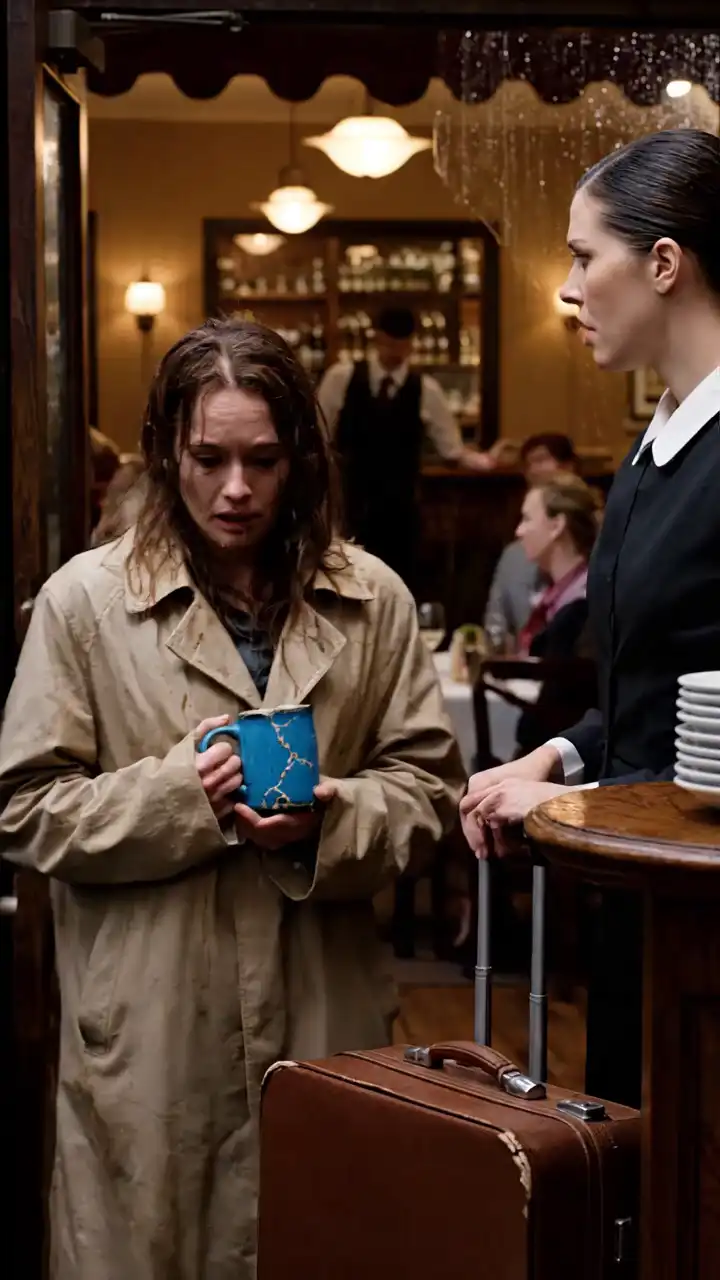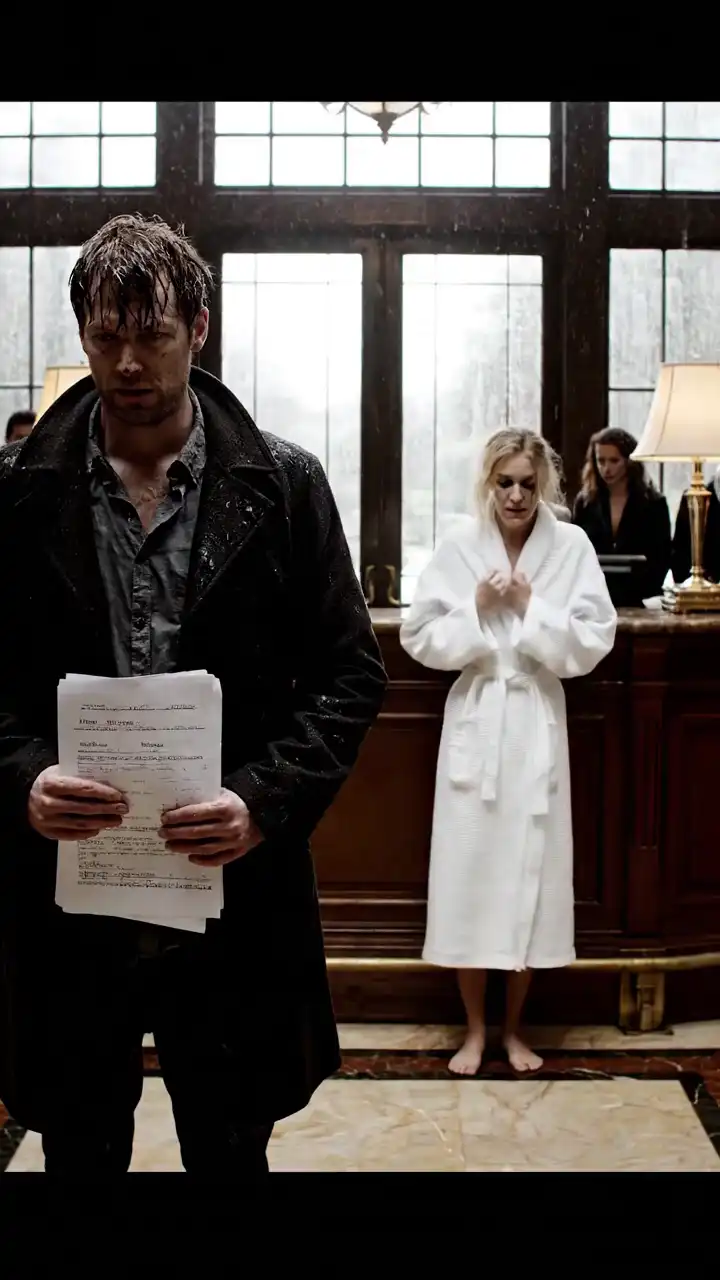
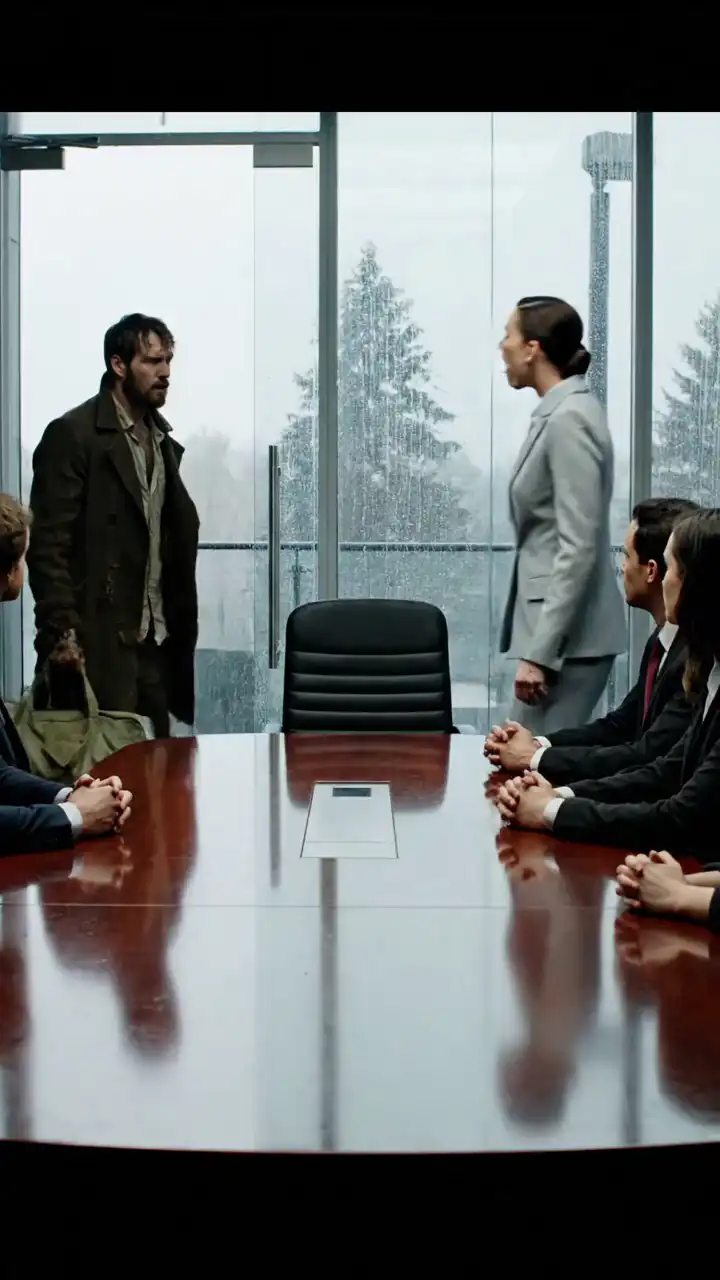
MY WIFE STOOD IN THE BOARDROOM AND CALLED ME A HOMELESS FRAUD
Chapter 1
The first thing everyone noticed was my coat.
It was a brown canvas coat with one sleeve darkened by old rain and the cuff torn where the lining had pushed through. It smelled faintly like bus station coffee and cold concrete, and when I stepped into the glass-walled conference room on the twelfth floor of Talcott & Rhine, that smell seemed to reach the polished table before I did.
My wife stood at the far end of the room in a pale gray suit, one hand on a leather folder, her face hard in a way I had not seen even during our worst nights. Her name was Celia Voss, and in that room she looked less like my wife than like someone filing a complaint against a stain.
The room went still.
There were eight people at the table. Two attorneys. A corporate secretary. Three members of the Bellmere Foundation board. One assistant standing by the wall with a tablet pressed to her chest. And near the windows, pretending not to stare, the building’s security supervisor.
Celia looked at me once, then at the room.
“I told you he’d come,” she said.
No one offered me a chair.
I kept my hand on the doorknob a second too long because I knew if I let go, I was really there. The conference room lights were too white. The windows behind Celia showed a strip of downtown Valewick washed in cold spring rain. On the table in front of her sat a yellowed envelope with a red wax seal that had been cracked years ago and then carefully tucked back into itself.
Even from the door, I knew what it was.
Or thought I did.
“Jonah,” Celia said, using my name like she had found it on a dirty receipt, “you shouldn’t have come up here.”
“You texted me the address.”
A flicker crossed her face. Not guilt. Annoyance that I’d said it out loud.
One of the board members, a thin man with silver glasses named Percy Dane, cleared his throat. “Ms. Voss, if this is a personal matter, we can reschedule.”
“It became a legal matter when he tried to interfere,” Celia said.
“Interfere with what?” I asked.
Her eyes dropped to my boots. Mud had dried in a pale crust around the soles. I had wiped them three times in the lobby restroom and still they looked wrong against this floor.
“With my father’s estate,” she said. “And with this board.”
The assistant by the wall glanced at me, then away. I was used to that look. People did quick arithmetic when they saw me—beard not recently trimmed, coat too old, hands rough, one duffel bag slung over my shoulder—and reached an answer before I even spoke. Not safe. Not stable. Not one of us.
I had learned to live inside that answer.
But standing there with Celia looking at me like that hurt in a place hunger never reached.
I said quietly, “I came for the envelope.”
A tiny reaction moved around the room. Percy’s silver glasses caught the light. One of the attorneys, a woman with neat copper hair and a nameplate that read MAREN SCULLY, sat straighter.
Celia gave a short laugh. “There. Finally.”
She opened the leather folder and pulled out a photocopy, then slapped it onto the conference table so sharply that a glass water pitcher trembled.
“Tell them,” she said. “Tell them why a man who’s been sleeping in shelters for six months suddenly cares about a sealed will.”
The word hit the room before the paper did.
Shelters.
Not separated. Not unemployed. Not gone through a collapse after the fire and the medical debt and everything that had come after.
Shelters.
The board members shifted with the ugly relief of people who think they now understand the whole story.
I looked at the photocopy but not at the details. I looked at Celia.
“You didn’t have to do it like this.”
“Yes,” she said softly, and that softness was colder than shouting. “I did.”
Percy folded his hands. “Mr. Voss—”
“Mercer,” I said automatically. “Jonah Mercer.”
That made things worse. Celia turned to them at once.
“You see? Even that. We are still legally married, but he hasn’t used my last name in years unless it benefited him.”
The security supervisor took one step closer to the glass wall, as if preparing for the moment I proved everyone right.
I had not come to fight. I had come because three nights earlier, in the soup line at St. Bartholomew’s Outreach on Hester Street, old Ms. Inez Bell had gripped my wrist with fingers so thin they felt made of twigs and whispered, “Don’t let them bury your name in that room.”
Inez had once worked in the Bellmere house before arthritis folded her hands into claws. Most people at the shelter knew her as the woman who saved sugar packets in her coat pocket and called every young volunteer “baby.” I knew her as the only person who had looked at me after the collapse and spoken like I still existed.
When she said, “There’s a paper they never wanted opened in front of you,” I listened.
Now that paper sat on the table under Celia’s hand.
Maren Scully said, carefully, “Ms. Voss, perhaps we should let Mr. Mercer explain why he believes he has standing to be here.”
Celia laughed again, but her fingers tightened on the edge of the envelope. “Standing? He followed me here after disappearing for half a year. He left our apartment, left our life, and now he walks in looking like this and claims he belongs in a room discussing my father’s final wishes.”
My throat burned. “I didn’t disappear. I got evicted while I was in County General.”
Silence.
That had not been in her version.
Celia didn’t blink. “And then you never came home.”
I heard the old argument inside those words, the one with too many broken pieces to hold in one hand. After the warehouse fire at my fabrication job, after the smoke damage in my lungs, after the bills, after my mother died in the middle of all that, I became a man who moved slower than grief expected. Celia became a woman who could not stand watching everything sink.
Neither of us was innocent. But only one of us had polished the story for strangers.
“I called,” I said.
“You stopped.”
No one at the table moved. Rain slid down the windows in narrow silver lines.
Then Celia lifted the yellowed envelope and held it up for the room to see.
“This document,” she said, “has become the center of a ridiculous claim. My husband”—she paused, and for one second her jaw tightened on the word—“is implying my father, Theodore Bellmere, intended to leave part of the Bellmere estate to him.”
A board member actually whispered, “What?”
That was the moment the eyes changed.
Not just contempt now. Curiosity. Scandal. Something close to enjoyment.
I could feel my face heating. My beard needed trimming. My knuckles were split from loading produce crates behind the market in exchange for cash and leftovers. My duffel bag was still on my shoulder like I might be thrown out before I finished a sentence.
Celia looked right at me and said the line that burned itself into me forever.
“Say it clearly, Jonah. Tell them why a homeless man thinks my father made him an heir.”
No one breathed.
The city below us looked small and wet and very far away.
I swallowed and looked at the envelope.
“I think,” I said, “he made a promise before he died.”
Celia’s mouth curved in disgust. “A promise? Or a story you built because you needed money?”
“It wasn’t money.”
“Then what was it?”
I looked at the cracked red seal, and something moved low in my chest—fear, yes, but also the old stubborn thing that had kept me standing in worse rooms than this.
“Open it,” I said.
Chapter 2
No one reached for the envelope.
It sat between us like something dead and expensive.
Percy Dane turned to Maren Scully. “Counsel?”
Maren folded her hands over a legal pad. “I’d like to understand why this meeting was called before we proceed. My office was told this was a governance review for the interim Bellmere Foundation vote.”
Celia’s voice was smooth again, almost elegant. “Because my husband has been contacting staff, suggesting that there are irregularities in my father’s estate documents and that I am acting without authority.”
“Are you?” I asked.
She didn’t answer me. She rarely answered me directly when truth might slip in through the side.
Instead she addressed the room. “My father left the Bellmere House, the surrounding acreage in North Bracken, and controlling authority over the foundation to me. The original will was probated years ago. This”—she tapped the envelope—“is a personal letter attached to old estate files. It has no legal force.”
“How do you know?” I said.
“Because I’ve seen it.”
“Then why hasn’t anyone else?”
That landed harder than I expected.
The assistant by the wall shifted. One of the board women, Denise Harlow, frowned at Celia. “You reviewed an attachment not presented to the board?”
“It was irrelevant.”
Maren’s pen stopped moving. “Who determined that?”
Celia’s color changed slightly. “My father’s attorney at the time.”
“Who is deceased,” I said.
Again the room turned to me.
I had not come empty-handed. I set my duffel bag on the floor, knelt, and pulled out a folded hospital discharge packet, a bus pass, a plastic bag with two apples, and finally a small spiral notebook wrapped in a grocery sack to keep it dry.
I opened it carefully. Inside, between pages of odd jobs and shelter meal times and names of people who still owed me five dollars, was a business card worn thin at the corners.
ELIAS VERRAN ESTATE ARCHIVES BELLMERE LEGAL ANNEX
“I met a man named Elias Verran,” I said. “Three weeks ago. Outside the annex on Union Crescent. He thought I was someone else at first.”
Celia’s eyes narrowed.
I went on. “He asked if I was Theodore’s boy.”
“That’s absurd,” Celia snapped.
“I told him no. He looked embarrassed, then stared at me for a long time. Then he asked my full name. When I told him, he nearly dropped his keys.”
Percy said, “Who is Mr. Verran?”
The answer came not from Celia but from the assistant by the wall, a young woman with dark braids and anxious eyes. “He was records clerk for Bellmere Legal before the annex closed.”
Everyone looked at her like she’d stepped into a scene she had no permission to enter. She lowered her eyes at once.
Maren said, “Your name?”
“Sabine Holt.”
“Thank you, Ms. Holt.”
Celia’s expression sharpened toward her. It was small, but I saw it.
I kept going. “Mr. Verran told me Theodore Bellmere once came down to archives himself, which he almost never did. He asked for a sealed addition placed with the estate materials and said it was to be opened only if a named party appeared in person.”
Maren leaned forward. “Named party?”
“Yes.”
“Who?”
I looked at the envelope again. “Me.”
That should have sounded ridiculous. In that room, with my coat and bag and cracked thumbnail and the stale smell of shelter soap still clinging to me, it should have collapsed under its own weight.
Instead it sat there.
Because no one had yet opened the paper and proved me wrong.
Celia drew in a slow breath through her nose. “This is what he does. He picks up fragments and makes a whole fantasy out of them.”
“What exactly am I gaining from this fantasy?” I asked.
“Money. Leverage. Revenge.”
“Against you?”
Her eyes flickered.
That was the first tiny opening.
Denise Harlow looked between us. “Ms. Voss, with respect, if there is a sealed attachment naming your husband, it would be simplest to have counsel review it now.”
“It would also be reckless,” Celia said. “The board is not a family court.”
“No,” I said, “but you made it one the second you called me a fraud in front of them.”
Her face stiffened. There it was: she had expected me to shrink. I usually did. Public humiliation works best on people already carrying private shame.
For six months, shame had walked beside me like a second shadow. I had slept behind the loading dock at Rainer Market, in the overflow beds at St. Bartholomew’s, once under the East Mercer overpass with my shoes tied to my belt so they wouldn’t be stolen while I slept. I had learned how quickly people stop seeing the person and start seeing only the condition.
But the strange thing about losing nearly everything is that eventually there is very little left to threaten.
Maren extended a hand. “May I see the envelope?”
Celia did not move.
“Ms. Voss,” Maren said again, more firmly.
A long second passed. Then Celia set it down.
Maren drew the envelope closer. The paper was brittle at the edges, cream once, now darkened to tea-stain yellow. Across the front, in a slanting black hand, were written four words.
TO BE OPENED WITH JONAH PRESENT
The whole room leaned without meaning to.
My pulse started hammering in my throat.
Celia said quickly, “Handwriting proves nothing.”
“No,” Maren said. “But it proves this room should have happened sooner.”
She slid one finger under the flap, hesitated, then looked at me. “Mr. Mercer, before I open this, I need you to answer one question directly. Did Theodore Bellmere ever tell you, in words, that you had any claim on his estate?”
I thought of Theodore in his greenhouse behind Bellmere House, damp earth under our shoes, him in shirtsleeves among lemon trees that should not have survived Valewick winters but somehow did. I thought of the smell of fertilizer and cigar smoke, the way he once stared at me too long when Celia left the room, the strange unfinished sentences he used to begin and abandon.
I thought of the night he was admitted to St. Anne’s Cardiac and called me, not his daughter, to drive through sleet and bring his reading glasses.
“No,” I said. “He never said it plainly.”
Celia gave a brittle smile. “There.”
“But he asked me once if I believed blood was the only way a name survives.”
The smile vanished.
Maren opened the envelope.
The sound was soft, but in that room it felt like cloth tearing at a funeral.
Inside was a folded document, thicker than a letter, and a single note clipped to the front. Maren removed the note first and read silently. I saw her face change. Not dramatically. Just enough.
“What does it say?” Percy asked.
Maren looked at Celia, then at me.
“It says,” she replied, “‘If Jonah Mercer is standing in this room, then someone has lied to him for far too long.’”
The room went dead quiet.
Celia stood up so fast her chair rolled backward.
“That note is not authenticated,” she said.
But her voice had lost its clean edge.
Maren unclipped the larger document. “There’s more.”
From the far side of the room, Sabine Holt whispered, almost to herself, “Oh my God.”
Celia turned on her at once. “You will stay out of this.”
Sabine went pale, but I caught something in her face that I hadn’t seen before.
Not fear.
Recognition.
Chapter 3
Maren read the first page twice before saying anything.
The rain outside had slowed, leaving the city gray and smeared. Somewhere beyond the conference room walls a phone rang and was muffled by carpet and distance. Inside, no one moved except Celia, who remained standing like she could intimidate the words back into the paper.
“This is a codicil,” Maren said. “Unsigned by witnesses on the attached page, but there are references to supplemental records.”
“Then it’s worthless,” Celia said too quickly.
“Not necessarily.”
She continued reading, eyes moving line by line. Percy rubbed his forehead. Denise Harlow had both palms flat on the table. The security supervisor had forgotten to pretend he wasn’t listening.
I stayed near the door.
I knew what my presence looked like reflected in the glass wall. A man brought in from the street. Beard rough. Coat stained. Hands scarred. A person every polished instinct in that room had already filed under trouble.
And yet there on the table lay a document with my name on it.
Maren finally lifted her head. “Ms. Voss, did your father ever tell you that your mother had a stillborn child before you were born?”
Celia stared at her as if slapped. “What kind of question is that?”
“A direct one.”
“My mother had miscarriages.”
“This document says otherwise.”
Celia’s laugh came out sharp and breathless. “Now we’re discussing family tragedy because my estranged husband wants a payout?”
I said, “Read it.”
“No,” Celia snapped, turning toward me. “No, you don’t get to stand there and command this room.”
“Then stop trying to control it.”
Her face flushed. For one brief ugly second, we were no longer in a conference room. We were back in our old apartment on Alder Row with the power bill on the counter, both of us too proud and too scared to say the one thing that mattered: we were drowning.
But this was worse, because now there were witnesses.
Maren kept her tone professional, but I could hear the strain in it. “The codicil states that Theodore Bellmere came into private knowledge that Jonah Mercer may be the surviving biological child of Warren Bellmere, Theodore’s older brother, and therefore a direct blood heir in the Bellmere line.”
The room cracked open.
Percy’s glasses slid down his nose. Denise actually whispered, “No.”
Celia’s mouth parted, but no words came.
My body did something strange then. It did not leap or reel or flood with relief. It went very cold.
Because a sentence on paper is one thing.
A sentence that rearranges your entire life while people stare at your coat is another.
Maren went on. “It further states that Warren Bellmere entered a relationship in 1985 with a woman named Leanne Mercer and that the child born from that relationship was concealed after a dispute between the brothers regarding family reputation, inheritance, and paternity.”
I closed my eyes for one second.
My mother’s name.
Leanne Mercer.
She had died in a county hospice bed with cheap curtains and a paper cup of melting ice on the side table. She never told me my father’s name. When I was younger, I thought that was shame. Later I thought it was pain. Now, standing in this cold office tower, I wondered whether it had been fear.
Celia found her voice. “That’s insane. My uncle Warren died before I was born.”
“Yes,” Maren said. “The document says he died without publicly acknowledging the child.”
“That child is not Jonah.”
Maren looked down again. “The codicil identifies the child by date of birth and the name given at baptism.”
My knees felt weak. “Read it.”
She did.
“Jonathan Elias Mercer.”
I heard the blood in my ears.
No one had called me Jonathan since my mother was well enough to sing while washing dishes in our apartment over the hardware store in Millhaven. I had not heard my middle name spoken aloud in years.
Celia shook her head hard. “Anybody could have found that.”
“Not from public records attached here,” Maren said.
She separated the pages. There were copies of parish registry notes from Our Lady of Sorrows in Millhaven. A private correspondence from a doctor. A notarized statement from someone whose last name was Bellmere. Every page seemed to carry the stale breath of a truth kept in drawers too long.
I should have stepped forward. I should have claimed the papers, demanded them, read every line myself.
Instead I stood still because another memory had risen and pinned me in place.
Theodore in the greenhouse, lifting a terracotta pot and saying, almost absently, “Families plant things and then swear they grew wild.”
At the time I thought he meant Celia.
Now I wasn’t sure.
Celia pushed both hands against the table and leaned toward Maren. “Even if this fantasy were true, Theodore handled the estate years ago. The foundation was transferred. The house was transferred. There are statutes. Limits. Procedures.”
“Correct,” Maren said. “Which is why this is not simple. But it is not nothing.”
That was all it took.
The contempt in the room changed shape.
Nobody was kind yet. Kindness rarely arrives first. What came first was recalculation. The board members looking at me were no longer deciding whether I belonged in the building. They were trying to determine what my existence could cost.
It was a familiar feeling in a new suit.
Celia saw it too. It frightened her more than the paper itself.
She pointed at me. “Look at him.”
No one answered.
“Look at him,” she repeated. “He vanished. He slept on the street. He showed up here because some archive clerk fed him a story. Even if there was some old family secret, that does not make him fit to inherit anything.”
The room held the ugliness of that sentence.
I said quietly, “Fit.”
“Yes, fit.” Her voice trembled now, not from weakness but from pressure. “This isn’t romantic. This isn’t some miracle. You don’t get to wander in from shelters and become Bellmere blood because a dead man wrote a guilty note.”
Sabine Holt made a small sound at the wall. Celia turned.
“You know something,” I said to Sabine.
She froze.
“Don’t,” Celia said.
Sabine swallowed. Her hands tightened around the tablet. She looked like someone who had spent years making herself invisible and had suddenly run out of places to hide.
“I work records now,” she said, voice barely steady. “Mostly digitization and old board minutes. Mr. Verran called me last week. He was upset. He said if anything happened to him, I needed to know there were estate pages missing from the scanned Bellmere files.”
Celia’s head snapped toward her. “Excuse me?”
Sabine flinched but kept going. “There were references to a supplemental packet. Internal notes from years ago said Ms. Voss reviewed restricted material before transfer.”
“Careful,” Celia said softly.
That softness was worse than shouting. Everyone in the room felt it.
Sabine’s eyes filled, but she did not stop. “I didn’t say anything because I need this job. But when Mr. Mercer came in the lobby this morning, I knew his face.”
“You’d never met me.”
“No,” she said, looking at me now. “But there’s a portrait in the old annex hallway. Of Warren Bellmere at twenty-six. You have his mouth.”
The room was so quiet I could hear the air system.
It was too much. Too strange. Too public.
I laughed once, not because anything was funny but because my body had no clean place to put the shock. “So that’s what this is? Everybody sees a face and a piece of paper and suddenly I’m supposed to become a man from a house I’ve never slept in?”
“No one said suddenly,” Maren replied.
Celia straightened. She saw my unsteadiness and rushed into it.
“You hear him?” she said to the room. “He doesn’t even want this. He knows this is unstable.”
That angered me in a way humiliation had not.
“Don’t tell them what I know.”
She blinked.
I stepped closer to the table. The board members watched every move, ready to call security if I became the kind of man they had imagined at the door. I kept my hands open at my sides.
“What I know,” I said, “is that you could have told me there was a sealed paper with my name on it. Years ago. Before the shelter cots. Before I started trading labor for meals behind a market. Before today.”
Celia looked back at me, and for the first time there was no polished answer. Only something raw and ugly.
“I didn’t know what was true,” she said.
Maren lifted the clipped note again. “Then why was this envelope kept out of probate review?”
No one spoke.
Then, finally, Celia said the one thing that made the room breathe in together.
“Because my father told me not to trust him.”
She was looking at me.
But I no longer believed she meant only me.
Chapter 4
Everything after that moved in bursts.
Maren asked for copies. Percy called for a temporary halt to the governance vote. Denise wanted a forensic review of all estate documents connected to Bellmere House and the foundation. The security supervisor left the glass wall and shut the conference room door so no one from the hallway could drift close and pretend not to listen.
And Celia sat back down like the force had gone out of her knees.
I had seen her tired. I had seen her angry, brilliant, ruthless, grieving, unreachable. I had never seen her cornered by her own choices.
Maren turned to her. “Ms. Voss, I need a complete answer. Why was this withheld?”
Celia stared at the yellowed envelope. “Because by the time my father showed it to me, he was already dying, and he changed his mind every other day.”
“What did he say?”
Her mouth pressed flat.
“Ms. Voss.”
“He said”—she stopped, swallowed, tried again—“he said if Jonah ever came asking, it meant the past had finally caught up with us.”
The word us sat there.
Not me. Not him.
Us.
Maren said, “Who is us?”
Celia gave a tired laugh that had no humor in it. “This family. This house. This brand everyone in this room is trying so hard to preserve.”
Percy leaned back, disturbed in a deeper way now. “Celia, are you saying Theodore believed this claim?”
“I’m saying Theodore believed guilt was the same thing as truth. Near the end, he couldn’t tell the difference.”
I said, “Did he tell you who my father was?”
She looked at me slowly.
“Yes.”
The room tilted.
For all the noise, all the humiliation, all the legal language, that one word went deeper than any of it.
“Yes.”
I almost didn’t trust my own voice. “And you married me.”
No one moved.
Celia shut her eyes for a moment. “Not knowingly.”
“You just said he told you.”
“He told me after we were married.”
The sentence landed so hard I had to grip the back of an empty chair.
Married.
We had stood in a county courthouse on Linden Avenue with two borrowed witnesses and cheap rings because we thought saving money for rent mattered more than a real ceremony. Celia wore a navy dress. I wore my one good jacket. We ate pie at a diner after and laughed because the waitress called us movie-star pretty.
Now all of it seemed to split open under fluorescent light.
Denise whispered, “My God.”
Maren’s expression sharpened. “When did Theodore tell you?”
“Eight months into the marriage.”
“Why didn’t you disclose that to counsel once estate questions arose?”
Celia barked out a bitter little laugh. “Disclose that I may have unknowingly married my cousin?”
No one spoke.
The room had gone beyond scandal. It was in the territory of contamination now, where even the witnesses seemed afraid of what the next sentence might stain.
I said, “Are we related?”
Celia looked at me as if she had hoped never to answer that directly.
“I don’t know,” she said.
The honesty of it was almost cruel.
Maren scanned the codicil again. “If the document is accurate, Mr. Mercer is the son of Warren Bellmere, who was Theodore’s brother. Ms. Voss is Theodore’s daughter. That would make you first cousins.”
The words sat in the center of the conference table like something surgical.
I thought I might be sick.
Celia whispered, “He told me there was uncertainty.”
“About what?”
“About whether Warren was truly the father. About whether Leanne Mercer had been pressured to name him. About whether Theodore altered things out of guilt because Warren died and he couldn’t stand what the family had done.”
Her hands shook now. She folded them together to hide it.
“You asked why I didn’t tell you,” she said, looking at me but speaking to the whole room. “How exactly was I supposed to tell my husband, ‘My dying father thinks you might be my cousin and also a Bellmere heir’? With what proof? On what day? After what dinner?”
No one had an answer.
Because for once, beneath the damage, there was a human problem no polished person wanted to touch.
I sank into the chair nearest me. The leather was cold.
When I spoke again, my voice sounded distant even to me. “So all this time, you knew there was a chance.”
“A chance,” she repeated. “Not certainty.”
“And you still let me believe you were just ashamed of me.”
Her face changed at that. The room disappeared for a second. It was just us.
“That wasn’t all of it,” she said quietly.
There was too much in those words.
Not all of it. Not just the possible blood tie. Not just the estate. There had been my collapse, my hospital stay, my failure to claw back into the life we had planned. There had been her resentment, my silence, the way poverty turns love into accusation if it stays too long in the room.
Sabine Holt stepped forward unexpectedly. “There may be proof.”
Every head turned.
She swallowed hard. “Mr. Verran told me there was one item he never scanned because it wasn’t paper. He said Theodore sealed it separately and noted it for release if the family claim was ever disputed.”
Maren said, “What item?”
“A hair envelope.”
Percy blinked. “A what?”
“A genealogy sample. Old-school. Before the later tests people do now. He said Theodore collected hair from Warren’s brush after his death and from a child garment sent from Millhaven. It sounded insane, honestly, and I thought maybe the old man had confused records.”
“It’s not insane,” Maren said. “Unusual, but not insane.”
Celia went pale. “Where is it?”
Sabine hesitated. “I think in the annex vault. If it wasn’t destroyed.”
For the first time since I entered the room, Celia looked frightened in the way I understood best: not of losing money, but of losing the final version of reality she had managed to live inside.
Percy stood. “Then we pause all proceedings and retrieve it.”
Maren nodded. “Agreed.”
“No,” Celia said quickly. “No, we are not turning this into a circus.”
“It already is one,” Denise said, not unkindly.
That seemed to cut Celia more than anger would have.
Maren gathered the papers. “Mr. Mercer, I strongly advise you remain available. Ms. Voss, I advise the same. No transfers, no asset actions, no destruction of records. I’ll file emergency notice before close of business.”
Celia gave a tiny, exhausted smile. “You think I shred family bones in my spare time?”
“No,” Maren said. “I think frightened people do strange things.”
That sentence hung in the room after everyone else began moving.
People stood, chairs rolled, phones came out, voices lowered to urgent legal murmurs. The spell of the boardroom broke into activity, but around Celia and me there was still a pocket of frozen air.
She didn’t look at me.
I said, “Did you ever love me?”
She closed her eyes.
It was a terrible question, too naked for that room, but humiliation strips manners before it strips need.
When she finally answered, it was barely above a whisper.
“Yes.”
I almost wished she had lied.
“Then why do this here?”
She opened her eyes and looked at my coat, my hands, my face. “Because if I didn’t expose you first, I thought you would destroy everything.”
“What everything?”
“My father’s name. My work. The foundation. The last structure I had left.”
I let that settle between us.
“And me?”
She looked away.
That was answer enough.
Chapter 5
By four that afternoon, the rain had stopped and the city looked scrubbed raw.
We drove to the Bellmere Legal Annex in three separate cars like people attending different funerals. I rode with Maren because she said I should not disappear now that the paper trail had surfaced. Her sedan smelled like peppermint gum and printer toner. I kept my hands in my lap the whole way because I was suddenly too aware of the dirt in the lines of my skin.
The annex stood on Union Crescent behind a rusting iron fence and a row of sycamores just beginning to leaf. It had once been a carriage house, then offices, then archives, then a place rich families forgot until secrets forced them back. The stone outside was dark with age. Inside, it smelled like dust, glue, and trapped winters.
Elias Verran was there.
He was older than I first remembered, maybe because the first time I had seen him he was half-hidden by late sun and cigarette smoke. Now he stood behind a reception counter in a cardigan with patched elbows, one hand braced against a file cabinet as if his own knees no longer trusted him.
“You came,” he said when he saw me.
“I did.”
His eyes moved to Celia, then to the others. “And you brought the storm.”
Celia did not answer.
We gathered in the records room instead of the boardroom this time. No glass walls. No skyline. Just metal shelves, banker’s boxes, and a square oak table under a buzzing light. Somehow that made the truth feel meaner and more honest.
Elias unlocked a narrow interior vault with two keys and a code he had to enter twice because his fingers shook. From inside he brought out a flat archival case and a second sealed packet.
“This is everything Theodore marked restricted under personal instruction,” he said.
Maren asked, “Why didn’t you surface it when he died?”
Elias looked at Celia. “Because I was told not to.”
“By whom?” Percy asked.
He answered without taking his eyes off her. “By Theodore Bellmere himself. And after his death, by Ms. Voss.”
Celia lifted her chin. “I told you to retain restricted materials pending verification.”
“You told me to bury them,” Elias said.
No one breathed.
This time Celia did not deny it. She looked tired clear through her bones.
Elias opened the flat case. Inside were copies of letters, church records, an old photograph of my mother younger than I had ever seen her, standing in front of a white clapboard house with a dark-haired man beside her whose face hit me like a blow because it was mine shifted slightly older. Not exact. But close enough to turn my stomach over.
Warren Bellmere.
At least, that was the name written on the back.
There was also a folded letter addressed in Theodore’s hand to Elias himself.
Maren read it aloud.
“If my daughter cannot bear to release these materials, then I confess I have made a coward of her by being one first. The boy, if he lives, has carried the punishment for our silence without ever knowing the crime.”
My throat closed.
Elias placed the second sealed packet on the table. “This is the sample envelope.”
Maren opened it with extreme care. Inside was a smaller evidence packet with labels, dates, and a signed notation from a private laboratory in Ashcombe dated twenty-one years earlier. There was also a later sealed report attached, unopened.
“Why unopened?” Denise asked.
Elias answered, “Theodore said he could not read it until he decided whether he was ready to do right by the result.”
I laughed once under my breath. It sounded broken.
Celia stared at the packet as though it might physically hurt her.
Maren broke the later seal and unfolded the report.
This time she did not need to read long.
“The result indicates a 99.2 percent probability that the child sample is biologically related to the Warren Bellmere reference line at the parent-child level.”
No one spoke.
She looked up at me.
“Jonah, this is as close to certainty as these methods offered then. With modern testing we can confirm fully, but legally and factually this is substantial evidence.”
I sat down on the edge of an empty records crate because my legs gave out.
The room blurred.
Not because I had become rich in a sentence. That part barely touched me yet. What broke me was simpler. More terrible.
My mother had told the truth by not telling it.
She had carried something too dangerous to name.
I put both hands over my face.
For a few seconds there was nothing in the room but the hum of the light and someone shifting weight on old floorboards.
Then Celia said, very softly, “I thought if I kept it buried, it would stay unreal.”
I lowered my hands.
No one interrupted her.
She was not speaking to the board now. Not to counsel. Just to the dust and the years.
“My father told me after our wedding,” she said. “He was drunk on pain medication and remorse and he started talking about Warren and Leanne and a child sent away from the family name. I thought he was delirious. Then he gave me the key to the annex and said if Jonah ever came asking questions, I was to tell him everything.”
She laughed once, and tears spilled before she could stop them. “Instead I did the opposite.”
“Why?” I asked.
She looked straight at me.
“Because I had just married you. Because if it was true, then our whole life was built on something rotten before we even chose each other. Because I loved you and then I started resenting you and then I hated myself for both. Because when you got sick and we lost everything, I told myself I was protecting us from one more disaster. Then when you were gone…” She swallowed hard. “It got easier to keep you gone in the story.”
No one in that room looked comfortable hearing that. Good. They weren’t supposed to.
Percy cleared his throat, subdued now. “What does this mean legally?”
Maren answered, “It means Mr. Mercer has a credible inheritance claim as a concealed blood heir. It means prior estate distributions may need court review. It means any actions taken to suppress this documentation will matter. And it means the marriage issue will require separate counsel and likely annulment review if the relationship is confirmed within prohibited consanguinity.”
The word annulment should have sounded clinical.
Instead it felt like a small final door closing somewhere behind me.
Celia’s shoulders folded.
Sabine, who had come in late with a cart of archived ledgers, stood near the doorway with tears in her eyes. She looked at me the way people look when they realize the person they judged was carrying a history heavier than the room knew.
Elias took off his glasses and rubbed them. “For what it’s worth, son, Theodore meant to correct this.”
I surprised myself by answering sharply. “Too late.”
The old man nodded. “Yes.”
That was the truth of it. Too late for my mother. Too late for the years spent wondering why I had my face and no one else’s. Too late for the marriage we built on missing blood and silence. Too late for the shelter nights and the way people had looked at me while my wife stood over a sealed paper and called me a fraud.
But not too late for the fact itself.
And facts, once opened, have a way of refusing burial.
Celia stepped toward me.
I stood at once, instinct more than anger.
She stopped.
“I’m sorry,” she said.
It was not enough. It was the first true thing she had said all day, maybe all year, but it was not enough.
Still, I believed she meant it.
“I know,” I said.
That was all I could give her.
Chapter 6
Three months later, the boardroom looked different to me.
Maybe because this time I entered in a clean navy jacket borrowed from St. Bartholomew’s job-placement closet and shoes donated by a dentist from West Hollow who only wore Italian leather and apparently felt guilty in generous bursts.
Maybe because this time there was a chair waiting.
Or maybe because once a room has watched the ground shift under its own polished feet, it loses some of its power.
Valewick was warm now. Sunlight lay across the conference table where the yellowed envelope had once sat. In its place were case folders, settlement drafts, and a framed photograph of Bellmere House that no longer looked majestic to me. Just large. Just old. Just capable of holding too many secrets.
The court had not finished everything, but enough had changed.
My status as a Bellmere heir was recognized pending final distribution review. A trust segment concealed under Theodore’s private directives had been restored in my name, along with a cash settlement drawn partly from assets Celia had controlled and partly from holdings the estate should have disclosed earlier. The foundation board removed Celia from interim authority during the investigation. She did not fight as hard as people expected.
The marriage was annulled quietly.
Not because we wanted it quiet. Because there was no decent public way to tell that story.
I rented a small second-floor apartment above a locksmith’s shop on Grady Street. The pipes knocked at night and the kitchen window faced a brick wall, but it was mine. Some evenings I still woke with my shoes on because my body had not fully accepted that a locked door could belong to me again.
I kept in touch with St. Bartholomew’s. The first check I wrote was to them. The second went to County General’s debt office, because there are humiliations I had no interest in carrying forward as symbols.
And on Tuesdays, I visited Inez Bell at Rose Harbor Care Home, where she liked to tell the nurses she had personally straightened out the Bellmere family because “rich people misplace babies and papers all the time.”
On that warm morning in the boardroom, we were there to vote on a restructuring proposal for the foundation. Percy was less certain these days. Denise listened more than she used to. Sabine Holt had been promoted to records compliance coordinator and wore that title like she still expected someone to snatch it away.
Maren nodded at me from across the table. “Mr. Mercer, before we begin, there is one final item. Theodore Bellmere left a handwritten note to be delivered after heir confirmation.”
She slid a small card toward me.
I opened it.
Jonah
If you are reading this then I have failed in life and only partly repaired it in death
The name matters less than the harm done to hide it
Take what is yours but do not let this family teach you to become hard in order to hold it
The truth weighs more than appearances ever will
T B
I read it twice.
Then I folded the card and put it in my inside pocket.
No one asked me to share the contents.
After the meeting, I found Celia downstairs in the lobby near the revolving doors, standing in a rectangle of sun with no coat on, though the air-conditioning was still too cold. She looked smaller somehow without the armor of that room.
“Jonah.”
I stopped.
There were a hundred things left unsaid between us, but they no longer scratched at me the way they once did. Some griefs do not heal by being solved. They heal by finally being named and then set down.
She held out a key.
“The greenhouse key,” she said. “At Bellmere House. I thought you should have it.”
I looked at the brass key in her palm. It was old, worn smooth at the teeth.
“You keep it,” I said.
She blinked. “I don’t want the house.”
“That’s not what I mean.”
I let the doors turn behind us, people coming and going, city noise rising from the curb. For once there was no audience that mattered.
“Theodore kept plants alive in winter,” I said. “Maybe that was his one decent talent. But I don’t need that house to prove who I am.”
Her eyes filled. She closed her hand around the key.
“I was cruel to you.”
“Yes.”
“I’m sorry.”
“I know.”
A long silence passed. Not warm. Not bitter. Just honest.
Then she asked the smallest question of all, the one that sounded more human than anything else she had said in months.
“What happens now?”
I looked through the lobby glass at the bright street outside, at a delivery driver balancing coffee cups, at a woman tugging a laughing child away from the fountain, at the ordinary movement of people who had no idea how much a name could bend a life.
“Now,” I said, “we live with what’s true.”
She nodded once.
I walked out into the sun without the key.
For a block and a half I kept expecting to feel lighter, as if money or blood or legal recognition should lift something cleanly. But that wasn’t what truth did. It didn’t erase the shelter nights, or my mother’s silence, or the marriage that should never have happened, or the cold public humiliation of hearing my wife call me a homeless fraud in a room full of strangers.
Truth was heavier than that.
Heavier, but steadier.
It gave shape to things that had hurt without a name.
By the time I reached Grady Street, I understood what mattered most was not that a hidden inheritance had been found. It was that the world had mistaken appearance for worth, and for once, it had been forced to look again.
And when I unlocked the door to my little apartment above the locksmith’s shop, stepped inside, and heard the pipes knock like an awkward welcome, I felt something I had not felt in a long time.
Not victory.
Not forgiveness.
Just a quiet, solid place to stand.
Disclaimer: Mention of any brand or trademark is for identification only and does not imply partnership or endorsement
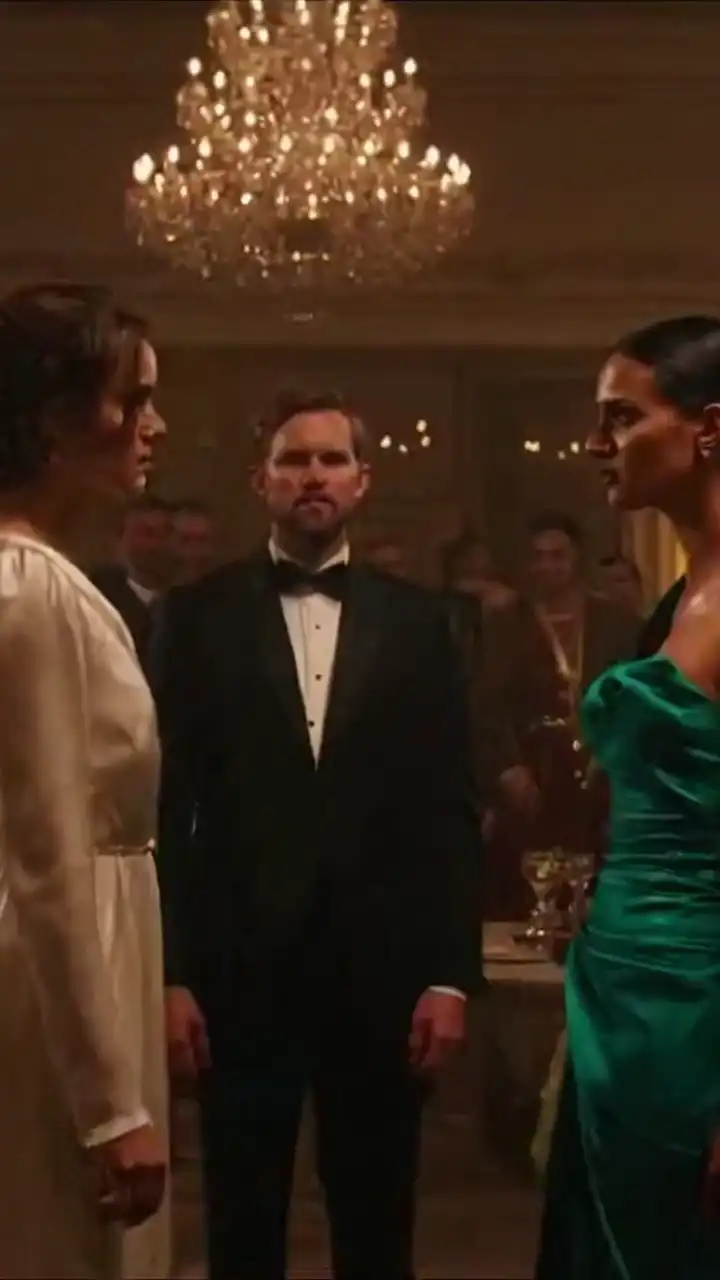
MY HUSBAND USED MY MONEY, GOT ENGAGED TO HIS MISTRESS, AND STOOD THERE WHILE SHE SLAPPED ME

THE MAID OF HONOR POURED WINE ON ME AT MY BRIDAL SHOWER AFTER STEALING MY FIANCÉ. SHE DIDN'T KNOW THE ROOM WAS ABOUT TO HEAR WHAT HE'D BEEN SAYING TO BOTH OF US.

THE MAID OF HONOR POURED WINE ON ME AT MY WEDDING AND CALLED ME CRAZY. SHE FORGOT I STILL HAD THE VOICE NOTE SHE SENT MY FIANCÉ.