HE STOOD IN A HOTEL LOBBY HOLDING DIVORCE PAPERS THAT WERE NOT WHAT THEY SEEMED
Chapter 1
The first thing people saw was the paper in my hand.
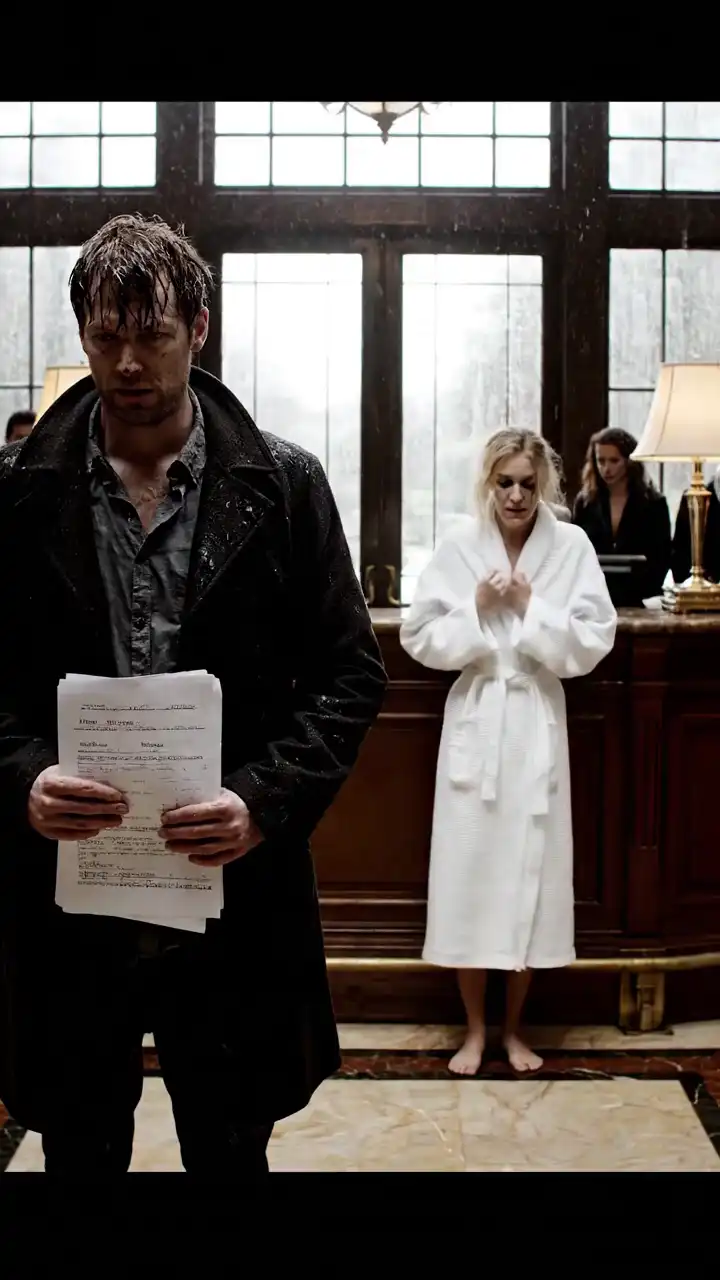
Not my face. Not the frayed cuffs of my only clean shirt. Not the rain still dripping from my coat onto the polished marble floor of the Bellmere House Hotel in Ashby Grove.
Just the paper.
My wife, Corinne, stood six feet away from me near the front desk, white robe tied tight over a silk dress she’d changed out of too quickly, her mascara slightly blurred under one eye as if she had wiped tears away with the back of her hand. A gold pen lay on the counter between us. The top page in my hand showed both our names in bold black letters.
Around us, suitcase wheels stopped rolling. A man in a navy blazer lowered his phone but didn’t put it away. A woman near the elevators pressed her lips together like she had already decided what kind of husband I was.
“Don’t do this here, Nolan,” Corinne said softly, but soft in a room like that was worse than shouting.
I looked at her and then at the page again.
“Then tell them what it is,” I said.
Her eyes flashed. “Not now.”
That was when the concierge, a sharp-faced woman named Trina, stepped out from behind the desk.
“Sir,” she said, “if the guest has asked you to stop, you need to stop.”
“I’m her husband.”
Corinne closed her eyes for one second. “Please don’t make this uglier.”
The word husband did not help me. It made it worse.
Because there I was: unemployed for four months, shoes damp, beard one day too rough, standing in the lobby of a hotel where my wife had spent the night without me, holding what looked exactly like divorce papers.
Trina’s expression changed from caution to conclusion.
“Sir, I’m going to ask you to lower your voice.”
“I’m not yelling.”
“Mr. Vale,” Corinne whispered, and hearing my last name from her like that hurt more than if she had called me a stranger. “Please.”
I looked down at the signature page because if I looked at all the eyes on me, I thought I might crack.
That was when I saw it again.
Not our names. I had already seen those.
It was the witness line near the bottom. Signed in tight blue ink.
M. Cormack.
At the time, it only made my stomach twist harder. I didn’t know why that name bothered me. I just knew it landed in me like a stone.
A bellman paused with a luggage cart full of silver garment bags. An older man in a conference badge leaned toward his wife and murmured something that made her shake her head at me with pity.
I wanted to disappear.
I also wanted someone to tell me I was not losing my mind.
The night before, Corinne had said she was working late at the tax office. Then she hadn’t answered three calls. At one in the morning, I found a charge on our account from Bellmere House. At two, after sitting in our apartment with the TV on mute and my chest turning to wire, I drove there.
I didn’t charge upstairs. I didn’t pound on doors. I sat in the parking garage until dawn like a fool, watching hotel staff change shifts while I tried to think of one explanation that would not break me.
Then she came down in that robe.
Not with another man. Not laughing. Not flustered in the way I expected. Just pale and tired and carrying a leather folder she tried to hide too quickly when she saw me.
I asked one question.
“What’s in the folder?”
She said, “Not here.”
I reached for it.
The papers slid out.
Now all of Bellmere House had a front row seat.
“Sir,” Trina said again, “you need to hand those documents back.”
I laughed once. It sounded ugly. “Back to who?”
“To your wife.”
The man with the phone raised it a little.
Corinne saw him and straightened. “Please don’t record this.”
He lowered it a bit but did not leave.
I looked at her robe, at the hotel logo stitched on the chest pocket, at the gold bracelet I had given her on our third anniversary. Last year, when I still had my job at Hanley Freight and we still talked about things before they turned hard and silent.
“I lost my job,” I said, and I didn’t mean to say it out loud like that. “I know how I look. I know everybody here already thinks I’m the man who got left.”
“Nolan,” Corinne said.
“But if those are divorce papers, just say it.”
Her throat moved. “I can’t.”
That word caught the room.
Can’t sounded different from won’t.
I heard it. Maybe nobody else did, but I heard it.
Trina stepped closer. “Sir, I’m calling security.”
I put the pages on the counter with both hands, flattening them because my fingers were shaking. The top page had our names. The second page had legal language. The signature sheet had mine blank, hers blank, witness signed.
M. Cormack.
The old unease stirred again.
“Who is that?” I asked, touching the witness name.
Corinne’s face changed too fast to hide it.
“Give me the papers.”
“Who is M. Cormack?”
“It doesn’t matter.”
“It mattered enough to witness this.”
“It’s not what you think.”
Trina exhaled through her nose. “They always say that.”
That little sentence did something cruel to the room. I felt people settle deeper into their judgment. The unemployed husband. The hotel lobby. The robe. The papers. The wife trying to stay calm. The staff member who had probably seen scenes like this before and thought she knew another one when it walked in wet from the rain.
I should have left then.
Maybe a wiser man would have.
But I had spent months swallowing things. The layoff. The savings draining out. My wife coming home later, speaking less, carrying stress in her jaw and saying she was just tired. Me pretending I didn’t hear the pity in my brother’s voice when he said I could pick up temp warehouse shifts “until something real came along.”
I had swallowed enough.
“No,” I said quietly. “Not this time.”
A security guard in a gray jacket appeared from a side hall, broad shoulders, tired eyes. His name tag read ELI.
“Problem?” he asked.
Before Trina could answer, a housekeeper near the flower arrangement lifted her chin toward the papers on the counter.
“His wife says stop,” she said, almost to herself, but loud enough.
The security guard looked at me, then at Corinne, then at the pages.
He had made up his mind before asking a single question.
“Yes,” Corinne said. “There’s a misunderstanding.”
“Ma’am, do you want him removed?”
That landed like a slap.
Corinne stared at the counter. “I want everyone to stop looking.”
Nobody moved.
I looked at the witness line again. M. Cormack. Blue ink. Careful hand.
Something about it scraped against memory, but I could not place it.
Then the bellman shifted his cart, and one of the silver bags slipped, knocking a hotel notepad onto the floor near my shoe. I bent automatically to pick it up.
On the top page, in the same tight blue ink, someone had written a room number.
917.
And under it, one word.
Probate.
I looked up too fast.
Corinne saw what I was holding, and the color drained out of her face.
“Nolan,” she said, barely breathing now. “Please. Just give me that.”
For the first time all morning, I knew one thing for sure.
Whatever was in that leather folder was bigger than a marriage fight.
And whatever my wife had hidden in this hotel, she had not hidden it because she stopped loving me.
She had hidden it because she was afraid of something else.
Chapter 2
Security did not remove me right away because the moment changed.
Not enough for people to stop staring. Not enough for Trina to stop standing like a wall between me and the desk. But enough for Corinne to stop pretending this was only about a husband making a scene.
She took one step toward me and lowered her voice.
“Give me the notepad.”
“What is room 917?”
Her eyes flicked toward the elevators.
That was answer enough.
“I asked what this is.”
She pressed her lips together. “Not here.”
“Everything’s here now.”
Eli, the security guard, glanced at Trina, then back at us. He was still ready to escort me out, but some instinct told him to wait.
Trina wasn’t interested in instincts. “Ms. Vale, if you’d like, we can bring you to the office.”
Corinne turned to her. “No.”
It came out quick and sharp. Too sharp for someone who wanted this to go away politely.
Trina blinked.
I held up the notepad page. “Probate?”
The woman near the elevators leaned closer to her husband. The man with the phone had started recording again, pretending he wasn’t.
Corinne noticed and said, “Turn that off.”
This time there was steel in her voice. The man hesitated, then lowered it.
I had heard that voice before. It was the voice she used when someone at the county office tried to cut corners with a widow who didn’t understand her taxes, or when her younger sister called crying and needed somebody solid. It was not the voice of a cheating woman cornered in a hotel lobby.
It was the voice of someone trying to hold a door shut with her bare hands.
“Come with me,” she said.
Trina stepped in. “Absolutely not. If he’s upsetting you—”
“He’s my husband,” Corinne said, and this time she said it like fact, not apology.
Trina’s face cooled.
Corinne turned back to me. “One minute. No shouting. No accusations. Just come with me.”
“Tell me first if those are divorce papers.”
Her hand curled against the robe tie. “No.”
The word hit me so hard my knees felt weak.
No.
Simple. Clear. Immediate.
Then why our names? Why the signatures? Why the secrecy? Why this hotel?
Eli watched me carefully. “Sir?”
I swallowed. “One minute.”
He nodded once, but I could tell his eyes said he would be ten steps behind us.
Corinne reached for the folder and papers on the desk. I let her take them, but I kept the notepad page. She noticed and looked like she wanted to argue, then gave up.
We crossed the lobby under every eye in the room. Past the vase of white lilies. Past the bar where two women stopped mid-conversation. Past the mirrored column where I caught sight of us together: me rumpled and tired, her in a hotel robe over formal clothes, both of us carrying the kind of silence that makes strangers feel invited.
At the elevator, she said, “Not 917. We’re going to the side lounge.”
“Who’s in 917?”
She did not answer.
The side lounge was empty except for a sleeping businessman slumped in an armchair and a lamp throwing yellow light over a stack of travel magazines. Rain tapped against the tall windows facing Mercer Street.
Corinne closed the door halfway. Not fully. Just enough.
Then she leaned both palms on the back of a chair and finally looked at me.
I had loved her for eleven years. I knew her faces. Her laughing face. Her angry face. Her paperwork face. Her grieving face from when her mother died. This one was new.
This one was fear mixed with stubbornness.
“I was going to tell you tonight,” she said.
“You said that before.”
“I know.”
“Were you ever going to tell me why my wife spent the night in a hotel with papers that have both our names on them?”
“Yes.”
“Then tell me now.”
She opened the folder. Inside were more pages than I had seen in the lobby. Deeds, affidavits, copied IDs, forms with county seals, and one thick manila envelope folded inside.
On top was the page with our names.
Petition for Dissolution of Marriage.
I stared at it and felt all the air leave the room again.
“You just said no.”
“It’s not a real divorce.”
“How is that not a real divorce?”
“It’s part of a filing strategy.”
I gave a short, disbelieving laugh. “A filing strategy.”
She shut her eyes. “Please don’t do that.”
“Do what?”
“Make it sound stupid before I can explain it.”
I had no energy left for pride, so I sat down.
She remained standing.
“Three weeks ago,” she said, “a woman came into the county records office asking for copies from an estate case. Her name was Mayra Lusk.”
I frowned. “I don’t know that name.”
“You wouldn’t. I didn’t either. She was shaking. She kept asking if the transfer had gone through and whether her signature had been recorded.”
Corinne pulled out a copy of a deed and slid it toward me.
“It hadn’t.”
I looked at the stamped pages without understanding.
“She was being pushed out of a property her brother left her,” Corinne said. “Only somebody had filed documents around the estate before probate closed. Fraudulent ones. Backdated. Witnessed. Clean enough to pass if nobody looked twice.”
“Who?”
“We don’t know all of them. But one name kept appearing.”
She tapped the witness line.
M. Cormack.
The same name from our page.
A cold feeling moved over my arms.
“Who is that?”
“A mobile notary who’s been signing things connected to dead people’s property.”
I looked from the deed to the so-called divorce petition.
“I still don’t understand what this has to do with us.”
Corinne pulled the manila envelope free and held it too tightly. “Because one of the shell transfers lists a spouse release requirement. They needed a married couple willing to sign away claim rights on a disputed property attached to an estate restructuring.”
“That doesn’t answer anything.”
“It will.”
She sat down across from me, lowering her voice as if the chairs might carry sound.
“There is an attorney in room 917. Martin Cormack.”
The name dropped between us.
“Same Cormack?”
“I think so.”
“You think so?”
“I needed proof.”
“Corinne, what are you doing?”
Her eyes filled suddenly, which terrified me more than the papers.
“I think he’s been using fake marital filings to move estate assets through confused heirs, low-income families, and people who don’t understand what they’re signing. Quiet separations. Waivers. spousal disclaimers. Small signatures hidden inside bigger packets.”
“And our names are on one because...”
“Because he approached me two months ago through a tax delinquency referral. He thought we were vulnerable.”
I felt heat rise up my neck. “Because I’m unemployed.”
“Yes.”
She did not soften it, and that honesty hurt because it was true.
“He knew you lost your job,” she said. “He knew we were behind on the truck payment. He knew we had no attorney. He thought if someone offered cash for a signature, we’d be easy.”
My mouth went dry. “Who offered?”
“A man named Dorian Pike. He said he represented an asset mediation group. I recognized the forms later.”
“You never told me this.”
“I was ashamed.”
That stopped me.
Of all the things I had expected, that was not one of them.
She looked down at her hands. “You were already carrying enough. I told myself I’d handle it. I told myself I’d get evidence first and then come home with something solid instead of one more thing to scare you with.”
“You stayed at a hotel for evidence?”
“No. I came here because Cormack has been meeting signers in private conference suites on probate weekends. I got a tip from a clerk who owes me a favor. I booked a room under my middle name so I could get close without walking in as county staff.”
The robe suddenly made sense. Or part of it did. But not all.
“You spent the night here alone?”
Her face tightened. “Yes.”
I believed her before she finished the word.
Then I hated myself a little for ever thinking otherwise, and hated her a little for putting me in a position where I had to.
“So what’s with our names on that?”
She took a breath. “I made bait.”
I stared.
“The petition is drafted but unfiled. Not legally active. It’s a mock packet built from templates. If Cormack was willing to touch it, I’d know he was willing to launder legal paperwork through a fake marital event.”
I looked at her as if I had never met her.
“You forged divorce papers?”
“I created a controlled packet to test whether he’d notarize and witness a sham filing tied to property release language.”
“You did this alone?”
“I thought I could.”
Outside the half-closed lounge door, someone passed with a housekeeping cart. The wheels squeaked, then faded.
“Corinne,” I said carefully, “if any part of this is true, why not call the police?”
“I did. Not enough for a warrant. Not enough for a raid. Just suspicion and damaged families and paperwork that always somehow looks technically clean. I needed him to touch one thing too many.”
I looked again at the witness name.
M. Cormack.
He had touched it.
And suddenly the whole hotel felt different.
Not like the place where my marriage came apart.
Like the place where my wife had walked into something dangerous and badly underestimated how alone she might end up in it.
“Who else knows?” I asked.
“One person at records. Maybe.”
“Maybe?”
“I left a voicemail with Bernadette Keel at the probate desk. She hasn’t called back.”
At that exact moment, from somewhere beyond the lounge, a woman’s voice echoed from the corridor.
“Trina, I’m telling you, those names are wrong.”
Corinne’s head snapped up.
I heard heels on tile, quick and firm.
Then the lounge door opened wider, and a woman in a plum cardigan with a county badge clipped to her waistband looked from Corinne to me to the papers on the table.
Her gray hair was coming loose from a bun. She carried a plastic accordion file against her chest.
“I knew it,” she said, breathing hard. “I knew I’d seen that name before.”
Corinne stood. “Bernadette?”
The woman pointed at the top page.
“That witness line,” she said. “Martin Cormack isn’t just a notary.”
She looked at me, then back at Corinne.
“He’s married to the judge’s niece.”
And all at once, I understood why my wife had chosen a hotel, a fake packet, and silence.
She wasn’t hiding from me.
She was hiding from people with doors she could not open by knocking nicely.
Chapter 3
Bernadette Keel had the look of a woman who had spent twenty years handling other people’s grief in triplicate.
Nothing dramatic about her. No polished shoes. No power suit. Just a county badge, sensible flats, a cardigan pilled at the sleeves, and eyes so alert they made everyone around her seem slower.
She shut the lounge door behind her and set the accordion file on the table.
“I came because your voicemail sounded wrong,” she told Corinne. “Then Trina said there was a marital incident in the lobby involving paperwork, and I saw the witness line.”
“A marital incident,” I repeated.
Bernadette gave me a quick glance, not unkind. “Hotels always rename trouble so they can keep serving coffee.”
That almost made me laugh.
Almost.
Corinne nodded toward the papers. “Tell him.”
Bernadette opened her file and pulled out copies with sticky notes attached. She worked fast, flattening pages with practiced hands.
“Martin Cormack has been appearing around estate transfers for two years,” she said. “Always peripheral. Witness here, acknowledgment there, courier on one packet, legal consultant on another. Never the lead name. Which is exactly why nobody pinned him.”
I looked at the documents. Deeds. Waivers. spousal relinquishments. Interim occupancy agreements. Pages dense with official words designed to make ordinary people feel stupid.
“We saw families losing rights they didn’t know they had,” Bernadette said. “Widows signing temporary access forms that turned into occupancy surrender. Cousins waiving claim priority because someone told them probate would take too long. People in debt signing whatever was put in front of them.”
“Why doesn’t someone stop it?” I asked.
“Because each piece alone looks small,” she said. “A clerical issue. A civil dispute. A signature mismatch. An heir forgot to appear. A spouse agreed to separate property handling. By the time the pattern shows, the house is sold, or occupied, or leveraged.”
Corinne folded her arms tightly. “And when I started asking questions, files went missing.”
Bernadette nodded. “Not from the court servers. From the edges. Intake scans. annex copies. roadside notaries. Third-party submissions.”
I looked at my wife. “You knew all this and still came here alone?”
“I didn’t know how high it went.”
Bernadette answered for her. “Now we do.”
The sleeping businessman in the corner shifted and snored softly. The sound was so ordinary it made everything else feel stranger.
I pointed at the fake divorce petition. “Why use our names?”
Corinne winced. Bernadette did not.
“Because your profile fit,” Bernadette said plainly. “No offense.”
I let out a breath through my nose. “I’m getting used to hearing that.”
She softened a little. “Unemployed spouse. Couple under financial strain. No in-house attorney. Ordinary debt pressure. If someone tried to slide spousal release language into a property settlement packet, nobody with bad intentions would think twice.”
Humiliation burned through me so suddenly I had to look away.
I had become a category.
A useful one.
Corinne saw it happen on my face. “Nolan—”
“No,” I said quietly. “I get it.”
The truth was I did get it, and that was the worst part.
Two months of trying not to feel like dead weight had not changed how we looked to the world. Men like Cormack saw a laid-off husband and a stressed wife and assumed there was a crack they could widen with money and paperwork.
A knock hit the lounge door before anyone answered it.
Trina stepped in with a fixed smile that wasn’t really a smile.
“I’m sorry,” she said, though she clearly wasn’t, “but if this is not hotel business, you can’t use this room indefinitely.”
Her eyes went straight to me, then to the spread of papers.
Bernadette put a hand over one file.
Corinne said, “We’ll be gone in a minute.”
Trina’s gaze lingered on the county badge at Bernadette’s waist. “Is there an official matter I should know about?”
“No,” Bernadette said.
Too fast.
Trina noticed. So did I.
She looked back to Corinne. “Mr. Pike is asking for you upstairs.”
That name cut through the room.
Corinne went still. “He knows I’m here?”
“He asked for Ms. C. Warren in 917 hospitality suite.” Trina glanced at me, taking in the whole thing now. “Should I tell him your husband found you first?”
For one second I thought Corinne might slap her.
Instead she said, “Tell him I’m coming.”
“Nobody’s going anywhere alone,” I said.
Trina raised one eyebrow. “I don’t believe that’s your call.”
“It is if there’s fraud happening in your hotel.”
She gave me a look that said unemployed men in damp jackets did not get to use words like fraud at Bellmere House.
Then she left.
The second the door shut, Bernadette cursed under her breath. “We’re out of time.”
“Dorian Pike is the recruiter?” I asked.
Corinne nodded. “Middleman. Smooth voice. expensive watch. He talks like every bad thing is already solved if you just sign.”
Bernadette began gathering papers into two stacks. “Listen carefully. If Pike thinks the packet is live, he’ll want signatures. If Cormack is upstairs, he may try to seal it today. If that happens on hotel property with witnesses and timestamped surveillance, we can tie presence to packet.”
I stared at her. “You want to continue this?”
“No,” she said. “I want to catch them.”
“I’m not bait.”
Corinne looked at me then with so much guilt that for a second I couldn’t hold her eyes.
“You were never supposed to be here,” she said.
“There it is.”
“Nolan—”
“No, say it. I wasn’t supposed to know. I wasn’t supposed to walk into a lobby and look like some broke husband waving divorce papers while my wife played a part in a hotel.”
“That’s not fair.”
“Fair?”
My voice rose and the sleeping businessman twitched awake, blinked, and then, sensing trouble, got up and quietly left without a word.
Good for him.
Corinne stepped closer. “I was trying to protect you.”
“From what? Feeling useless? Too late.”
Her face crumpled, then hardened again. “From being pressured. From being approached. From letting men like Pike smell our desperation.”
That one landed because it was true too.
I rubbed my forehead. “You should have told me.”
“Yes.”
It was the first thing she said without defense.
Bernadette cleared her throat. “You can decide the marriage part later. Right now, you need to decide whether you want to stop them or leave.”
Before I could answer, Eli appeared at the door.
He did not step in all the way. “I thought you should know there are two men by the elevators asking whether the husband has calmed down.”
“The husband,” I repeated.
He ignored that. “One of them is wearing a slate suit, red tie, slicked hair. Carrying a leather folio.”
“Pike,” Corinne said.
“And the other?” Bernadette asked.
“Older. Silver hair. expensive coat. He hasn’t said much.”
Cormack, I thought.
Eli looked at the papers, then at our faces. “I don’t know what’s happening, but Trina keeps trying to move this out of camera range.”
Bernadette and Corinne exchanged a look.
That was the first moment I realized Eli was not on hotel management’s side.
“Why are you telling us?” I asked.
He hesitated. “Because my mother lost her house in Briar County after my grandfather died. Signed one thing she didn’t understand. Everyone told her she should’ve read better.”
No one spoke.
He nodded toward the hallway. “So if there’s a document in this building that matters, maybe don’t let it disappear.”
Then he left.
Silence sat heavy for one beat.
Then Bernadette said, “There’s your witness.”
Corinne reached for the folder again. “I can go up, get them talking, and stall.”
“No,” I said.
She looked at me. “Nolan.”
“No more secret plans. No more sending me home with half a story. If my name is in this, then I’m in this.”
“You don’t know how these men work.”
“Neither do you, apparently.”
The words were cruel and I regretted them the instant they landed, but she didn’t argue. Maybe because she regretted her part too.
Bernadette slid the signature page toward me. “Look at the release clause on page four.”
I flipped through until I found it.
There, buried under procedural language, was a line waiving marital interest in a future asset determination related to an estate annex under emergency management review.
Even I could tell it didn’t belong anywhere near a divorce packet.
My skin went cold.
“If somebody desperate signed this,” I said, “they’d be giving up rights to property they didn’t even know existed.”
“Exactly,” Bernadette said.
Corinne sat down hard, as if the weight of what she’d nearly carried alone had finally become visible.
I looked at her robe, the folder, the pages, the tired set of her shoulders.
For months I had thought our marriage was dying quietly. Maybe it had only been drowning under things neither of us knew how to say.
“What do we do?” I asked.
Bernadette took out her phone. “I’ve already sent copies to a private email and to a contact at the state bar. But we need one thing live and undeniable.”
“His acknowledgment,” Corinne said.
Bernadette nodded. “Or his signature. Or Pike saying money in exchange for execution.”
I stood.
My hands were still shaking, but now for a different reason.
“Then let’s go upstairs.”
Corinne stared at me as if trying to decide whether I was being brave or stupid.
I wasn’t sure either.
But I knew this much: if men like Pike and Cormack picked people like us because they thought shame would keep us quiet, then shame had already done enough damage.
I opened the lounge door.
The hallway beyond looked too clean, too bright, too calm for what waited at the other end.
“Stay close,” Corinne said.
It was such an ordinary wife thing to say that for one painful second, I nearly broke.
Instead I nodded, and together we walked toward room 917 while the hotel around us kept pretending it was only a hotel.
Chapter 4
The ninth floor of Bellmere House smelled like lemon polish and expensive silence.
The carpet swallowed our steps. Framed black-and-white photos of old Ashby Grove lined the hallway: trolley cars, church picnics, brick storefronts from a town small enough to remember itself. At the end of the corridor, suite 917 sat behind a paneled door with brass numbers and a small plaque that read HOSPITALITY.
The kind of room where business got done off the books while everyone downstairs called it private service.
Eli had followed us as far as the elevator and then stayed behind, positioned where he could see the hall camera. Bernadette walked on my left carrying the accordion file. Corinne was on my right in that stupid hotel robe, her jaw set, her eyes forward.
She reached for the door handle.
I caught her wrist gently. “Last chance to tell me to leave.”
She shook her head. “No more leaving.”
Then she opened the door.
Inside, the suite looked less like a hotel room and more like a law office pretending to be comfortable. A long table. Six upholstered chairs. A sideboard with coffee service. Half-drawn curtains over a city view blurred by rain. A silver tray of untouched pastries. Two leather briefcases open on the table.
And two men.
Dorian Pike was exactly as advertised. Mid-forties, polished tan, smile too white, red tie loosened just enough to look friendly. The kind of man who could discuss foreclosure in a voice that sounded like he was offering golf tickets.
Martin Cormack was older, broad-shouldered, silver hair cut close, dark coat folded over a chair. He wore rimless glasses and the expression of a man who spent his life watching other people become smaller in his presence.
Neither looked surprised for long.
Pike recovered first. “Ms. Warren.”
He used Corinne’s alias without blinking.
Then he saw me.
“Ah,” he said. “And this must be the complication.”
Corinne said nothing.
Bernadette stepped in farther. “Interesting choice of venue for document execution.”
Pike’s eyes slid to her badge and narrowed. “And you are?”
“Interested.”
Cormack stood slowly.
He did not smile. “This meeting is canceled.”
“No,” Corinne said. “It’s just finally public.”
Pike spread his hands. “I think there’s been a misunderstanding.”
That phrase had started to rot in my ears.
I looked at the table. On top of one packet lay the same signature page I had held downstairs. Our names. Blank lines. Witness field prepared. Tabs marking where to sign.
Next to it sat a cashier’s check.
Ten thousand dollars.
Payable to Nolan and Corinne Vale.
Everything in me went hot and cold at once.
Pike noticed me looking and said, almost kindly, “Everybody is under strain these days. We help people simplify complicated transitions.”
“By burying property releases in sham divorce packets?” Bernadette asked.
Cormack’s voice was low and controlled. “If you are making allegations, I advise you to be very careful.”
“Are you advising as counsel or participant?” Bernadette shot back.
His face changed by less than an inch.
Enough.
Corinne walked to the table and touched the top page. “You told me this was a standard marital separation instrument tied to debt relief review.”
Pike gave a little shrug. “That is one way to describe it.”
“No,” I said. “It isn’t.”
All three of them looked at me then, and I knew exactly what they saw.
The unemployed husband. Off-balance. Easy to dismiss.
Pike leaned into that instinct like a hand into warm water.
“Mr. Vale,” he said, “I understand this is emotional. When a provider goes through a professional setback—”
Corinne said, “Don’t.”
He didn’t stop. “—a spouse may need to make practical decisions. That doesn’t mean anyone is against you.”
The room tilted for one ugly second.
There it was. The oldest humiliation in the world, dressed up in a legal tie.
I had not worked in months. Corinne had carried the bills, the groceries, the health insurance panic, the cracked molar I kept ignoring. And here stood a man offering us money in a hotel suite while talking about practical decisions like dignity was a luxury item.
“You picked us,” I said. “Because you thought I’d sign anything.”
Pike’s smile thinned. “I picked no one. Options were presented.”
Cormack gathered one corner of the packet. “This conversation is over.”
Bernadette put a hand flat on the papers before he could move them. “Take your hand off.”
He looked at her with genuine irritation now. “County clerks do not have authority here.”
“Fraud can happen anywhere.”
He turned to Corinne. “You misrepresented yourself to gain access to a private meeting?”
“And you inserted estate language into a marital packet.”
“That is not an estate packet.”
I stepped forward and read the clause from page four aloud.
Not because I understood every word.
Because I wanted the words alive in the room.
Waiver of marital interest in future asset determination related to annexed estate review.
When I finished, silence slammed down.
Pike recovered first. “Standard contingency language.”
Bernadette gave a sharp laugh. “In a dissolution petition?”
Corinne pulled the cashier’s check off the table and held it up between two fingers like something sticky. “Ten thousand dollars for what exactly?”
Pike looked at her with faint disappointment now, like she had failed some private test.
“For cooperation,” he said.
“Say it plain,” I told him.
“For efficient execution.”
“Say it plain.”
Cormack’s voice snapped. “We are done.”
He reached for the packet again, but before he could lift it, the suite door opened wider behind us.
Trina stood there with two uniformed city officers.
For one blind second, I thought help had finally arrived.
Then Trina looked directly at me and said, “That’s him.”
I turned. “What?”
She pointed. “He took documents from the lobby desk, entered a guest restricted area, and has been harassing a registered guest all morning.”
Everything happened fast after that.
One officer moved toward me. “Sir, step back.”
Corinne stepped between us. “No.”
The second officer looked at the robe, the check, the men, the papers, and still his eyes landed on me first.
Of course they did.
“Nolan,” Corinne said under her breath. “Don’t react.”
Pike actually sighed, as if saddened by how messy poor people made things.
“Officers, I believe this is a domestic misunderstanding,” he said. “We were trying to mediate financially sensitive paperwork when he became unstable.”
Unstable.
I heard Bernadette suck in air sharply.
“Lie again,” she said.
One officer held up a hand. “Ma’am, everybody calm down.”
Trina pointed at the check. “He may have been attempting extortion.”
That word was so absurd I almost choked on it.
Corinne turned on her. “You know that’s false.”
“Do I?” Trina said coldly. “I know a distraught husband stormed my lobby with what appeared to be divorce papers.”
“And you decided the rest,” I said.
The officer nearest me said, “Sir, hands where I can see them.”
I obeyed. Slowly.
My chest pounded so hard I could feel it in my teeth.
This was how it happened. Not with some dramatic conspiracy. Just a series of assumptions stacking neatly against the person who looked least credible in the room.
Unemployed man. Upscale hotel. Wife in robe. Legal papers. Raised voice.
Done.
Corinne lifted the packet toward the officers. “Read page four.”
The older officer frowned. “Ma’am, we’re not litigating a contract in a hotel suite.”
Bernadette stepped up. “Then at least read the witness line.”
Cormack moved at last, quick for a man his age, trying to snatch the packet free.
But he was too late.
A folded sheet slipped from the manila envelope and floated to the carpet between us.
Everyone saw it.
County Probate Court.
Emergency Asset Preservation Order.
Stamped but unsigned.
Attached memo requesting temporary sealing of related identities pending fraud inquiry.
At the bottom, in typed lines, were three names flagged for confidential review.
Mayra Lusk.
Martin Cormack.
Corinne Vale.
Trina frowned. “What is that?”
Cormack bent too fast to pick it up. The older officer stopped him with one hand.
“No,” the officer said.
For the first time, Martin Cormack looked rattled.
Bernadette stared at the sheet, then at Corinne. “You got the draft order?”
Corinne looked equally stunned. “I never saw that page.”
Pike’s face lost all color.
The younger officer took the sheet and read. “Confidential review? Fraud inquiry?”
The room shifted on its axis.
I saw it in their faces.
The officers no longer saw just a marital scene.
They saw hidden process. Missing context. People who had come in too certain and maybe too late.
Trina stepped back a full pace. “I didn’t know.”
“No,” Bernadette said. “You just knew enough to choose a side.”
Pike straightened his cuffs. “That document is privileged.”
Corinne laughed once, broken and furious. “So is my life, apparently.”
The older officer looked at Cormack. “Sir, I’m going to need identification and I need everyone away from the table.”
Cormack tried controlled dignity. “This can be resolved with one phone call.”
The officer said, “Then make it after you step back.”
Pike glanced toward the door as if calculating whether he could leave.
He couldn’t. Eli was there now, filling the frame.
His security jacket suddenly looked less like hotel staff and more like a witness who had decided not to blink.
“I saved the hallway footage,” he said quietly.
No one had asked him a question, but somehow that sentence answered everything.
Pike sat down.
Cormack did not.
He stood staring at the unsigned court memo on the officer’s hand like he had just realized the ground under him was thinner than he thought.
I looked at Corinne.
She was shaking, but she was still standing.
Months ago I had watched her carry groceries up three flights because I was sick with the flu. Last winter I had watched her sit in the emergency room for six hours with her sister and never complain once. I had always known she was strong.
I had not known strength could look this frightened.
Our eyes met.
“I’m sorry,” she whispered.
I didn’t know which part she meant.
The secrecy. The hotel. The papers. The months of trying to protect me by pushing me outside the truth.
Maybe all of it.
“We’re not done yet,” I said.
And I meant the room.
But I also meant us.
Chapter 5
They separated us for statements in three different rooms on the ninth floor.
Not official interrogation rooms. This was still a hotel pretending not to be in the middle of a legal collapse. I ended up in a small conference nook with frosted glass, a fake ficus, and a bowl of wrapped mints nobody touched.
The older officer introduced himself as Sergeant Lowell Vance. He had a lined face and a voice that no longer rushed to certainty.
That was new.
He sat across from me with a yellow pad. “Start from the charge on your bank account.”
So I did.
The missed calls. The Bellmere House transaction. The parking garage dawn. Corinne in the robe. The folder. The lobby. The witness name. Probate written on the notepad. Everything.
He did not interrupt much.
When I finished, he tapped his pen once.
“You thought she was cheating.”
“Yes.”
“And now?”
I looked through the frosted panel where only shapes moved.
“Now I think my wife is either braver than I knew or worse at asking for help.”
He almost smiled. “Those aren’t mutually exclusive.”
A knock came at the door and Eli stepped in.
“Sorry,” he said. “You might need this.”
He held out a hotel key sleeve and a printed receipt.
The sergeant took them. “What is it?”
“Suite access log,” Eli said. “Ms. Warren checked in yesterday at 6:12 p.m. No guest entered with her. Housekeeping did robe delivery at 7:04. No other registered access to her room overnight.”
My eyes closed for a second.
Such a stupid detail to break me. Not the fraud. Not the check. Not even the papers.
A robe delivery timestamp.
Proof that the ugliest thing I had imagined was wrong.
Eli glanced at me. “Figured it mattered.”
“It does,” I said.
He nodded and left.
Sergeant Vance wrote something down and then slid a form toward me. “Do you recognize this language?”
It was a copy of the waiver clause.
“No.”
“Would you have signed it?”
I thought about the truck payment, the overdue electric bill we had barely caught last month, the way ten thousand dollars looked when your pride had been scraping bottom for weeks.
“I want to say no.”
“That’s not what I asked.”
I stared at the paper.
“I don’t know,” I said.
It was the most honest answer I had given all day.
He nodded as if honesty mattered more to him than the right response.
After another twenty minutes, he led me back to the main suite.
The room had changed.
The pastries were gone. So were Pike’s smooth manners. He sat at the table with his tie pulled loose, jaw tight, one officer beside him. Cormack stood near the window speaking in a low, controlled voice to someone on speakerphone who sounded increasingly unwilling to save him.
Bernadette was organizing copies in neat piles like she had waited years for this exact kind of mess. Trina stood by the sideboard, all certainty drained out of her face. Corinne sat in a chair near the wall, still wearing the robe, hands wrapped around a paper coffee cup she had not sipped.
When she saw me, she stood.
“Are you okay?” she asked.
The question was so tender and so normal that it nearly undid me.
“I’m here,” I said.
She nodded once.
Sergeant Vance addressed the room. “We’ve contacted the county fraud unit and a state investigator is en route. Until then, no one leaves.”
Pike laughed under his breath. “Over paperwork irregularities.”
Bernadette looked up. “You offered a ten-thousand-dollar check for signatures tied to estate language hidden in a marital dissolution packet.”
“It was settlement facilitation.”
“For whom?” she snapped. “The dead?”
Cormack ended his call and turned. “This is theater.”
Sergeant Vance held up the unsigned preservation order. “Then explain why your name appears in a confidential fraud memo attached to a packet you said was private mediation.”
Cormack adjusted his glasses. “Because my name has been maliciously circulated by clerks who mistake complexity for crime.”
Bernadette said, “Say county clerk one more time like it means stupid.”
To my surprise, Trina spoke then.
“He asked me to reroute them,” she said quietly.
Everyone looked at her.
Pike’s face hardened. “Excuse me?”
Trina swallowed. “This morning. After the scene in the lobby started. Mr. Pike asked if there was a way to move the couple to a service corridor without cameras.”
The room went still.
Sergeant Vance turned toward her. “Why didn’t you mention that earlier?”
Her eyes flicked to me, then away. “Because I thought he was helping contain a domestic problem.”
The shame in her voice had a different flavor from mine. Cleaner. Newer.
Bernadette muttered, “Convenient.”
Trina nodded once, like she deserved that.
Then another voice came from the hall.
“Where is the original packet?”
A woman entered in a navy raincoat carrying a hard case and a state ID. Behind her came a younger man with a portable scanner bag.
She introduced herself as Dana Sorrell from the Office of Professional Review.
Everything after that moved with frightening precision.
Gloves on. Photos taken. Pages separated. Signatures scanned. Check photographed front and back. Hotel logs copied. Bodycam time stamps cross-referenced with hallway footage Eli preserved.
Dana read fast and asked faster.
“Who drafted this?”
Silence.
“Who inserted the annex estate clause?”
Silence.
“Who ordered payment issuance?”
Pike looked toward Cormack. Cormack looked at no one.
Dana turned to Corinne. “You created this bait packet?”
“Yes.”
“Did you alter any seals or file any false instrument with a court?”
“No. It never left my possession.”
“Who knew you were here?”
“Only Bernadette, maybe. I left a voicemail.”
Dana nodded. “And your husband?”
Corinne looked at me and answered with painful honesty. “No.”
Dana wrote that down too.
Then she asked the question I had been circling all day without saying right.
“Why use your own marriage?”
Corinne’s mouth trembled.
For a moment I thought she would give the practical answer. Profile fit. Credibility. Access. Strategy.
Instead she said, “Because it was the one thing they would believe could be broken.”
No one moved.
She stared down at the coffee cup in her hands.
“They look for couples under pressure,” she said. “Money problems. fatigue. silence. embarrassment. They assume love gets thin under strain. They assume people will sign almost anything if they can call it relief.”
Dana’s expression changed, just slightly.
Corinne went on, quieter now. “And if I’m being honest, I think part of me believed it too. Not that we’d end, exactly. But that maybe things had already cracked enough for strangers to write on top of them.”
I felt that sentence all the way through me.
Not because it accused me.
Because it admitted what we had both been living beside.
Sergeant Vance cleared his throat and looked away.
Dana asked one more question. “Where did you obtain the unsigned preservation order?”
“I didn’t,” Corinne said. “It must have been inserted into the envelope after I left my room or while the packet was on the table.”
Every head turned toward Pike and Cormack.
Pike finally snapped.
“Do you have any idea how many incomplete drafts circulate in probate practice?” he said. “One stray memo in one packet proves nothing.”
Dana said, “The payment offer proves interest.”
“Interest is not crime.”
“No,” Bernadette said. “But patterns are.”
That was when the younger man with the scanner looked up from his equipment.
“I’ve got overlap,” he said.
Dana turned. “What kind?”
He rotated the screen so she could see.
“Signature pressure analysis. The witness line on the Vale packet and three estate packets from Briar County were executed by the same hand pattern and pen angle. Same writer. Same pause marks.”
Dana’s eyes lifted to Cormack.
He did not speak.
The younger man zoomed in. “And the notary impression on one estate waiver was digitally cloned from another filing. Not a standard stamp strike. A copied seal image.”
Pike sat back slowly.
Crumbling did not happen the way movies show it. No confession. No dramatic collapse.
Just tiny losses.
Color leaving faces.
Confidence draining from posture.
People realizing the room no longer belonged to them.
Dana closed the folder in front of her. “Mr. Cormack, Mr. Pike, you are both being detained pending formal review of fraud-related instruments and possible conspiracy tied to estate transfers.”
Pike started to protest.
Dana raised one hand. “Save it.”
Officers moved.
Handcuffs clicked.
Not loud. Just final.
Trina covered her mouth with her hand. Bernadette sat down hard in a chair, like years of anger had suddenly needed somewhere to go. Eli, standing by the door, exhaled through his nose and looked at the carpet.
And Corinne looked at me.
Not triumphant. Not relieved.
Just tired beyond words.
Later, after signatures on statements and evidence receipts and more questions than I could hold in order, we ended up downstairs by the side entrance because the lobby was swarming with plainclothes investigators and hotel management pretending they had always supported proper procedure.
Rain still fell over Mercer Street, softer now.
Bellmere House glowed behind us, all chandeliers and polished lies.
Corinne had finally changed back into her own clothes. The robe was gone. Her hair was damp at the temples. There was a crease on her cheek from where she must have pressed her face into a chair or folded arms at some point in the last ten hours.
We stood beneath the awning in the sound of tires on wet pavement.
Neither of us moved toward the car.
“I’m sorry,” she said again.
This time there was no room full of witnesses. No officers. No papers between us.
Just that.
“I know,” I said.
“I should have told you the minute Pike approached me.”
“Yes.”
“I should have told you when I came here.”
“Yes.”
She nodded, absorbing each blow because they were earned.
Then she asked the harder thing.
“Do you still think I was leaving you?”
I looked out at the rain, at the blurred streetlights, at my own reflection faint in the hotel glass.
“No,” I said. “But I think we were both disappearing in different ways.”
Her face folded at that.
“I didn’t know how to tell you I was scared,” I said. “Not just about money. About what losing work did to me. About feeling like every room had already decided my worth before I opened my mouth.”
She took that in without interrupting.
“And you,” I said, “didn’t know how to tell me you were carrying something dangerous because you thought I had enough shame already.”
A cab rolled by, spraying gutter water.
Corinne whispered, “I hated that they were right about one thing.”
“What thing?”
“That we looked vulnerable.”
I met her eyes.
“Looking vulnerable and being broken are not the same thing.”
She started crying then. Quietly. No collapse. Just tears she had held back since the lobby, maybe longer.
I stepped closer.
Not all the way.
Just enough for her to know I was still there.
Chapter 6
Two months later, the Bellmere House changed its name.
That was the hotel’s answer to scandal. New branding. New website. Same stone facade on Mercer Street, same brass door handles, same lobby where I had once stood with rain on my coat and a fake divorce packet in my hand while strangers decided who I was.
The county case spread wider than anyone first said. There were more families. More properties. More “irregularities” than the papers called them. Dana Sorrell’s office found layers of shell filings and cloned notary seals tied to estate pressure tactics in three counties. Bernadette had to testify twice and discovered she liked being underestimated right up until the moment she ruined someone’s timeline with facts.
Eli left hotel security and took a job with the county facilities division. “Better pension,” he told me over coffee, but I think he also wanted to work in a building where trouble didn’t wear cuff links.
Trina sent us a note.
Not a long one. Just three lines.
I was wrong about you I was wrong too quickly I am sorry
Corinne read it at the kitchen counter and set it down without comment. Later she tucked it into the same drawer where we kept unpaid bills and spare batteries and birthday candles. Human things. Messy things. Things you don’t display but don’t throw away.
As for me, I found work again.
Not at Hanley Freight. That chapter was over. A maintenance supervisor named Gus Minter at Ralston Civic Center took a chance on me after one awkward interview and one honest answer about the gap in my employment. It wasn’t glamorous, but it was steady. I came home tired in a useful way. My hands smelled like sawdust and machine oil instead of stale worry.
The bigger repair took longer.
Corinne and I started talking at night without the TV on. Not every conversation was graceful. Some of them were ugly in the way truth often is when it has waited too long.
We talked about money.
About pride.
About how unemployment had turned me quiet and sharp around the edges.
About how responsibility had turned her secretive and overconfident.
About the way love can survive strain and still get hidden under it until outsiders mistake the weight for emptiness.
One Sunday afternoon, I found the mock divorce packet in a banker’s box under the hall table, preserved for evidence copies and legal follow-up. Our names were still there on the top page. So was the witness line that had first caught my eye.
M. Cormack.
I held it for a while, then took it to the kitchen where Corinne was slicing peaches.
“Do you want me to burn this?” I asked.
She looked at the page and gave the smallest, saddest smile.
“No,” she said. “I want us to remember it right.”
So we did.
We kept the first page and the hidden clause copy in a sealed envelope marked DO NOT SIGN ANYTHING ANGRY OR AFRAID. It was half joke, half rule.
Sometimes that’s what marriage becomes after you survive the thing that almost taught strangers how to define it.
A rule.
A laugh.
A scar you don’t hide because you earned it.
On the first cool evening of October, we drove past Mercer Street on the way home from dinner at a little place called Juniper Plate. The old hotel sign was gone. Workers were installing a new one under floodlights.
Corinne looked out the passenger window and said, “I still hate that robe.”
I laughed so hard I had to pull over.
She laughed too, hand over her mouth, eyes watering, and the sound of it filled the car in a way our silence used to.
Then she turned serious and touched my arm.
“Nolan.”
“Yeah?”
“That morning in the lobby, when everybody was looking at you... I should have stood beside you sooner.”
I thought about the marble floor, the gold pen, the phone half raised, the way shame had crowded me before truth had a chance to enter the room.
Then I thought about what came after. The notepad. The witness line. The check. The hidden order. The rain outside the side entrance. All the moments when what looked obvious turned out to be the smallest part of the story.
“You stood beside me when it counted,” I said.
She nodded, but I could tell she still carried some of it.
Maybe we both always would.
That’s the thing I learned from a hotel lobby full of strangers and a packet of papers heavier than they looked.
People trust appearances because appearances are fast.
Truth is slower.
It comes in hidden clauses, tired faces, unsigned orders, witness names that don’t sit right, and apologies spoken after the room finally clears.
It comes after humiliation.
After anger.
After everyone has already decided.
And when it arrives, it often weighs more than the scene that tried to bury it.
So if you ask me what happened at Bellmere House, I could tell you about the fraud case, the arrests, the legal review, the evidence chain, the check on the table.
But that still wouldn’t be the whole truth.
The whole truth is that I walked into a hotel certain my marriage was ending and walked out understanding how easily fear lets the world write a false story over ordinary people.
And I learned, too late to avoid the pain but not too late to save what mattered, that truth is often heavier than what it first looks like.
We drove home after that with the windows cracked to the cool night air.
At a red light, Corinne reached across the console and took my hand.
This time, neither of us let go.
Disclaimer: Mention of any brand or trademark is for identification only and does not imply partnership or endorsement

MY HUSBAND USED MY MONEY, GOT ENGAGED TO HIS MISTRESS, AND STOOD THERE WHILE SHE SLAPPED ME

THE MAID OF HONOR POURED WINE ON ME AT MY BRIDAL SHOWER AFTER STEALING MY FIANCÉ. SHE DIDN'T KNOW THE ROOM WAS ABOUT TO HEAR WHAT HE'D BEEN SAYING TO BOTH OF US.

THE MAID OF HONOR POURED WINE ON ME AT MY WEDDING AND CALLED ME CRAZY. SHE FORGOT I STILL HAD THE VOICE NOTE SHE SENT MY FIANCÉ.