SHE HELD OUT AN OLD PENDANT AND MY SISTER SAID THAT GIRL IS NOT FAMILY
Chapter 1
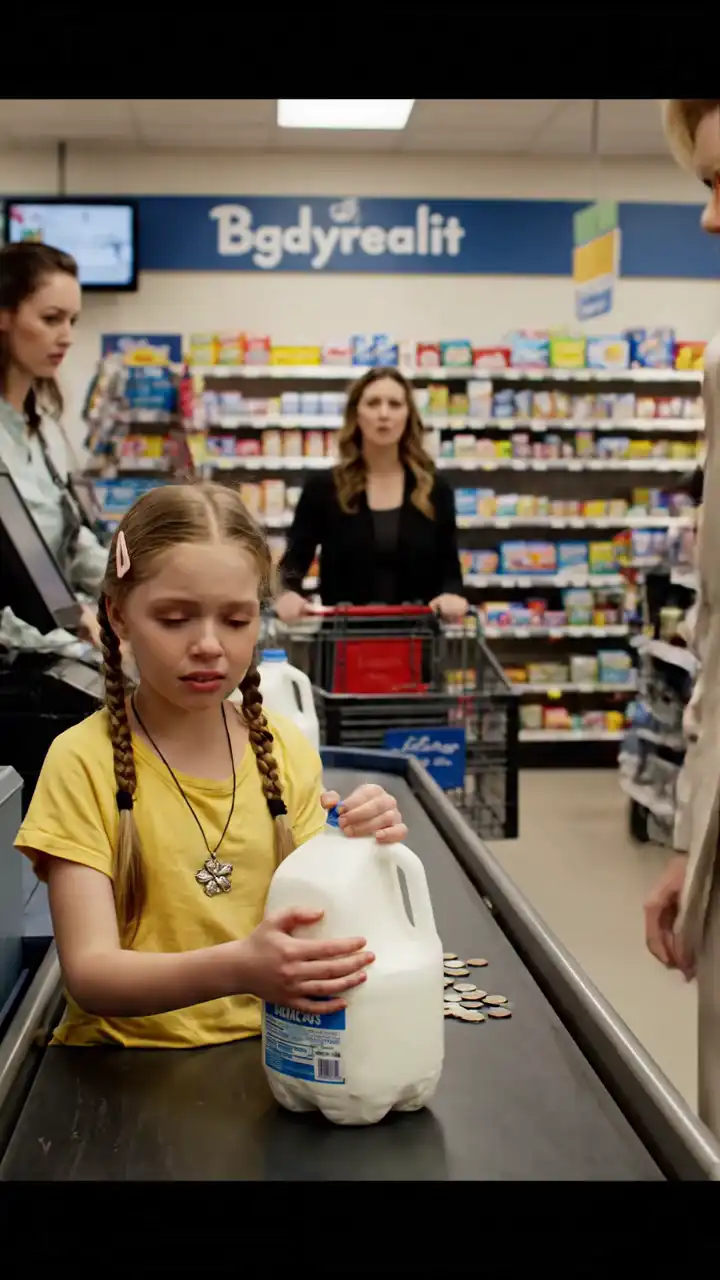
The little girl was standing in the express checkout line with both hands wrapped around a gallon of milk like it might break if she breathed too hard.
People were already staring.
The cashier at Bellridge Market had stopped scanning the woman in front of her and was leaning over the counter, voice flat, tired, and sharp all at once. “Sweetie, you need an adult.”
“I have money,” the girl said.
Her voice was so small I almost missed it over the beeping scanners and the hum of the freezer aisle. She couldn’t have been more than eight. Thin shoulders. Faded yellow T-shirt. A pink barrette hanging loose in her braids. On a cord around her neck was an old silver pendant, dark with age, shaped like a tiny pressed flower.
I was three carts back with a bag of dog food and a basket full of things my husband would forget to buy if I sent him alone. I only looked up because there was something about the child’s stillness that didn’t fit the moment. Most kids cried when adults cornered them in public. This one just stood there like she had already practiced being turned away.
The cashier, whose name tag read TRINA, folded her arms. “Store policy. No child can make a purchase alone if we think there’s a safety issue.”
The girl slid two crumpled bills and a pile of coins onto the conveyor. “Please. My grandma needs this.”
A murmur moved through the line behind me. The people closest leaned sideways the way strangers do when they smell a scene they can watch without joining.
Trina didn’t touch the money. “Where is your parent?”
The girl swallowed. “Outside.”
“Then go get them.”
“She can’t walk good.”
That should have ended it. Any decent person would have carried the milk out themselves. Any decent person would have picked up the phone and called a manager with a little urgency in their voice instead of annoyance.
But Trina’s face hardened as if kindness were some trap she had learned to avoid.
“We can’t just let kids come in here and buy things because they say an adult is waiting. That’s not how this works.”
The girl looked down at her pendant, touched it once, then lifted her chin with a kind of forced bravery that hurt to watch.
“My name is Leni,” she said. “My grandma is Viola Dane. She’s in a blue car. She’s sick. Please.”
The last word barely made it out.
That was when my sister Jolene stepped forward from the pharmacy line.
At first I felt relief. Jolene lived only five blocks from Bellridge Market, and she knew everyone in Hollow Creek or acted like she did. She was the kind of woman who could untangle a clerk, a coupon issue, and a neighborhood argument before most people had found the right tone of voice. She was wearing cream slacks, gold hoop earrings, and that cool expression she had perfected years ago when our family started pretending its worst parts had healed.
She took one look at the little girl and said, “No. Don’t ring that up.”
The line went quiet.
Trina straightened at once, grateful to be backed by somebody older, cleaner, surer. “Do you know her?”
Jolene’s mouth barely moved. “Enough.”
Leni turned, hope flashing over her face so quickly it was painful. “Aunt Jo—”
“Don’t call me that,” Jolene said.
It was one of those moments that changes the temperature of a room. You could feel people stop breathing right.
Leni’s fingers tightened around the milk jug handle until her knuckles blanched white. The pendant slipped out over her shirt and swung against the plastic gallon. I saw then that the back of it was dented and engraved with tiny curling initials.
“Please,” Leni whispered. “Grandma said to get milk and crackers.”
Jolene didn’t look at the girl’s face. She looked at the pendant first, then at the coins, then at the watching line behind us, as if humiliation was the real emergency here.
“She is not family,” my sister said. “And nobody should be encouraging this.”
For one second I forgot where I was.
I knew every mean register in Jolene’s voice. I knew when she was embarrassed, when she was lying, when she was scared enough to become cruel. This was the last one.
Leni stared at her. “Grandma said—”
“I said don’t.” Jolene lowered her voice, but in the silence it carried farther. “You need to leave the store.”
A man behind me muttered, “Lord.”
Someone near the gum racks whispered, “That poor baby.”
The child’s face didn’t crumple. It did something worse. It went blank.
I left my cart where it was and walked right up to the counter. “Ring up the milk,” I said.
Jolene swung around. “Mara, stay out of this.”
That was another shock for the line—two women, clearly sisters if you looked at the jawline and the same dark brows, standing on either side of a little girl with a gallon of milk between them like it was evidence.
“She said her grandmother is outside sick,” I told Trina. “If policy is your concern, I’ll walk it out myself.”
“It’s not your problem,” Jolene said.
“It became my problem when you made a child ask for food in front of a crowd.”
Jolene took a breath through her nose. She hated scenes, which was interesting, because she caused them whenever she thought control was slipping. “You don’t know what she’s doing.”
Leni flinched at the word she.
Doing.
Like she was running some little scam at eight years old.
I crouched so I could look at the child without towering over her. “Leni, where is your grandmother parked?”
“By the cart return,” she said. “Blue Buick.”
Her eyes were large and dry, but red around the rims in the way that told me she had been scared long before she got into this line.
“What’s your grandma’s full name?” I asked gently.
“Viola Dane.”
The name hit me strangely. Not because I knew a Viola Dane. Because Jolene did. I saw it in the stiff twitch at the corner of her mouth.
“Ring up the milk and crackers too,” I said.
“She doesn’t have crackers,” Trina said, almost defensive.
“I’ll go get them.”
“I told you no,” Jolene snapped.
I stood up slowly. “You don’t get to say no to milk.”
Jolene stepped closer, lowering her voice enough to make it more dangerous. “Mara, if you walk outside with that girl, don’t come to me later acting surprised.”
“Surprised by what?”
But she wouldn’t answer. She just looked at the pendant again.
I followed that look.
The tiny silver flower was old enough to have belonged to our mother’s generation. Maybe earlier. It had one petal bent inward and a chain cord threaded through a hole where a proper clasp should have been. The engraving on the back was partly rubbed away, but I could make out one letter cleanly.
R.
Something cold moved through me.
Our mother’s name had been Ruth.
Leni noticed me looking. She put a hand over the pendant instinctively, protective, almost afraid someone might take it.
“Who gave you that?” I asked.
Before she could answer, Jolene said, “Enough.”
Not loud. Worse than loud. A command.
Leni looked between us, then toward the automatic doors, where the afternoon sun flashed in bands every time somebody entered. “Grandma’s waiting.”
The whole store seemed to hover there, all of us pinned inside one ugly little moment.
Then an older stock clerk I knew, a bent, quiet man named Emmett Voss, spoke from the endcap where he’d been pretending to straighten canned beans.
“That pendant,” he said softly, “I’ve seen that before.”
Jolene’s head turned fast enough to be guilty.
And just like that, what should have been a simple purchase of milk became something far harder to stop.
Chapter 2
Bellridge Market was one of those grocery stores that always smelled faintly of overripe bananas and floor cleaner, no matter what time of day it was. I had been coming there for twelve years. I knew where they kept the cheap pasta, which freezer door stuck, and how Trina’s voice changed depending on whether she thought someone could answer back.
I also knew my sister’s face when the past came walking in.
“Emmett,” Jolene said, recovering quickly, “you must be mistaken.”
The old stock clerk rubbed his jaw. He had a patchy white beard and thick glasses that made his eyes look watery and surprised. “Maybe,” he said. “But I don’t think so.”
Leni was shrinking into herself by the checkout, clutching the milk and staring at the floor tiles.
I took the crackers from a nearby display and set them on the counter. “Trina.”
The cashier hesitated. She looked at Jolene. Then at the line. Then at me. Maybe she saw she was losing the room. Maybe she was just tired of being the villain in a story she hadn’t meant to enter.
She scanned the crackers. Then the milk.
The register beeped.
It sounded absurdly loud.
Leni let out a breath that trembled. She pushed her coins forward. “I have enough.”
I put my card on the counter. “I’ve got it.”
“No,” Leni said at once, almost panicked. “Grandma gave me money.”
“Then keep it for next time,” I told her.
She looked uncertain, as if accepting help might cost something she couldn’t afford. I knew that feeling. Children in tight homes learned early that nothing free stayed free.
Jolene leaned in. “Mara, stop performing.”
That did it. I looked straight at her and said, “If you want to humiliate a child, do it without me.”
A hush followed. People love conflict until someone names it cleanly.
Trina bagged the items with stiff, jerky movements. Leni reached for the bag, but it was nearly as big as her torso. I took it instead.
“I’ll carry it,” I said. “You lead me to your grandma.”
Jolene stepped back as if to leave, then stopped. “Do not go near that woman.”
“What woman?”
She said nothing.
Emmett came closer, one careful step at a time. “I’ll come too.”
Jolene gave a short laugh with no humor in it. “Of course you will.”
I turned to her. “Who is Viola Dane?”
She pressed her lips together, then lifted a shoulder. “Someone who should know better than to send a child into a store alone.”
That answer told me almost everything except the truth.
Leni was already moving toward the doors, shoulders bowed from too much attention. I followed with the grocery bag, and Emmett came behind us. Through the glass I saw the late afternoon sun lying hot over the parking lot, turning windshields white. Near the cart return sat an old blue Buick with one rear tire low and the paint peeling from the roof.
In the driver’s seat was a woman bent small against the steering wheel.
Leni hurried to the passenger side and tugged on the handle. “Grandma, I got it.”
The woman lifted her head slowly.
She had silver hair pinned loose at the nape, deep brown skin, and one of those faces that age doesn’t soften so much as carve into honesty. She looked sick immediately—not dramatic, not theatrical, just exhausted down to the bone. Sweat had dampened the collar of her faded green blouse. A folded pharmacy paper sat on the dashboard beside an inhaler.
When she saw me, her eyes sharpened.
“I’m sorry,” she said through the half-open window. “She was only supposed to be a minute.”
“She was being refused,” I said.
Viola’s mouth tightened. “I figured.”
“You know my sister,” I said.
It wasn’t really a question.
Viola looked past me toward the store entrance, where Jolene was now visible through the glass, standing rigid by the self-checkout lane like she could keep distance from the parking lot but still monitor it.
“Yes,” Viola said. “I know Jolene Bell.”
Leni climbed into the passenger seat and held the milk in her lap like something rescued. I gave her the crackers. She whispered, “Thank you.”
Emmett had stopped dead two spaces away. He was staring through the windshield at Viola like he’d opened a door into a room he had sealed off years ago.
“Vee?” he said.
Viola’s expression shifted, startled. “Emmett Voss?”
“You’re still alive,” he said, then winced. “That came out wrong.”
For the first time, her face softened. “A lot of things did.”
I should have backed away. I knew that. But too much had already happened, and the air around us felt full of pieces trying to connect.
Leni reached up and touched her pendant. Viola saw me notice.
“Where did she get that?” I asked.
Viola’s hand moved instantly. “Leni.”
The girl looked down.
“It’s mine,” she said.
“No,” Viola said quietly. “It isn’t.”
That opened a silence no one liked.
I glanced at the pendant again, the tiny worn flower, the engraved letter on the back. R.
“My mother had jewelry like that,” I said carefully.
Viola closed her eyes for a second.
From behind us, heels clicked on the concrete. Jolene had come outside after all.
“I knew this was a mistake,” she said.
Viola turned her head toward her, and the two women looked at each other with the kind of recognition that does not fade with time. Not friendship. Not exactly hatred. Something older and more exhausted than both.
Leni’s eyes moved between them. “Grandma?”
“Sit still, baby,” Viola murmured.
Jolene folded her arms. “You shouldn’t have brought her here.”
“I live three blocks away,” Viola said. “I needed milk. My legs gave out.”
“So call someone.”
“I did. Nobody answered.”
I thought of our family group text, mostly recipes, church updates, and shallow concern. I thought of how easily some people disappear even when their names are still technically known.
“Why did she call you Aunt Jo?” I asked.
Jolene’s face went flat again. “Because children repeat what they hear.”
Viola gave a tired little smile that held no warmth. “No. She called her that because it’s true enough to hurt.”
“Mara,” Jolene said sharply, “we’re leaving.”
I almost laughed. She still thought she could close a curtain with tone alone.
“I’m not leaving,” I said.
Leni was watching all of us the way children do when they can tell the adults have entered dangerous territory and nobody is protecting the edges. She touched the pendant again. It had become a reflex, a tiny self-soothing motion.
Emmett stepped closer to the car, squinting. “That necklace,” he said. “Ruth Bell wore one like it the summer before she died.”
The parking lot seemed to still around us. Even the carts rattling in the return lane felt farther away.
Jolene’s voice dropped. “Emmett. Stop.”
But he was staring now, memory fully lit. “No. I remember because the clasp broke during church picnic setup. I fixed it with wire from my tackle kit. Bent one petal inward by accident.” He pointed with a shaking finger. “That one.”
I felt heat flood my face, then leave just as fast.
The bent petal.
The rubbed initial.
R.
Leni looked up at Viola, frightened now. “Grandma?”
Viola’s hands were trembling on the steering wheel. She looked at me, not Jolene.
“You have your mother’s eyes,” she said.
I had heard that all my life. Usually as comfort. In that moment it sounded like a key turning somewhere I had never known there was a lock.
“What does that mean?” I asked.
Jolene took one abrupt step forward. “It means nothing. This is old mess and manipulation.”
Viola’s laugh was weak, but real. “That’s rich coming from you.”
“Say one more thing,” Jolene said.
“Why?” Viola asked. “You kept the first one buried thirty-one years.”
My stomach dropped.
Leni started to cry without sound, tears just spilling over while she held the milk in both arms. That small sight split something open in me more than the words had.
I crouched by the passenger window. “Leni, hey. Look at me.”
She did.
“You didn’t do anything wrong.”
Her mouth trembled. “I only wanted milk.”
I nodded. “I know.”
Behind me, my sister and that sick old woman stood on opposite sides of the same buried history, and for the first time in my life I felt the ugly shape of my family moving under the ground.
Chapter 3
I didn’t go home that evening.
Neither did Jolene.
Bellridge Market’s assistant manager came outside after a customer complained that there was “some kind of family dispute” holding up the front lane, and for a humiliating ten minutes we all stood under the hard sun while he asked if anyone needed police or medical help. Viola said no to both. Jolene said, “Absolutely not,” in her best respectable voice. I said we were fine when we clearly weren’t.
What happened next felt almost more painful because it was ordinary.
I drove behind Viola’s Buick to her apartment building on Densmore Street in the old part of Hollow Creek, where the porches sagged and people still knew who had lived in each unit before the paint peeled. The building was called Ashby Terrace, though the sign out front had lost most of its letters and just read HY TE CE. Emmett followed us in his truck.
Jolene came too.
She claimed she only wanted to make sure “no accusations” got thrown around, which was exactly the kind of sentence people use when they know accusations belong in the room already.
Viola lived in a first-floor corner unit that smelled faintly of mothballs, Vicks rub, and something simmered earlier in the day with onions. It was clean in the way homes are clean when money is short but dignity is not. A crocheted blanket covered the sofa. School papers were clipped neatly to a string by the window. Leni’s sneakers sat side by side on a mat, toes aligned.
On the wall above a chipped bookshelf were three framed photos. One of a much younger Viola holding a baby. One of Leni in a kindergarten cap made of blue construction paper. And one old black-and-white photograph of four women in church dresses standing outside a clapboard building I didn’t recognize.
I walked straight to it.
One of the women was my mother.
You can know a face in ten different ages if it lives in your bones.
She was young there, maybe nineteen, her hair pinned up, chin tilted in that stubborn way I had inherited. Beside her stood Viola, younger and smiling. The other two women I didn’t know. The photo was faded at the edges, but the closeness between my mother and Viola was unmistakable. Not strangers. Not casual church friends. Something stronger.
“You knew my mother well,” I said.
Viola lowered herself into an armchair with visible effort. “Too well for your sister’s comfort.”
Leni stood by her knee with the milk and crackers still in her arms because she was too unsettled to remember she could set them down. I took them gently and carried them to the kitchen counter.
Jolene remained standing, handbag looped over one arm like she was careful not to touch the room.
“This is ridiculous,” she said. “A photo proves nothing.”
“Neither does cruelty,” I said, “but you led with it anyway.”
Her nostrils flared.
Emmett took off his cap and held it in both hands. “Maybe we should all settle.”
“No,” Jolene said. “What we should do is stop letting a child sit in the middle of adult lies.”
That landed because it was partly true. Leni had gone still again, watching faces. Children learn to read danger by cheek muscles, by pauses, by how long adults leave one question unanswered.
Viola reached for her. “Come here, baby.”
Leni climbed into the armchair sideways, careful not to hurt her grandmother. She looked older there somehow, not because she was mature, but because worry makes children lose roundness.
“Can I have crackers now?” she asked.
“Yes,” Viola said, and almost smiled.
While I opened the box, Emmett moved closer to the old photo on the wall. “Ruth and Vee sang together,” he said, half to himself. “At New Mercy Baptist. Every Sunday evening for a year.”
I glanced at him. “You knew my mother then?”
He nodded. “I worked maintenance there before my back went bad. Everybody knew everybody’s business and still missed the important parts.”
Jolene let out a cold breath. “Can we not turn this into storytelling?”
Viola looked at her. “Truth sounds like storytelling when you’ve spent years editing it.”
Leni ate one cracker slowly, eyes on the adults. A crumb stuck to her lower lip. I wanted suddenly, fiercely, to clear this room of all sharpness and let her be eight again.
“Tell me plainly,” I said to Viola. “What does this have to do with Leni?”
Viola did not answer right away. Her chest rose and fell too fast, and she reached for the inhaler on the side table. I crossed the room and handed it to her. She took two puffs, waited, then said, “Leni thinks I’m her grandmother because that is the safest truth she’s had.”
The room contracted.
Jolene turned away toward the window.
I felt my pulse in my throat. “Safest truth?”
Viola nodded weakly. “I raised her from eleven months old. Her mother was my daughter, Celia.”
I had never heard the name Celia in my life.
“She died?” I asked.
Viola looked down. “Two winters ago. Infection after a job lot injury. She was twenty-four.”
Leni’s chewing slowed. She stared at the cracker in her hand.
“Does she know?” I asked.
“Enough,” Viola said. “Not everything.”
Jolene spoke toward the window, still not turning back. “And none of this concerns us.”
Viola’s eyes flashed. “There it is. The family motto.”
I stood very still. “Why would Leni call you Grandma and Jolene Aunt Jo if none of this concerns us?”
No one spoke.
The apartment felt full of clocks though I could only hear one. Finally Emmett said, “Maybe I should go.”
“No,” I said. “Please stay.”
He did.
I looked at Jolene. “Answer me.”
She faced me then, and what I saw was not just anger. It was fear fused to pride so long ago they had become one expression.
“Because Mama was weak,” she said.
I recoiled before I could stop myself. “Don’t.”
“She was,” Jolene said. “She made reckless choices and then expected everyone else to carry them.”
Viola let out a harsh laugh that turned into a cough. “Reckless. That’s what you call love when the wrong man is involved?”
Leni looked up. “Who’s the wrong man?”
Silence again.
That was the shame of it. Adults will let a child stand in smoke as long as nobody has to admit who struck the match.
I sat on the edge of the sofa so I would be closer to Leni and said softly, “Do you have a friend or someone you want to call?”
She shook her head. “Miss Tasha next door is at work.”
At the name, Viola finally seemed to gather herself. “Get Tasha,” she told me. “Please.”
I stepped into the hallway and knocked on the neighboring door. A woman in purple scrubs opened after a minute, tired-eyed and wary until she recognized Viola’s unit.
“Tasha, right? I’m Mara Bell. Viola asked if you could come sit with Leni for a minute.”
She looked past me and saw enough in one glance to understand this was not a social visit. “I’ll be right there.”
Miss Tasha turned out to be in her thirties, broad-shouldered, calm, with the kind of no-nonsense gentleness children trust immediately. She walked in, crouched by Leni, and said, “You want to help me feed Mr. Biscuits next door?” Apparently Mr. Biscuits was a cat. It was enough. Leni slid off the chair after kissing Viola’s cheek.
“Be right back,” she whispered.
When the door shut behind them, the room seemed to sag.
Viola closed her eyes. “Thank you.”
Then she opened them and looked directly at me.
“Your mother had a baby before you.”
The words hit like a dropped tray, loud and metallic and impossible to gather cleanly.
I stared at her. “What?”
Jolene snapped, “No.”
“Yes,” Viola said. “And your family gave that baby away before the church ladies stopped whispering.”
My hands went numb.
“That’s a lie,” Jolene said, but there was strain in it now, not certainty.
Viola kept her gaze on me. “Ruth was eighteen. The father was a married man from Lakemont. Important enough to be protected, ordinary enough to disappear afterward. Your grandfather made arrangements. Ruth was sent to stay with an aunt in Rosby Parish for five months. She came back thin, quiet, and told everyone she’d had pneumonia.”
I remembered our mother’s strange silences around pregnancy stories, the way she would smile through baby showers and then need air. I remembered once finding an old infant sweater in her cedar chest, yellowed and folded into tissue. She told me it had belonged to a cousin.
“Stop,” Jolene said.
“You stop,” I said without looking at her.
Viola continued. “Ruth came to me because she had nobody else she trusted by then. I was pregnant too. Celia. Same season. Our girls were born six weeks apart.”
The room tilted.
“My mother’s baby…” I couldn’t finish.
“Lived,” Viola said. “A little girl. Ruth held her. Named her in secret. Then your grandfather and your aunt took over.”
Aunt. Singular.
Jolene.
I turned slowly to my sister.
She stood frozen, jaw tight.
“What did you do?” I asked.
Her eyes flashed with injured righteousness. “I was seventeen.”
“That’s not an answer.”
“I did what I was told to do,” she said. “What had to be done.”
The old photo on the wall, the pendant, the way she’d looked at Leni in the store—all of it was starting to gather around one terrible center.
Viola’s voice dropped to a near whisper. “The baby was placed through a private arrangement in Evan’s Ridge. Ruth never forgave herself. But years later, after Celia grew up and had Leni, after too much death and too many bad men, Ruth found out something.”
I was afraid to breathe.
“What?” I asked.
Viola looked toward the bedroom where Leni’s small backpack hung from a doorknob with a glitter keychain.
“That the lost child had not been lost far enough.”
Chapter 4
I wanted certainty, and what I got first was fragments.
That is how family secrets survive: not by being invisible, but by being broken into pieces too awkward to hold at once.
Jolene refused to sit. Viola refused to soften. Emmett leaned against the doorframe looking sick with old memory. And I stood in the middle of Viola Dane’s small living room trying to understand how a little girl in a grocery store had just cracked open everything I thought I knew about my mother.
“Say it clearly,” I told Viola.
She did.
“Celia found records after Ruth died,” she said. “Not official adoption papers. Enough names, enough church gossip, enough old addresses to follow. The people who took Ruth’s baby had a son. Years later, that son became the father of Leni.”
For a moment the words made no shape in my mind.
Then they did.
And I sat down hard on the sofa because my knees gave out.
Leni.
My mother’s first child had been a girl. That girl had grown up elsewhere. The family that took her in had raised her as their own. One of their sons—without knowing the full truth, maybe without anyone knowing—had later fathered Leni with Celia.
Hidden blood crossing back toward itself through ignorance and neglect.
I looked at Viola in horror. “Are you saying—”
“I am saying,” she interrupted, “that your mother’s first daughter was in that household. And Leni comes from that line.”
“Who was the daughter?” I asked.
Viola’s voice broke. “Her name became Brenda Hale.”
The name meant nothing to me, but Jolene closed her eyes as if struck.
“She knew,” I said.
Jolene said nothing.
“She knew,” I repeated, louder now.
“I knew enough to keep it buried,” Jolene said at last. “Because once Celia started chasing names, there was no good outcome.”
“No good outcome for who?”
“For anyone.”
Viola gave a bitter shake of the head. “That’s the language of people who protect furniture while the house burns.”
I pressed my palms together so hard they hurt. “How do you know this is true?”
Viola pointed toward a narrow desk by the hallway. “Top drawer.”
Inside, beneath medicine receipts and school forms, was a thick envelope worn soft at the corners. It held copies of letters, a funeral card with my mother’s name, a page torn from an old Bible with births written in fading ink, and three photographs.
One photograph was of a woman in her forties standing beside a mailbox in a town I didn’t know, her hair light brown, her face narrow. On the back, in Celia’s handwriting apparently, someone had written: BRENDA HALE POSSIBLE MATCH TO RUTH BABY.
Another photo was of Celia herself, younger than I had imagined, beautiful in a hard, tired way, holding a toddler Leni on one hip. The third made my hands go cold.
It was my mother, older now, sitting on a church bench beside Viola. In her lap was the old flower pendant. On the back, in her handwriting, a note:
For the first girl and the child who comes after her So somebody remembers
I sat there staring until the ink blurred.
“She had it made after she found out Brenda had a daughter in the family line,” Viola said. “Not because she understood every legal branch of it. Because she couldn’t bear the thought of another girl growing up unclaimed.”
“Then why didn’t she say something?” I whispered.
“She tried,” Viola said.
Jolene laughed once, sharply. “She reminisced. She cried. She went back and forth. That’s not the same as saying something.”
I stood up so fast the papers slid to the floor. “What did you stop?”
Jolene’s face changed. That was when I finally saw the younger sister hidden inside the polished woman she had become—the frightened seventeen-year-old who had learned that loyalty meant obedience, and then spent the rest of her life dressing obedience up as morality.
“When Mama got sick,” Jolene said, “she started talking nonsense. About finding people. About writing letters. She wanted to drag up old disgrace when she had a husband, children, grandchildren—”
“She had no grandchildren,” I said.
Jolene looked at me as if I had missed the point on purpose. “A family, Mara. A life she built after surviving that.”
“Built on what?”
On that, Jolene fell silent.
Viola answered for her. “On the sacrifice of the first one.”
The apartment door opened then, and Miss Tasha stepped back in with Leni beside her. The child’s face had been washed, but her eyes were puffy. She paused when she saw the papers in my hands.
“Are y’all fighting?” she asked.
Every adult in the room failed her for one full second.
Then I crossed the room and knelt in front of her. “We’re talking about old things. Grown-up things. But nobody is mad at you.”
She looked at the photographs. “That’s my mama.”
I nodded. “Yes.”
She pointed to the photo of my mother. “Who’s that?”
Before anyone else could shape a safer lie, Viola said, “That was Ruth.”
“Was she nice?” Leni asked.
Tears burned my eyes. “Yes,” I said. “I think she was.”
Leni looked at the pendant around her neck. “Grandma said a lady gave it to my mama when I was a baby.”
Viola corrected gently, “Before you were born.”
Leni touched the bent petal. “I wear it when I go somewhere scary.”
That almost undid me.
Jolene turned away again, but it was too late now. The room itself seemed to have chosen honesty.
“Does Aunt Jo know Ruth?” Leni asked.
No one moved.
The child waited, then asked the most devastating question in the simplest voice.
“Why didn’t she want me in the store?”
Jolene finally faced her.
I had spent years watching my sister glide through funerals, church committees, fundraising drives, neighborhood disputes. She could always find the sentence that made her look composed. But a child’s question does not care about composure.
“It wasn’t about wanting,” she said.
Leni looked unconvinced. “It felt like wanting.”
Miss Tasha lowered her eyes.
Viola put out a weak hand and Leni came to stand beside her chair. “Baby, go bring me my water from the kitchen.”
As soon as the child left the room, Viola fixed Jolene with a stare so direct it almost felt holy.
“That is what you did,” she said. “You made a little girl feel unwanted because you were afraid of the dead.”
Jolene’s voice shook with anger. “I was afraid of damage.”
“What damage?” I demanded. “To reputation? To memory? To your version of who we are?”
“You think you’re brave because you arrived late,” Jolene shot back. “You were the baby. You got softness. You got what was left after all the hard decisions.”
I stared at her.
There it was. Not only guilt. Resentment.
She had carried the family’s ugliness and built her identity around it. To admit it had been wrong would mean she had given her life to the wrong god.
When Leni returned with the water, the room went still again. Viola drank, then set the glass aside.
“There’s one thing left,” she said.
My skin prickled. “What?”
She looked at Jolene. “Tell her.”
Jolene shook her head once.
“Tell her,” Viola repeated.
Emmett spoke for the first time in ten minutes. “Jo.”
Something in his old voice reached her where the rest of us hadn’t.
Jolene sat down finally, very slowly, as if her bones had become heavier than before. “After Ruth died,” she said, not looking at me, “I found a letter in her sewing table. It was addressed to Viola. She said if anything happened to her, the pendant should go to ‘my granddaughter if the road ever finds her.’”
My mouth went dry. “Granddaughter?”
Jolene nodded once.
I couldn’t speak.
“She believed,” Jolene said, “that Brenda Hale was her daughter. And when Celia traced enough of the line to realize Leni came from that branch, Ruth started calling Leni her granddaughter in private. Not legally. Not publicly. But in her heart.”
Viola’s eyes filled. “She bought hair ribbons for a child she had never met.”
The room blurred for me again.
“So in that store,” I said slowly, “you looked at Leni and knew.”
Jolene clasped her hands until the knuckles whitened. “I knew what she represented.”
“A child,” I said.
“A scandal that never ended.”
The cruelty of that sentence was so naked that even she seemed to hear it after it left her mouth.
Leni, standing there with Viola’s water glass in both hands, whispered, “I’m not a scandal.”
No one in that room deserved the dignity with which she said it.
I went to her at once. “No, honey. You are not.”
Miss Tasha put a hand over her own mouth.
Emmett took off his glasses and wiped his eyes with the heel of his hand.
Jolene didn’t apologize.
Not then.
But something had shifted beyond repair.
The truth was no longer a rumor between adults. It was standing in the room in a yellow T-shirt, wearing an old silver pendant, learning who would claim her and who would not.
Chapter 5
The next morning Hollow Creek woke up to weather so gray it turned every porch and parking lot the same tired color.
I had barely slept.
My husband, Nolan, listened at the kitchen table while I told him everything in broken pieces. He kept one hand around his coffee mug and didn’t interrupt until I finished.
“So your mother had a daughter before you were born,” he said carefully. “That daughter’s line leads to Leni. And your sister knew enough to reject that little girl on sight.”
“Yes.”
He exhaled. “My God.”
That was the right response. Not advice. Not analysis. Just recognition.
By nine-thirty I was back at Ashby Terrace with a bag of groceries, children’s cereal, soup, fresh fruit, and a small stuffed rabbit I had no plan for except that some part of me couldn’t stop picturing Leni in that checkout line with nothing soft in her hands.
Miss Tasha answered Viola’s door. “She had a rough night,” she said quietly. “Breathing.”
Viola was awake in the armchair, wrapped in a blanket despite the heat from the old radiator. Leni sat on the floor coloring on the back of junk mail. She looked up when I entered, then at the rabbit.
“For me?” she asked.
“If you want it.”
She took it with both hands and pressed it against her chest without a word. Then, in a voice so polite it hurt, she said, “Thank you, Miss Mara.”
I sat on the floor beside her. “You can just call me Mara.”
She nodded, though I knew children like her rarely took that kind of liberty fast.
Viola motioned me close. “There’s more in the envelope,” she said.
“There has been enough more.”
“No,” she said. “This matters.”
She pointed me toward the bedroom closet. Behind a stack of towels was a tin biscuit box wrapped in a dish towel. Inside were three letters and a hospital bracelet.
The bracelet was for a baby girl. Date: August 14, 1973. Mother: Ruth Bell.
I had to sit on the edge of the bed.
No more rumors. No more maybe.
Under the bracelet was the first letter, in my mother’s hand, never mailed. It was addressed simply:
To my first baby
The paper shook in my fingers as I read. She wrote about hearing a train the night after the birth. About counting the baby’s toes. About being told not to hold her too long if the transfer was going to “take.” About naming her Rose in her head though no one else agreed. About spending years imagining a flower-shaped keepsake should she ever find her again.
Rose.
Not Brenda. Rose.
The second letter was from Celia to Viola, written years later. She described finding church records, rumors of a private placement with the Hale family in Grayfen County, and a man named Wesley Hale who had fathered Leni and then disappeared before she was born. Celia wrote one line three times in different ways as if she couldn’t stop circling it:
If Brenda Hale is Ruth’s baby then Leni belongs to that blood whether they like it or not
The third letter was the one Jolene had mentioned, from my mother to Viola after a doctor’s appointment she must have known was bad. Near the end she wrote:
Do not let my sister make silence sound like dignity If the little girl ever comes near us give her the pendant Someone in this family must choose love before appearances
I folded the letter and cried without making noise.
When I came back to the living room, Leni was lining crackers up on the rug and feeding pretend ones to the rabbit. Viola watched my face and knew.
“Now you understand,” she said.
“Yes.”
At eleven o’clock there was a knock.
Jolene stood outside in a navy raincoat, hair set, lipstick perfect, as if grief and history might respect presentation. But her eyes were swollen. She carried a white bakery box from Mercer’s Café, absurdly formal in that doorway.
Miss Tasha looked at me before letting her in.
“I need to speak,” Jolene said.
Viola’s expression hardened. “Need is a strong word for you.”
Jolene set the box on the kitchen counter and looked at Leni. “Would you like a cinnamon roll?”
Leni pressed closer to me.
It was not dramatic. It was not rude. It was worse. It was honest.
Jolene saw it.
Her face changed in a way I had never seen before. Not cracked exactly. Emptied.
“You were cruel yesterday,” I said.
“I know.”
To her credit, she said it plain.
Viola folded the blanket tighter around her shoulders. “That child asked for milk.”
Jolene’s voice turned thin. “I know.”
I had spent years wanting my sister to admit wrong in simple words. Now that she had, it did not feel satisfying. It felt late.
She looked at Leni again, then crouched carefully, keeping distance. “I am sorry,” she said. “You did not deserve that.”
Leni studied her with grave concentration. “Why did you do it?”
Jolene shut her eyes briefly. When she opened them, she gave the only answer worth anything.
“Because I was mean before I was brave.”
The room went still.
Children know when adults are finally telling the truth, even if they don’t understand all of it.
Leni hugged the rabbit tighter. “Are you still mean?”
A sound escaped me that might have been a laugh or a sob.
Jolene’s mouth trembled. “Sometimes. I’m trying not to be.”
Leni seemed to think on that. Then she asked, “Did you know my necklace?”
“Yes,” Jolene whispered. “I knew it.”
“Did the lady in the picture love me?”
Viola put a hand to her chest. Miss Tasha turned toward the window. Even Emmett, who had come by again with oranges and was standing just inside the door, bowed his head.
Jolene nodded. “Yes,” she said. “She did.”
Leni accepted that with a seriousness beyond her years. “Okay.”
Then she held out one of her lined-up crackers toward Jolene.
It was such a small thing. A child offering one plain cracker to the adult who had humiliated her.
Jolene took it with shaking fingers.
That should have been the highest point of forgiveness I could manage that day. It wasn’t. The true peak came an hour later, when Viola’s breathing worsened and we had to call an ambulance.
At Saint Agnes Regional, under fluorescent lights that make everybody look already mourned, the nurse asked for next of kin.
Viola, on oxygen now, pointed not to Jolene, not to me, but to Leni. “Her,” she rasped.
The nurse gave a patient smile. “Sweetheart, how are you related?”
Leni looked terrified.
Before any paperwork logic could flatten her again, I stepped forward. “Family,” I said. “Write family.”
The nurse glanced up, then nodded.
Jolene stood beside me and, after one long second, said, “Yes. Family.”
It mattered more than any legal file in that moment.
While Viola was taken for tests, Leni sat in a molded plastic chair swinging her feet above the floor. The pendant rested against her rabbit’s ear where she had leaned down over it. Rain beat softly against the hospital window.
“Will Grandma die?” she asked.
I crouched in front of her. “Not today if stubbornness has anything to say about it.”
She managed a tiny smile.
Jolene sat beside her after a while, not too close. “Your grandma used to sing louder than anyone at church,” she said.
Leni looked surprised. “Really?”
“Really.”
“What song?”
Jolene’s eyes lifted as though searching a ceiling far beyond the hospital tiles. Then, very softly, she sang one line of an old hymn our mother used to hum while washing dishes.
Leni listened.
So did I.
And in that waiting room, with vending machine light on one side and storm light on the other, I finally felt our family’s lie losing its strength.
Not because the dead had come back.
Because the living had stopped pretending a child could carry shame that belonged to adults.
Chapter 6
Viola came home from Saint Agnes two days later with new medication, stricter instructions, and an oxygen machine that made her apartment sound like it was breathing with her.
I started stopping by every morning before work.
At first I told myself it was practical. Groceries. School drop-offs. Insurance forms. But that wasn’t the full truth. The fuller truth was that once I saw Leni standing in that checkout line with that gallon of milk, I could not go back to being the kind of person who only felt bad and kept walking.
Jolene came too, though never empty-handed and never easy. Some people apologize once and think the work is done. My sister had to learn something harder: apology is a door, not a house.
She brought soup, new barrettes, a proper chain for the pendant though Leni chose to keep the old cord, and one afternoon, awkwardly, a framed copy of the photograph of our mother and Viola.
“Only if you want it,” Jolene said.
Leni took it and set it on the bookshelf beside the kindergarten picture.
That was how the room changed.
Not in one miracle sweep. In objects. In repetition. In who showed up again after shame.
I spent weeks tracing records through Grayfen County with help from Emmett’s cousin at the courthouse. We found enough to confirm what Viola had said. My mother’s first child had indeed been placed into the Hale household under private guardianship and later informal adoption. Brenda Hale had died six years ago from a stroke. There were no letters from her, no testimony to whether she ever knew whose baby she had once been. That grief stayed unfinished.
But one thing became clear: my mother had been right. Blood had circled back. Not cleanly, not nobly, not in a way anyone would choose. Yet there Leni was, living proof that secrets do not disappear. They just wait for a child to walk into a bright public place carrying a need too simple to deny.
One Sunday, a month after the supermarket scene, Bellridge Market held a canned-food drive with New Mercy Baptist. Hollow Creek loves redemption as long as it comes with folding tables and sheet cake. I almost didn’t go. Then Viola insisted.
“Take the child,” she said from her armchair. “People should practice seeing what they missed.”
So I did.
Leni wore a clean denim jumper, pink sneakers from Miss Tasha’s niece, and the pendant resting bright at her throat now that Jolene had polished it. She held my hand going in, not because she was timid, but because she had learned the world could shift under her without warning.
Trina was at register three.
The moment she saw us, color rose in her face. She stepped around the counter. “Leni,” she said, bending a little. “I owe you an apology.”
Leni looked up at me, then back at Trina. “Okay.”
Trina’s eyes filled unexpectedly. “No child should have to beg for milk.”
“No,” Leni agreed.
There was no spite in it. Just fact.
Then Trina reached under the counter and brought out a small paper sack. Inside was a box of animal crackers and a carton of strawberry milk. “On my break money,” she said. “If that’s all right.”
Leni took the bag carefully. “Thank you.”
Around us, people moved carts, stacked canned beans, compared prices, lived their normal little lives. But I stood there feeling the weight of something simple and enormous.
Not poverty.
Not scandal.
Not blood alone.
Choice.
Jolene came in a few minutes later carrying donation bags and wearing none of her usual armor except lipstick. She paused when she saw Leni by the register with the strawberry milk.
“You got served faster this time,” she said, trying for lightness.
Leni looked at her, then nodded. “People can learn.”
Jolene let out a breath that sounded almost like relief. “Yes,” she said. “They can.”
Before we left, Leni asked if we could buy flowers. Bellridge Market kept cheap bouquets near the entrance in plastic buckets. She picked the smallest bunch of white daisies.
“For Ruth,” she said.
We took them to Green Hollow Cemetery that afternoon, to the stone where my mother’s name was cut deeper than the dates. Viola couldn’t come, so it was just me, Leni, and Jolene standing in the soft spring mud.
Leni laid the daisies down and touched the pendant once.
“Hi,” she said to the stone. “I got the necklace.”
That was all.
No grand speech. No heavenly bargain. Just a child greeting the woman who had loved her before meeting her.
Jolene started crying first.
I put an arm around her because grief does not become pure just because it is guilty. She leaned into me the way she had not since we were girls.
“I thought if I kept things neat,” she whispered, “none of it could hurt us.”
I looked at the flowers, the bent grass, the little girl standing between what was buried and what was finally named.
“It hurt us anyway,” I said.
On the drive back through Hollow Creek, Leni fell asleep in the back seat with the rabbit tucked under her chin and the paper flower from the cemetery visitor box clutched in one fist.
At a red light near Bellridge Market, I glanced at the store doors sliding open and shut, open and shut. I thought about how quickly a crowd can decide who belongs, who is trouble, who deserves help, who can wait outside. I thought about milk, and a pendant, and a child speaking softly because the world had already taught her not to take up too much space.
People talk about poverty like it is the worst thing that can happen to a family.
Sometimes it isn’t.
Sometimes the worst thing is a cold heart in a full room. A rule used as a shield. A relative who would rather protect silence than protect a child.
Money can leave people hungry.
But coldness can make them feel invisible.
And in the end, that was the truth our family had nearly handed down like an heirloom.
Not the pendant.
Not the blood.
The coldness.
We were lucky one little girl walked into a supermarket and refused, in the gentlest way possible, to carry it for us.
Disclaimer: Mention of any brand or trademark is for identification only and does not imply partnership or endorsement
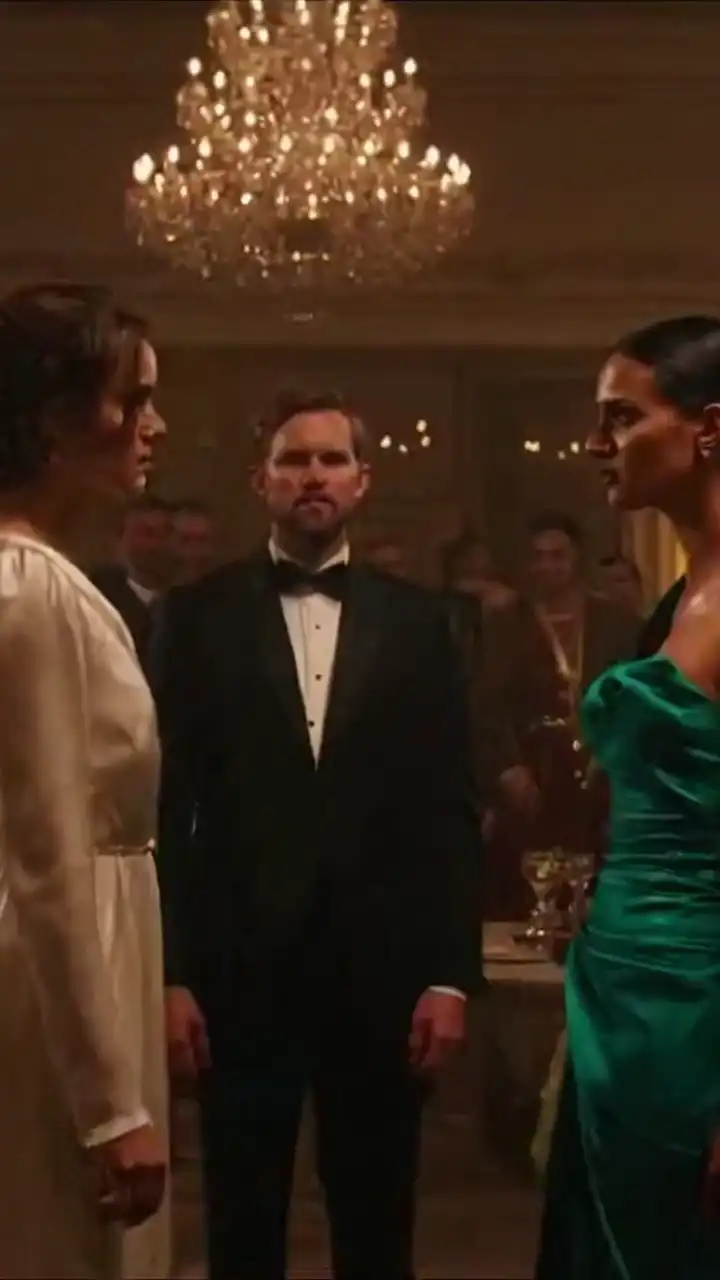
MY HUSBAND USED MY MONEY, GOT ENGAGED TO HIS MISTRESS, AND STOOD THERE WHILE SHE SLAPPED ME

THE MAID OF HONOR POURED WINE ON ME AT MY BRIDAL SHOWER AFTER STEALING MY FIANCÉ. SHE DIDN'T KNOW THE ROOM WAS ABOUT TO HEAR WHAT HE'D BEEN SAYING TO BOTH OF US.

THE MAID OF HONOR POURED WINE ON ME AT MY WEDDING AND CALLED ME CRAZY. SHE FORGOT I STILL HAD THE VOICE NOTE SHE SENT MY FIANCÉ.