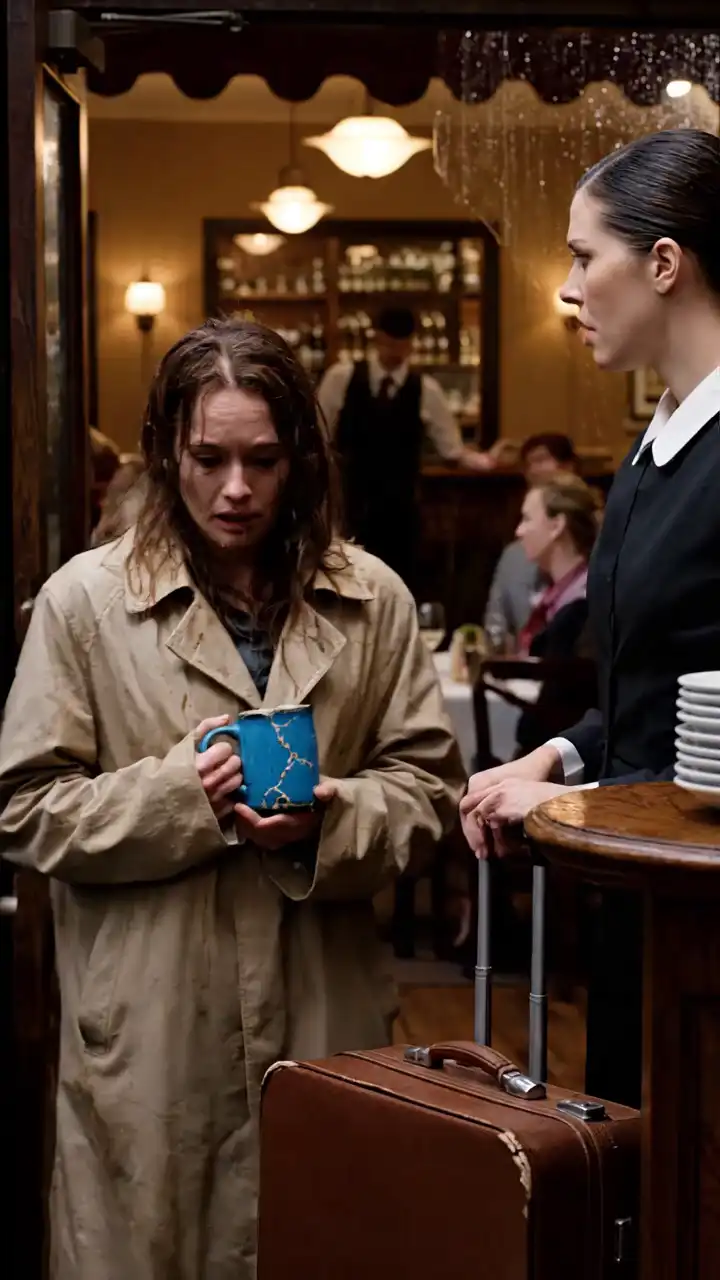
THE WOMAN THEY WOULD NOT SERVE OWNED THE TABLE THEY PROTECTED
Chapter 1
By the time the coffee went cold, every table in the front half of Marrow House Grill had turned to look at me.
I was still standing near the host stand, my suitcase beside my leg, one hand wrapped around a plain blue ceramic mug I had carried in from the rain because I did not trust leaving it in the cab. It looked cheap. Drugstore cheap. The kind of thing somebody picked up for four dollars and forgot in the back of a cupboard.
But I held it like glass.
The hostess with the sharp gold hoops had told me, “Just one second,” twelve minutes earlier. She had seated three couples, a family of five, and a man in a suit who came in after me and did not even have a reservation. Each time she passed, I gave her a small hopeful smile, and each time she looked through me like I was part of the wall.
Rainwater had dried in streaks on my coat. My shoes were still muddy from the bus stop on Alder Crest Road. I knew exactly how I looked: tired, out of place, trying too hard to be neat.
A waitress balancing a tray brushed my shoulder and said, without slowing, “You can’t block the aisle.”
“I’m waiting to be seated,” I said.
She gave a quick little shrug that meant not my problem.
Behind the host stand, the hostess checked names on a glowing tablet. Her name tag said BRENNA. Her lipstick was perfect. Mine had long since worn off somewhere between the interstate and this town.
“Excuse me,” I said, as gently as I could. “I think maybe I got skipped.”
Brenna did not lift her head. “If your table is ready, I’ll call you.”
“I’ve been here a while.”
“We’re busy.”
It was not what she said. It was how easy it was for her to say it. Like I was not a person losing one piece of dignity at a time in front of forty strangers. Like she had already decided that whatever my reason was for being there, it did not matter.
I tightened my grip on the blue mug. A gray-haired man at a nearby booth watched me over his menu. Two teenage girls by the window had stopped eating fries. Someone near the bar gave a low laugh.
“I don’t need anything special,” I said. “Just a table.”
Still nothing. Brenna tapped the screen. A tall blond server came over to whisper something in her ear, and both of them glanced at my suitcase, then my coat, then the mug in my hand.
The server asked, “Is she ordering to-go?”
I heard it. So did everyone else near the front.
My face burned.
“I’m dining in,” I said.
Brenna sighed, finally looking up. “Ma’am, we do have standards here. If you’ve brought in outside food or drink, that’s not allowed.”
I looked at the mug. “This is not a drink.”
The blond server snorted softly.
Brenna folded her hands. “Then what is it?”
For one ugly second, the whole restaurant seemed to lean toward me.
I could have said none of your business. I could have left. I could have spared myself the humiliation of trying to explain something private in a room full of people who already thought they knew what kind of woman stood in front of them with a suitcase and a cheap mug.
Instead I said, “It belongs to my father.”
That should have ended the question. It should have brought some small human pause. But Brenna’s eyes only hardened, as if I had offered a dramatic line she did not appreciate.
“Then maybe keep it in your bag.”
“It doesn’t fit.”
“Then maybe this isn’t the best place for you tonight.”
The teenage girls looked down fast, pretending not to stare. The man at the booth did not bother pretending at all.
I should tell you that I had not come to Bellmere, Ohio, to fight with a hostess in a restaurant lobby.
I had come because my father, Ellis Vale, had died three weeks earlier in a nursing facility outside Dayton, and the last thing he had said to me through an oxygen mask was, “Take the mug to Bellmere. Don’t mail it. Don’t trust anybody who smiles too fast.”
He had been a difficult man, secretive even with people he loved, especially with people he loved. For most of my life he was more absence than father. A holiday call. A money order when he remembered. A postcard from some city where he had worked a job he never explained.
Then my mother died, and in the years after that, he had begun circling back into my life in small clumsy ways, as if he did not know how to be sorry but wanted credit for trying.
When the nurse handed me his canvas bag after he passed, the mug was wrapped in one of his flannel shirts. Inside it, taped under the bottom with waterproof medical tape, was a folded card with one sentence:
MARROW HOUSE GRILL TUESDAY 6 PM ASK FOR NO ONE
It was Tuesday. It was six-fifteen. And I had asked for no one.
I had simply walked in, given my name to the hostess when she asked if I had a reservation, and waited.
Now I stood there with my father’s old secret in my hands while a restaurant full of people watched me be treated like something the rain had dragged in.
A voice behind me said, “She said she’s waiting.”
We all turned.
A woman in a damp navy suit stood just inside the door, holding a leather briefcase under one arm. She was in her sixties, with silver curls pinned at the nape of her neck and the kind of posture that made everyone around her unconsciously straighten. She looked like nobody’s grandmother and everybody’s problem.
Brenna forced a smile. “We’ve got it handled.”
The woman’s eyes dropped to the blue mug in my hand. Just for a second, something changed in her face. Not surprise exactly. Recognition sharpened by alarm.
She stepped closer. “May I ask your name?”
I hesitated. “Mara.”
“Mara what?”
“Vale.”
The woman went still.
Brenna gave a little laugh of relief, like finally the weird stranger could be sorted into some manageable category. “She’s been waiting, but we’re full.”
The woman never looked at her. “Who told you to come here?”
“My father.”
The woman’s gaze flicked to the mug again. “Did he tell you who to ask for?”
I remembered the note. Ask for no one.
“No,” I said. “He told me not to.”
For the first time all evening, someone in that room looked at me as if I was not ridiculous.
The woman set her briefcase on the host stand. “My name is Judith Cates. I’m an attorney. And if that mug is what I think it is, this restaurant can make a table.”
Brenna blinked. “I’m sorry?”
Judith turned, her voice suddenly crisp enough to cut glass. “You heard me.”
The room had gone so quiet I could hear the ice machine behind the bar dumping cubes.
Brenna flushed. “Ma’am, with respect, we can’t just remove guests.”
“You won’t have to,” Judith said. “But you are going to stop ignoring this woman.”
That was the moment the whole place changed shape around me.
Not because they believed I mattered.
Not yet.
But because they had all seen one thing at the same time: a stranger no one wanted to seat had walked in carrying a plain blue mug, and a lawyer had turned pale at the sight of it.
Chapter 2
They sat me at a small two-top near the brick wall, halfway between the kitchen doors and the windows facing Main Street. It was not a good table. People brushed past it on their way to the restroom, and the candle in the middle had already burned down to a puddle of wax. But after the lobby scene, it felt almost ceremonial.
Brenna set a menu in front of me without meeting my eyes.
“Your server will be by,” she said.
Judith Cates sat across from me as if invited by the dead.
“I didn’t ask you to help,” I said.
“No,” she said, smoothing rain from her sleeve. “But your father would have expected me to.”
That landed heavier than I wanted. I kept the mug on the table between us. Up close its flaws were even clearer. A tiny chip at the handle. Faded glaze around the rim. On one side, barely visible unless the light hit it, a stamped maker’s mark from a pottery shop in Asheville. Ordinary. Forgettable.
Yet Judith kept watching it like a loaded gun.
A waiter named Emil came over. His smile was the careful kind people use when management has already warned them there may be trouble.
“Can I start you ladies with water?”
“Coffee,” I said.
He glanced at the mug. “In a house cup only.”
Judith looked at him until his ears reddened.
“Water is fine,” I said quietly. I had no strength left for another small battle.
When he left, Judith folded her hands. “Did Ellis explain any of this before he died?”
“No.”
“Did he tell you what was inside?”
“There’s nothing inside.”
“Not in the cup.” She lowered her voice. “What it represents.”
I almost laughed then, because if I did not laugh, I might cry again, and I had done enough of that in bus station bathrooms over the past month. “I’m sorry. I drove six hours on two borrowed tires because my father gave me a note and a mug and one of his famous half-secrets. So no, he didn’t explain what it represents.”
Something like regret passed over Judith’s face.
“I should start at the beginning,” she said.
Before she could, the kitchen doors swung open and a man in a white shirt with rolled sleeves strode toward us. Mid-forties. Expensive watch. Dark hair combed too carefully. He had the polished impatience of someone accustomed to walking into problems after others have failed to prevent them.
“Brenna says there’s confusion at the front,” he said, not to me but to Judith. “I’m Colter Wynn. General manager.”
Judith did not stand. “There’s no confusion. Ms. Vale is here on business that concerns this property.”
Wynn gave me the kind of once-over that stripped a person without touching them. Coat from a thrift rack. Suitcase from a bus station. Knuckles white around a chipped blue mug.
“This is a restaurant,” he said. “Not a law office.”
“No,” Judith said. “It’s also an estate asset.”
That got his attention.
He pulled out the empty chair from the next table and sat sideways on it, one arm slung over the back. “I think I need to be very clear. Marrow House Grill is privately owned by the Holloway Hospitality Group. If someone has a complaint, they can file it through corporate.”
Judith opened her briefcase and removed a sealed envelope. “I’m not here to file a complaint.”
He saw the law firm letterhead and the muscle in his jaw twitched.
My water arrived. Emil set it down too fast, splashing the tablecloth. “Sorry.”
“It’s fine,” I said.
He wiped at it while trying not to stare at the envelope.
Judith placed one finger on top of it but did not slide it over. “This is a notice regarding dormant ownership rights, trust execution, and contingent transfer attached to the original Marrow House property. I was supposed to deliver it only when the claimant appeared with identifying proof.”
Wynn gave a tight smile. “And you’re saying identifying proof is a coffee mug.”
“Not any coffee mug.”
He laughed then, softly, with enough contempt to turn nearby heads. “This is absurd.”
I finally spoke. “I don’t know what this is either.”
Wynn looked at me for the first time as if my confusion pleased him. “There. Even she knows.”
Judith ignored him. “Ellis Vale was one of three witnesses to a private agreement made thirty-one years ago when this place was still a boarding house diner on Willow Fen Street. Before the Wynn lease. Before the remodel. Before the holding company. The proof item was chosen because no one would steal it.”
I stared at her. “My father worked here?”
“No,” she said. “He built half the back kitchen.”
That stopped me cold.
My father had been a tradesman, always between jobs, always disappearing into other people’s buildings. Drywall, plumbing, tile, repairs. He could fix almost anything mechanical and nearly nothing human.
“He and the owner were friends,” Judith said. “Or as close to friends as two stubborn men could be. The owner, Maeve Torlin, had no children and no surviving siblings. She was dying. She wanted to leave a controlling interest in this property to someone she trusted not to sell it to a chain. But she also wanted to punish the family members who appeared after years of neglect. So she did something very like her.”
Wynn leaned back, expression flat now. “You’re talking about a dead woman from three decades ago.”
“Yes.”
“And this comes up now?”
“It comes up,” Judith said, “because the trust required presentation of the proof item by the named successor or their heir, in person, on the first Tuesday after the death of the final witness.”
My mouth went dry. “Final witness?”
“Your father,” she said.
The candle flame between us trembled when someone passed.
Wynn shook his head. “No court is going to hand over anything based on folklore and crockery.”
“It already has,” Judith said. “The preliminary order was signed yesterday pending verification.”
He held out his hand. “Let me see the order.”
She did not move.
“No.”
That one word did something strange in the room. It was so calm, so final, that even the diners pretending not to listen seemed to stop chewing.
Wynn rose from the chair. “Then I’m going to ask both of you to leave until this can be addressed properly.”
I felt all the air leave my body.
Of course. Of course this was how it would go. Another door. Another face deciding I was too shabby, too uncertain, too inconvenient to be taken seriously.
Judith looked up at him. “You may ask.”
He crossed his arms. “I am.”
Before I could say I would go, before I could rescue the last torn scrap of dignity from this table, an elderly busser who had been refilling water glasses nearby turned and stared straight at the mug.
His tray clattered against the service station.
“Oh Lord,” he whispered.
Everyone looked at him.
He was thin as wire, with liver-spotted hands and a limp that pulled one shoulder lower than the other. His name tag read ROYCE. He took one step closer, eyes wet and wide.
“I know that cup,” he said.
Judith exhaled slowly, like a clock had finally struck the expected hour.
Wynn snapped, “Royce, get back to work.”
But Royce was already shaking his head.
“That was Miss Maeve’s table cup,” he said. “She kept her bourbon in tea and her secrets in plain sight.”
A low murmur rolled through the dining room.
Royce pointed at me with a trembling hand. “And if that girl brought it in, somebody better sit down and listen.”
Chapter 3
Everything ugly about a public humiliation is how quickly it becomes entertainment.
You can feel the exact moment people stop seeing a person and start seeing a scene.
By seven o’clock, half the diners at Marrow House Grill were lingering over dessert they did not want just to hear what happened next. The bartender kept polishing the same row of glasses. Servers invented reasons to pass by my table. A woman in a green sweater had angled her phone on the salt shaker until Judith looked at her once and she lowered it.
I wanted to disappear.
Instead, I sat with my father’s mug between my hands while Royce, the old busser, lowered himself carefully into the chair Colter Wynn had vacated.
“Five minutes,” Wynn said through clenched teeth. “Then back to the floor.”
Royce did not answer him.
Close up, he smelled faintly of dish soap and peppermint. “You’ve got Ellis’s nose,” he told me. “Less mean in the eyes, though.”
I did not know whether to smile.
“You knew my father well?”
“Knew him enough.” Royce looked at the mug with a tenderness that startled me. “Maeve Torlin used to drink from this every Tuesday after closing. Said fancy people steal silver but ignore ugly pottery. She was right.”
Judith opened a folder from her briefcase. Inside were copies of old documents, property maps, a photograph of a squat brick building with a hand-painted sign: TORLIN HOUSE EATERY. The place looked nothing like the polished restaurant around us now.
Wynn stayed standing, arms folded. “This proves nothing.”
Royce looked up at him. “Depends what scares you.”
Wynn’s face darkened. “Be careful.”
There it was. Not annoyance. Fear under the annoyance. Thin but real.
Judith laid out a yellowed sheet protected in plastic. “This is Maeve Torlin’s supplemental trust declaration. Signed in front of three witnesses. Ellis Vale, Royce Lamm, and Father Benecio Hall of Saint Alder Parish. Father Hall died in 2009. Royce is living. Ellis has passed. The claimant appears as instructed, carrying the designated object.”
I tried to steady my breathing. “Claimant to what?”
Judith met my eyes. “Not full ownership. But enough control to trigger a review of every lease, every transfer, and every redevelopment agreement tied to this property since 1995.”
Wynn laughed again, but the sound cracked. “You mean enough to cause nuisance litigation.”
Judith’s tone stayed even. “I mean enough to stop a pending sale.”
That word cut through me.
Sale.
Around us, even strangers understood it. You could hear it in the little intake of breath from the next booth, the scrape of a fork set down too hard.
Wynn looked at Judith. “You had no right to discuss confidential business in front of staff.”
“And you had no right,” Judith said, “to proceed with an asset sale while suppressing a trust trigger you were informed might still exist.”
His silence lasted one beat too long.
Royce muttered, “There it is.”
I turned to Wynn. “You knew?”
He gave me the coldest smile I had ever seen. “I knew there were stories. Every old building has stories. Usually told by people who want money.”
“I don’t want money,” I said.
“Then why are you here?”
It was a fair question. Embarrassing in its simplicity. Because I did not know. Because grief makes fools of the living. Because my father had almost never asked me for anything, and when he did, it had come in the form of one confusing note and a mug wrapped in his shirt.
“I’m here because he told me to come.”
Wynn spread his hands to the room, to my suitcase, my wrinkled coat, my obvious exhaustion. “And that should overturn legal ownership?”
The nearby tables went still again. He had said exactly what they were all thinking in one form or another.
Look at her.
Why her?
What could she possibly be to this place?
My face grew hot. “I never said it should.”
“Then maybe you should let professionals handle adult matters.”
Royce pushed back his chair so suddenly it screeched. “Boy, I watched you start here polishing forks. Don’t puff up now.”
Wynn’s eyes flashed. “I said back to work.”
Royce’s mouth hardened, but his age betrayed him; he sat again slowly, wincing.
Judith interlaced her fingers. “Mr. Wynn, if you continue to interfere with a trust presentation, I will seek an emergency injunction before nine a.m. tomorrow and name you personally in the filing.”
For the first time, he stepped back.
Not much. Just one pace.
But everyone saw it.
A server with freckles whispered, “Oh my God,” under her breath.
Then a woman from a corner booth stood and marched over before anyone could stop her. She was maybe fifty, wrapped in a camel coat despite the warm room, with a diamond ring that flashed when she pointed at me.
“This is inappropriate,” she said to Wynn. “My husband and I have been waiting forty minutes for our entrée while your staff stages courthouse theater.”
Wynn seized on her outrage like a drowning man grabbing driftwood. “I apologize, Mrs. Kessler. We’re resolving an unexpected disturbance.”
Disturbance.
I looked down at the mug. My thumb rested over the chipped handle where my father’s fingers must have rested too.
Mrs. Kessler turned to me. “If you have a personal issue, take it outside.”
“I’m trying,” I said, and hated how small I sounded.
She sniffed. “Then try harder.”
Something in me almost broke right there. Not because of her. Because of how normal it was for her to say it. How easy for a room full of people to accept that some bodies belonged in comfort and some belonged in inconvenience.
Before I could answer, a teenage boy from another table spoke up. “Mom, stop.”
He was red-faced and mortified, the human shape of every decent instinct crushed under good upholstery. Mrs. Kessler stiffened.
“We are leaving,” she hissed to her husband.
They did not leave. They sat back down after another minute, too curious to surrender the show.
That was the ugliest part.
Judith reached into her briefcase again and withdrew a small velvet pouch.
Royce inhaled sharply. “You still have it.”
“I do,” she said.
Wynn’s face changed. “What is that?”
“Something Maeve left with me.” Judith tipped the pouch and emptied a key onto the table. It was old brass, no larger than a finger, with a tiny stamped number on the head: 14.
Royce whispered, “Upstairs.”
I frowned. “Upstairs where?”
Judith pointed toward the ceiling. “The original boarding rooms. Most were gutted during renovation. A few storage areas remain sealed behind the west office wall.”
Wynn moved fast then, snatching for the key. Judith closed her hand over it before he could touch it.
“Do that again,” she said softly, “and I’ll call the sheriff from this chair.”
His breath came hard through his nose. The polished manager mask was gone now, revealing something desperate and mean.
“There is nothing up there.”
Royce looked him dead in the eye. “Then why’re you sweating?”
The kitchen doors banged open and a line cook leaned out, confused by the silence in the dining room. Nobody moved.
I realized then that this had stopped being about whether I would get served. It had become something more primitive. A room full of people watching class and certainty crack under the weight of one ugly mug and one dead woman’s instructions.
Judith stood. “Ms. Vale, I’m going upstairs.”
Wynn stepped into her path. “You are not authorized.”
She held his stare. “I am exactly authorized.”
I heard myself say, “I’m going too.”
Every eye swung back to me.
Wynn gave a short cruel laugh. “In those shoes?”
I looked down. Mud stains. Scuffed leather. Bus stop dirt dried into the seams.
Then I looked back at him. “Yes. In these shoes.”
Royce pushed himself up with both hands on the table. “Then I’m coming.”
“You can barely make the stairs,” Wynn snapped.
Royce smiled without kindness. “Still enough to ruin your night.”
No one spoke while Judith took the brass key, lifted the mug, and nodded toward a narrow service hall beyond the bar.
As I followed her, I felt the room part around me.
Not respectfully.
Not yet.
But no longer as if I were invisible.
Chapter 4
The stairwell smelled like dust, fryer grease, and old rain trapped in brick.
Judith led the way with the confidence of someone walking through a memory. I came behind her carrying the mug now, because she had handed it back to me at the base of the stairs and said, “Keep hold of that.” Royce climbed after us, slower, one hand on the rail. Colter Wynn followed whether invited or not, his dress shoes striking the metal steps with angry precision.
At the top was a short hallway with low ceilings and walls painted over too many times. The restaurant music below came up muffled through the floor, cheerful and wrong for the moment.
On the left were two locked utility closets. At the end stood a paneled wall that looked newer than the rest.
Judith touched it once. “This is where the office expansion happened.”
Wynn folded his arms. “An old storage void. Nothing more.”
“Then open it,” she said.
“It’s not in use.”
Royce pointed with his chin. “See that trim line? It ain’t original. They sealed over the room.”
Judith slipped the brass key into a small square plate near the molding, half hidden under paint. It did not fit.
Wynn smiled tightly. “There. Done?”
But Judith was already scraping paint with her thumbnail. “No. Not there.”
I shifted the mug to my other hand. My heart was thudding so hard it hurt.
Royce tapped the wall twice, listening. Then again, lower. Hollow.
He squinted toward a framed fire evacuation map hanging crooked nearby. “Take that down.”
Wynn said, “No one is removing fixtures from my building.”
“My building may be more accurate by morning,” Judith said.
She lifted the frame off its hook. Behind it, set into the wall, was a narrow brass keyhole blackened with age.
For one full second no one moved.
Then Royce gave a rough little laugh. “Maeve, you witch.”
Judith inserted the key. It turned with resistance, metal grinding against years.
A click.
The panel shifted inward half an inch.
Wynn lunged and caught the edge before she could pull it open. “This is unlawful.”
Judith’s voice stayed very calm. “Step away.”
“No.”
I had spent most of my life shrinking from angry men because experience had taught me the cost of standing in front of them. But grief does strange work. It empties some fears out and leaves others too tired to rise.
So I stepped forward and said the smallest, truest thing I had.
“He asked me to come.”
Wynn looked at me like I was a stain that had learned to speak.
“And that means what?”
I swallowed. “It means you don’t get to shut this door.”
He opened his mouth, maybe to mock me again, maybe to threaten, but Royce put one shaking hand on the panel and said, “Move, son.”
What happened next was almost nothing.
A pause.
A stare.
Then footsteps on the stairs below and a new voice calling up, “Judith?”
A man in a charcoal overcoat appeared at the landing, broad-shouldered, wet-haired, carrying a county badge on his belt. Sheriff Dana Mercer, though I did not know his name yet. Behind him came Brenna, pale and breathless.
“Manager called in a trespass concern,” the sheriff said.
Judith did not so much as flinch. “Perfect timing. Witness this opening, please.”
Wynn released the panel as if it had burned him.
The sheriff frowned from Judith to the wall to the mug in my hands. “What exactly is this?”
“A probate-trigger verification tied to sealed estate storage,” Judith said. “And if I’m wrong, I’ll apologize on the way out.”
Mercer looked at her, then at Wynn. Whatever he saw in Wynn’s face made him step aside instead of intervening.
“Open it,” he said.
Judith pulled.
The panel swung inward with a long sticky groan, dragging stale air into the hall. A narrow room appeared, no bigger than a pantry. Shelves lined one wall. A covered trunk sat on the floor. Dust filmed everything so thick it softened the edges.
No one spoke.
The sheriff pulled a flashlight from his coat and clicked it on.
At the far end of the room hung an old photograph in a wooden frame. Even in the dim beam, I could see a younger version of the building downstairs. Men in aprons. Women in dresses. A hand-painted sign. And in front, standing stubbornly square to the camera, a heavyset woman with cropped dark hair and an expression that said she had outlived better people than you.
Maeve Torlin, I guessed.
Next to her stood three men. One of them was young, lean, and unsmiling.
My father.
I did not realize I had made a sound until Judith touched my elbow.
“You see him?”
I nodded.
It is a brutal thing, meeting the face of your parent before disappointment finished shaping it. He looked almost handsome. Hard, yes, but not yet closed. Not yet a man who could vanish for six months and return with an apology in a paper sack.
Royce wiped his eyes with the heel of his hand. “That was after the roof repair.”
The sheriff swept the light lower. On the shelf beneath the photo sat ledgers, tied bundles of receipts, and a metal lockbox. On top of the box rested a folded envelope browned with age. Written across the front in blunt black ink were four words:
FOR THE ONE WHO COMES
Judith inhaled sharply. “Don’t touch anything yet.”
But Wynn had already lost the last of his composure.
“This proves nothing,” he said too loudly. “Old junk in a wall? That’s your revolution?”
Judith turned on him. “It proves concealment at minimum.”
He took a step back. “I never knew this room was here.”
Royce barked out a laugh. “Liar.”
Brenna, still hovering at the stairwell, whispered, “Colter?”
He did not look at her.
The sheriff entered the room carefully. “No one else comes in until I document this.”
He photographed the shelves, the trunk, the envelope, the lockbox, the wall cavity. His flashlight beam passed over a set of yellowing invoices stamped with the current parcel number. Then over a leather folio cracked with age.
Judith said, “The envelope first, if you please.”
Mercer nodded, put on gloves from his coat pocket, and lifted it. The paper crackled. He opened the flap and unfolded a single handwritten page.
His eyes moved once, twice. Then he looked at me in a way that made my knees weak.
“What?” I asked.
He hesitated. “I think you should hear this from counsel.”
“Read it,” Judith said quietly.
So he did.
“If this room is opened by the bearer of the blue cup or by their blood, let it stand as witness that I, Maeve Torlin, leave my controlling interest in Torlin House and all attached claims to Ellis Vale, unless he is dead, missing, or too proud to take it. In that event it passes to the child of his blood who arrives carrying the cup in person. Because anyone willing to carry an ugly thing through public shame may be trusted more than anyone who arrives polished and empty.”
No one breathed.
The sheriff lowered the page.
I was aware of everything at once: the rough mug handle in my palm, the smell of dust, Brenna’s hand over her mouth, Royce crying openly now, Judith’s eyes closed for half a second in grim relief.
And Wynn.
Wynn staring at me as if the floor had tilted beneath him.
The line hit me all at once, delayed and brutal.
Anyone willing to carry an ugly thing through public shame.
My father had known.
He had known I would be judged when I walked in with this chipped mug and my borrowed coat and bus-stop shoes. He had known they might ignore me, laugh at me, try to turn me away. And still he sent me.
For a heartbeat anger rose through the grief so hot I thought I would choke on it.
“He used me,” I whispered.
Judith’s voice was gentle. “He may have. He may also have believed only you would finish it.”
That did not comfort me. Not then.
The sheriff continued reading the page silently, then said, “There’s more. Instructions for transfer review. Named counsel is Judith Cates.”
Judith nodded once.
Wynn found his voice. “This is insane. A handwritten note in a hidden room doesn’t just—”
Mercer cut him off. “You can argue that in court. For tonight, this area is secured.”
On the shelf beside the envelope, the flashlight caught something that flashed dull gold inside the lockbox grate.
Judith saw it too. “Open that.”
Mercer checked the latch. Locked.
Judith reached into the envelope and withdrew a smaller key taped inside the fold.
Royce whispered, “She thought of everything.”
The lock clicked.
Inside the box were deed copies, original trust papers, and a ring of old brass keys tagged in careful writing. On top lay a cashier’s certificate and stock documents with values that meant nothing to me until Judith’s breath caught.
“Good God,” she murmured.
“What is it?” I asked.
Her eyes lifted to mine. “Reserved equity distributions. Decades of them. Unclaimed. Invested, rolled over, protected.”
“How much?”
She swallowed. “Enough that no one in this building should ever have looked at your coat before looking at your face.”
Behind us, Brenna made a soft choked sound.
But the paper that mattered most to me was still in Mercer’s gloved hands. The line about shame. The line my father must have read and kept alive all these years.
I stood in the hidden room above the restaurant that had treated me like a nuisance and understood something terrible.
My father had not tested whether the law would recognize me.
He had tested whether the world would humiliate me first.
Chapter 5
They closed the dining room early.
Nobody announced it dramatically. The music was cut. Servers moved from table to table with tight smiles and apologies about an unforeseen private matter. Some customers left irritated. Some left thrilled to have witnessed the beginning of someone else’s collapse. A few glanced at me on their way out with expressions I could not bear—curiosity, embarrassment, guilt, hunger for gossip.
Mrs. Kessler avoided my eyes.
The teenage boy did not. As he passed, he gave me a tiny nod, the kind decent people offer when they have no power to fix what they’ve watched. It nearly undid me.
Judith, Sheriff Mercer, Royce, and I sat at the long communal table near the center of the restaurant while deputies photographed documents in the upstairs room. The candles had been extinguished, and without them the place looked less elegant, more staged. Brick, reclaimed wood, polished brass, all of it built to feel intimate and expensive. All of it suddenly flimsy under fluorescent task lighting.
Colter Wynn stood near the bar speaking in furious low tones into his phone. Whatever charm he had worn earlier was gone. Sweat darkened his collar. Every few minutes he looked over at us and then away.
Brenna lingered by the service station, folding napkins that did not need folding.
The blue mug sat in front of me on the tablecloth.
I hated it a little.
I loved it a little too, because my father’s thumb had worn a faint smooth groove along one side and now mine fit there exactly.
Judith spread out copies of the key documents. “Here’s the immediate truth,” she said. “The hidden interest didn’t make you owner of the whole restaurant tonight. It made you the controlling beneficiary of the original property trust, which is enough to freeze sale proceedings and force full accounting. Depending on what we find in the leases, Mr. Wynn and Holloway Hospitality may be in very serious trouble.”
Royce gave a humorless chuckle. “Knew he was moving too fast.”
I looked at Wynn. “He was selling it?”
“To a development group out of Columbus,” Judith said. “Boutique hotel concept. They planned to keep the restaurant brand for a year, then phase in a rooftop bar and private event space.”
Royce snorted. “Maeve would haunt every pipe.”
Sheriff Mercer leaned back in his chair. “What matters tonight is chain of custody and statement clarity. Ms. Vale, I’m going to need to ask some questions about how the mug and note came into your possession.”
I nodded. “I can do that.”
Before he began, Brenna approached our table with a pot of fresh coffee and four clean cups on a tray. She was no longer polished. Her lipstick had faded, and there was mascara smudged at one corner of her eye.
“I know you probably don’t want this from me,” she said, looking at me, “but I thought you might still want something hot.”
The silence stretched.
She reached for a cup. “I can leave it.”
“Wait,” I said.
She froze.
“Pour it.”
Her hands trembled just enough to make the pot rattle softly against the cup.
When she finished, she whispered, “I’m sorry.”
I believed she meant it. I also knew an apology often arrives after safety does. It is easier to be kind to the person everyone has decided matters.
“Thank you,” I said, because I did not know what else to do with her shame.
She nodded once and backed away.
Mercer asked his questions. I answered carefully. Date of death. Name of facility. What the note said. Where the mug had been kept. Whether anyone else had opened or altered it. When I was done, he took my statement and left to coordinate with the deputies.
Royce remained, turning his paper napkin into smaller and smaller squares.
“He talked about you, some,” he said eventually.
I looked up. “My father?”
Royce nodded. “Not a lot. Ellis wasn’t built for a lot. But after your mama died, he carried a school photo in his wallet till it cracked down the middle.”
Something tightened in my throat.
“He ever say why he stayed away?” I asked.
Royce took a long breath. “Pride. Shame. Restlessness. Pick one, maybe all three. Some folks do one bad thing young and spend the rest of life mistaking distance for penance.”
I stared at the mug. “He set me up to be humiliated.”
“No,” Royce said softly. “Maeve did that. Ellis just believed you’d walk through it.”
“That’s not better.”
“No,” he said. “It ain’t.”
Judith closed the folder. “Your father nearly came here two years ago.”
I looked at her sharply. “What?”
“He called me. Said his health was turning. Wanted to know if the trust instructions could be changed. I told him maybe, but only if he appeared in person and executed an amendment. He said he’d think on it.” She paused. “He never came.”
“Why not?”
“I don’t know.”
But I did, suddenly. I could see him too clearly. Sick. Proud. Afraid of being looked at the way I had been looked at tonight. Afraid of walking into a polished room carrying a ridiculous mug and being treated like nothing.
He had sent me because he could not bear it himself.
The realization was so sharp it made me put my hand over my mouth.
Not because he doubted me.
Because he doubted mercy.
Judith’s expression shifted as she watched understanding cross my face.
“Yes,” she said quietly. “I think that’s true.”
At the bar, Colter Wynn ended his phone call and strode toward us.
“Counsel is on the way,” he said to Judith. “Until then, I advise everyone here to stop making assumptions.”
Judith did not rise to it. “Sit down, Mr. Wynn.”
He barked a laugh. “You don’t command me.”
“No,” I said, surprising myself. “But I do think you should sit.”
He looked at me as if still hoping I would revert to the ignored woman at the host stand.
I did not.
Slowly, with visible reluctance, he pulled out a chair and dropped into it.
I asked, “How long did you know there might be another owner?”
His mouth tightened. “There wasn’t another owner.”
“That’s not what I asked.”
Judith watched him. Royce glared openly. Even Brenna had stopped pretending not to listen.
Wynn dragged a hand down his face. “Four years.”
Royce slammed his palm on the table. “You snake.”
“An old letter turned up during archive cleanup,” Wynn snapped. “It mentioned a side trust and a proof item, nothing more. No cup. No claimant name except Ellis Vale, who was impossible to locate.”
“I was not impossible to locate,” I said.
“No,” Judith said coldly. “Your investigators were lazy because they assumed the claim had no value.”
Wynn ignored her. “The board wanted certainty before listing the property. I was told to treat it as dead paper unless someone surfaced.”
“And if someone surfaced?” I asked.
He hesitated.
Royce answered for him. “He would’ve paid you off quiet.”
Wynn did not deny it.
My stomach turned. “You saw me the second I walked in.”
He said nothing.
“You knew my last name?”
“Brenna entered it at the stand.”
“And you still left me there.”
His jaw worked.
That was the real reveal, stranger than deeds or hidden rooms.
He had not ignored me because he did not know who I was.
He had ignored me because he suspected I might matter and hoped humiliation would make me leave before proof could catch up.
The room seemed to narrow.
Brenna covered her mouth again. “Colter…”
He snapped, “I was trying to avoid chaos.”
“No,” I said. “You were trying to make me disappear.”
He looked at the mug, then finally at me. “You came in with a suitcase and that cup. No reservation. No context. Do you know what this place deals with? Scammers, grifters, people with stories—”
I cut him off. “So you decided what I was before I sat down.”
He had no answer.
The front door opened and two men in suits entered with umbrellas and legal pads. Corporate counsel, no doubt. Their arrival should have made Wynn look relieved. Instead he looked cornered.
Judith stood. “Good. Now we can all speak plainly.”
But I barely heard the next few minutes—introductions, objections, requests for copies—because my mind had returned to the host stand, the waiting, the snickers, the tiny public shrinking of a person under fluorescent light.
It all meant more now, and not in a way that softened it.
Money had not saved me from cruelty because cruelty had arrived first.
Judith placed one hand lightly on the mug. “Ms. Vale, there is one more document.”
I looked up.
She slid over a folded page from the lockbox. It was in my father’s handwriting.
I recognized it instantly from birthday cards that came late and postcards that came stranger than affectionate.
Mara—
If you are reading this, I didn’t make it back in time to do this myself.
You may be mad, and you’ll be right.
Maeve said the cup would tell me who could be trusted. I used to think she meant lawyers and judges. Took me too long to understand she meant ordinary people in ordinary rooms.
Watch how they treat you before they know what they can get from you.
That’s the whole map.
If they shame you for carrying something plain, they will shame anyone for being poor, old, sick, foreign, slow, grieving, or alone.
Don’t save the place unless it deserves saving.
And don’t forgive me too fast.
Dad
I read it twice, then a third time because my vision had blurred.
Royce turned his face away to give me privacy he could not truly give in a bright half-empty restaurant.
Judith asked softly, “Do you want a minute?”
I laughed once, broken and small. “I think he finally told the truth.”
Outside, rain tapped at the windows. Inside, the corporate lawyers were already discussing injunction language and access rights and preservation orders.
But the loudest thing in the room was that sentence on the page.
Watch how they treat you before they know what they can get from you.
That was the inheritance.
Not the money.
Not the property.
The test.
Chapter 6
Three months later, I stood in the same front lobby of Marrow House Grill and watched a delivery kid track wet footprints across the tile.
Brenna saw them and started to move with a towel, then stopped when I shook my head.
“Leave it a minute,” I said.
She smiled, understanding. “So people can remember floors are for walking?”
“Exactly.”
A lot had changed in three months. The sale had been halted. Holloway Hospitality settled fast once the trust documents, concealed room, and withheld disclosures came fully into daylight. Colter Wynn resigned before the civil hearings were done. I later heard he took a consulting job in another county and told people he’d left for family reasons.
Maybe that was even partly true. People are rarely made of one motive at a time.
Royce no longer bussed tables. He now sat by the window most afternoons with a ledger and a plate of pie “for quality control,” which meant he talked to every staff member and every lonely customer who looked like they might leave feeling smaller than they arrived.
Sheriff Mercer ate lunch here every Thursday and insisted on paying like everyone else.
Judith Cates remained exactly as frightening as ever, which I had come to find deeply comforting.
As for me, I did not become the glamorous owner people in Bellmere wanted to imagine once the story spread. I still wore practical shoes. I still checked prices before buying groceries. I still felt like an outsider in this town some mornings when the church bells carried over Willow Fen and everyone seemed to know where they belonged but me.
But I had made one decision before signing anything permanent.
We were not saving the place as it had been.
We were changing the terms of what welcome meant.
The host stand was gone. In its place stood a long wooden bench under a sign that read SEAT YOURSELF OR ASK WE WILL SEE YOU. No one waited like a supplicant anymore while being judged by shoes, luggage, accent, or silence.
One section of the menu each day was pay-what-you-can, no explanation required.
We trained staff on service, yes, but also on attention—real attention, the kind that notices a trembling hand, a confused elder, a soaked teenager with nowhere to be for an hour, a traveler carrying something strange and fragile.
Some people called it soft management.
Those people generally said it once.
The blue mug sat in a glass case near the old brick wall, not under a spotlight, not romanticized, just plainly displayed with my father’s line beneath it:
WATCH HOW THEY TREAT YOU BEFORE THEY KNOW WHAT THEY CAN GET FROM YOU
I had resisted showing it at first. The mug felt too private, too rough with memory. But Judith convinced me.
“It isn’t a trophy,” she said. “It’s a warning.”
So it stayed.
That afternoon, as I checked invoices near the front, a man in work coveralls came in with a little girl in a yellow raincoat. He hesitated when he saw the dining room, the polished wood, the lunch crowd in office clothes.
I knew that hesitation. The body measuring itself against a room before the room could do it first.
The girl pointed at the pie case. “Daddy, can we?”
He crouched beside her. “Maybe not here, bug.”
“Yes, here,” I said.
He looked up too fast. Embarrassment flashed over his face. “Sorry. We just came in out of the rain.”
“You’re fine.”
“We don’t want trouble.”
“You’re not trouble.”
The little girl stared at the blue mug in the case. “Why’s that cup famous?”
I walked over and knelt so we were eye level. “Because people made a mistake when they saw it.”
She considered that solemnly. “Did they say sorry?”
“Some did.”
“Did that fix it?”
Children ask questions like knives sometimes, clean and exact.
“No,” I said. “But it was a start.”
Royce called from his window table, “Tell her the pie’s better than the story.”
The girl grinned. “Can I have apple?”
Her father opened his mouth, maybe to explain, maybe to apologize for existing on a budget in public. I spared him.
“Two slices,” I told Brenna. “And coffee.”
He started to protest. I shook my head.
“Sit down,” I said. “In those shoes.”
For one second he looked confused. Then he laughed, tired and relieved, and some old hurt in me loosened.
As they settled by the window, I glanced at the mug.
I still had not forgiven my father all the way. Maybe I never would. Love does not erase anger just because someone dies. But I understood him now in the only way left to me. He had spent too much of his life learning what rooms do to people when they smell weakness. He had wanted me to see it clearly, even if the lesson cut.
And he had been right about one thing I could not shake.
Poverty hurts.
Loss hurts.
Shame hurts.
But the coldest force in the world is not being poor. It is being treated as if your poverty, your strangeness, your grief, or your plainness makes you unworthy of being answered.
That is the rot.
That is what ruins a place long before money does.
Brenna set the pie down for the man and his daughter. Royce lifted his coffee in greeting. Rain softened against the windows.
And this time, when someone walked through the door carrying the weather on their coat and uncertainty in their face, nobody looked away.
Disclaimer: Mention of any brand or trademark is for identification only and does not imply partnership or endorsement
MY HUSBAND USED MY MONEY, GOT ENGAGED TO HIS MISTRESS, AND STOOD THERE WHILE SHE SLAPPED ME

THE MAID OF HONOR POURED WINE ON ME AT MY BRIDAL SHOWER AFTER STEALING MY FIANCÉ. SHE DIDN'T KNOW THE ROOM WAS ABOUT TO HEAR WHAT HE'D BEEN SAYING TO BOTH OF US.

THE MAID OF HONOR POURED WINE ON ME AT MY WEDDING AND CALLED ME CRAZY. SHE FORGOT I STILL HAD THE VOICE NOTE SHE SENT MY FIANCÉ.