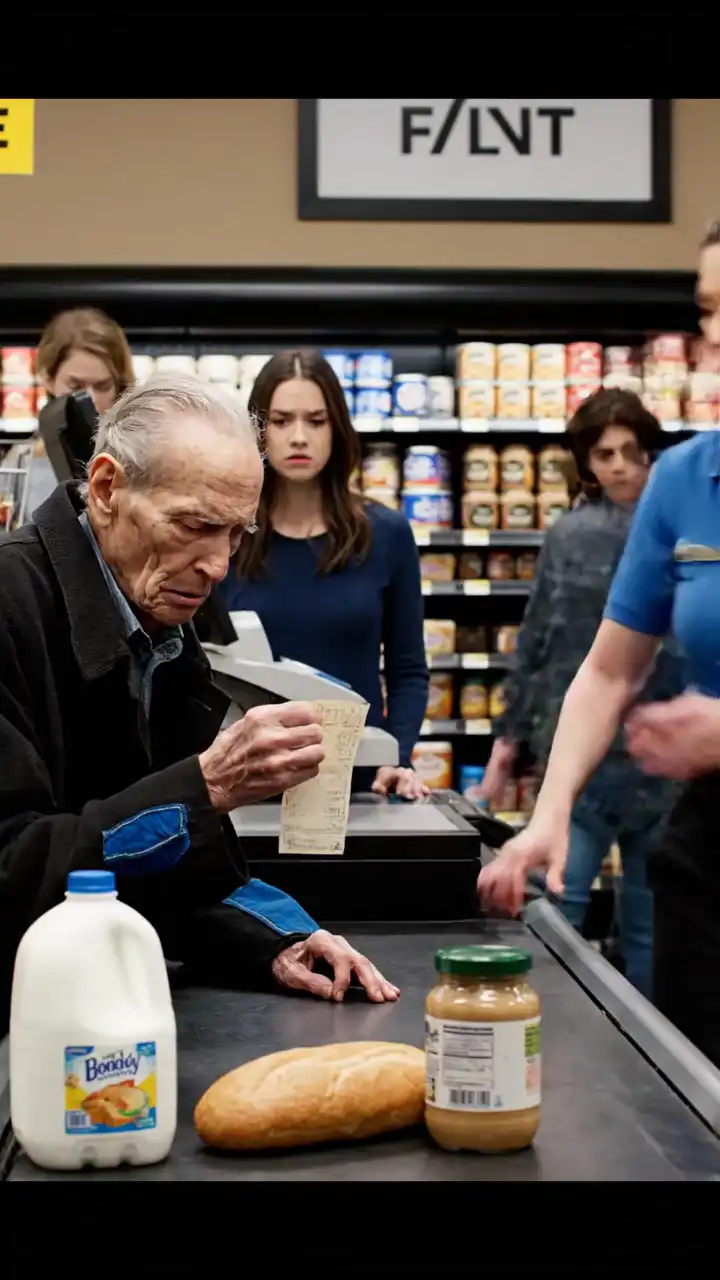
THE MAN MY FAMILY WOULD NOT CLAIM STOOD SHAKING AT MY GROCERY LINE WITH A FOLDED RECEIPT
Chapter 1
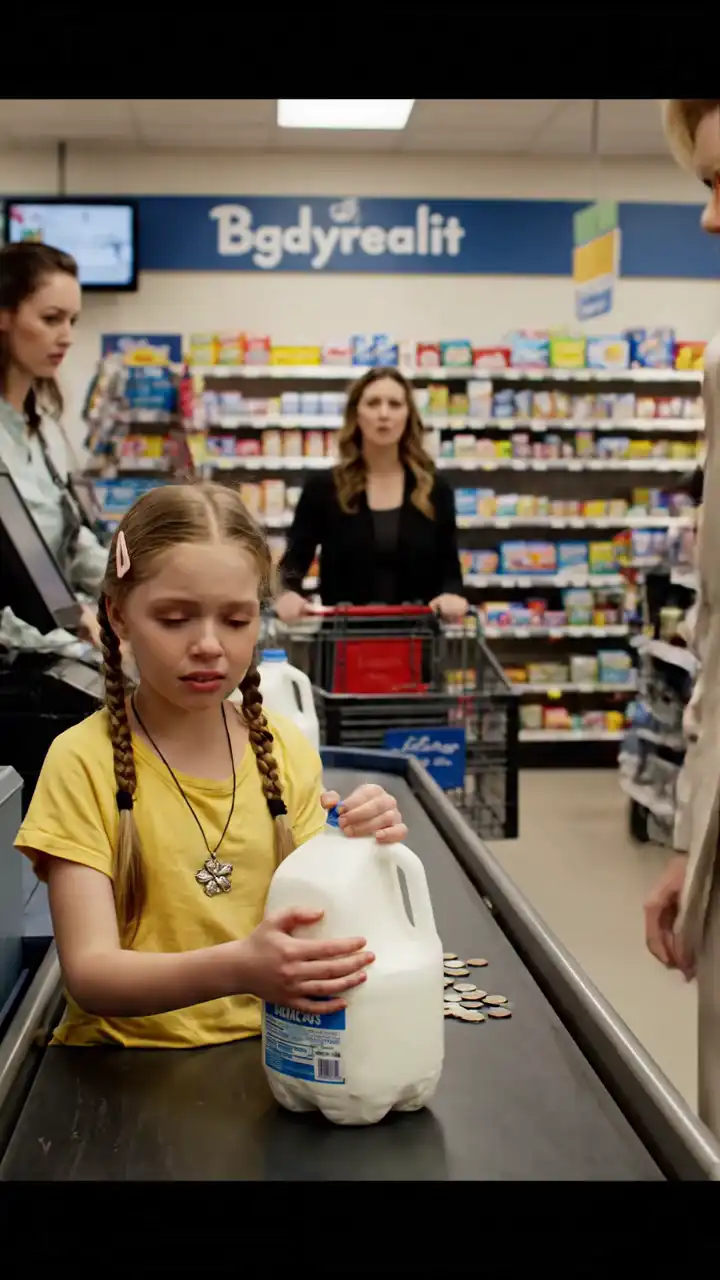
The old man put a gallon of milk, a loaf of white bread, a jar of peanut butter, and a box of store-brand oatmeal on my checkout belt like he was apologizing to each item.
Then he unfolded a yellowed receipt with both hands.
“Please,” he said softly. “I just need these.”
The line behind him went quiet in that ugly way people do when they smell a scene coming.
I stood at register four in Bellmarket on Harrow Street, with my scanner in one hand and my stomach already tight. It was the end of the month, which meant crowded aisles, declined cards, tired tempers, and people counting coins into their palms like prayers.
The old man’s coat was too thin for March in Larkhaven. One sleeve had been mended with blue thread that didn’t match. His shoes were clean but cracked at the toes. He kept one hand over the receipt and one over the edge of the belt, as if he thought somebody might snatch either from him.
Across from me, our front-end supervisor, Della Pike, had already noticed him. Della noticed everything that might cost the store money or time or sympathy.
“What seems to be the problem?” she asked, though her voice said she had already decided.
The old man looked at me first, not her. “I was told,” he said, “years ago, if I ever came back with this, the family account would cover basic groceries.”
He lifted the receipt a little higher.
It was old, so old the paper had gone soft and brown at the folds. I could see the faded Bellmarket logo from before the chain had changed names. The date was nearly impossible to make out. There was handwriting at the bottom in blue ink.
Della stepped closer and took it from him before I could say anything.
“This is not valid,” she said after one glance. “Sir, we do not honor random pieces of paper.”
“It’s not random.”
“Do you have a payment method?”
He shook his head.
The woman behind him gave a long sigh. Somebody farther back muttered, “Of course.”
I hate that sound. Not anger. Not even impatience. That flat little tone people use when they’ve decided a stranger’s hunger is an inconvenience.
The old man swallowed hard. “I was told to come to this store. Harrow Street. I came to the right place.”
Della turned the receipt over. “This is from twenty-two years ago.”
He nodded. “Yes.”
“And you think that means today you can walk in and take food?”
His face changed at the word take. It wasn’t outrage. It was something smaller and worse. Shame with nowhere to go.
“I don’t want to take anything,” he said. “I came because she told me to come if I ever needed help.”
Della’s eyes sharpened. “Who?”
He looked past her, past me, toward the pharmacy sign at the back of the store, as if he could still see someone standing there.
“Maris Vann.”
My hand stopped over the scanner.
Nobody in the store knew that name but me.
Maris Vann had been my grandmother.
I had not heard anyone say her full name out loud in six years.
Della glanced at me. “You know him?”
“No,” I said too fast, because I didn’t. Not really. I had never seen him before. But I knew the name he had spoken, and I knew the old Bellmarket logo, because my grandmother had managed this store before it was renovated, before the bright self-checkout kiosks, before the polished produce mist and curated seasonal displays.
The old man must have seen something move in my face.
“You’re one of hers,” he said.
I felt heat crawl up my neck. “What do you mean?”
He gave me the kind of look old people give when they see family resemblance before you do. “Your eyes.”
Della snapped the receipt once between her fingers. “Enough. Sir, if you can’t pay, you need to step aside.”
“Please,” he said again, and now there was a tremor under the word. “Just these few things.”
“Step aside.”
He didn’t move.
The line behind him tightened. I saw phones coming out. A teenage boy near the magazines lifted his camera without even pretending not to. A woman in a camel coat whispered to her husband, “This is why prices go up.”
I should have rung up the next customer. I should have looked away. That was the smart thing. Cashiers who involved themselves in management trouble didn’t stay cashiers very long, and I needed this job more than pride.
My name is Tessa Vann, I am thirty-two years old, and I know exactly how a public humiliation starts. It starts with one person having no room left to back out.
The old man put his fingers on the receipt in Della’s hand. Not grabbing. Just touching. “I kept it safe.”
Della pulled it back. “That’s enough.”
He looked at the groceries, then at me.
There was something terrible in that glance. Not demand. Not anger. Recognition without certainty. Like he had walked into a room hoping one memory still belonged to him, and now the room was bright and strange and full of people waiting for him to fail.
“Please don’t make me leave it,” he whispered.
My chest went tight.
Because my grandmother used to say that exact thing when she came home from double shifts and found one of us had thrown out leftovers she meant to stretch into soup.
Please don’t make me leave it.
Della put the receipt on the counter and reached for the grocery divider. It was the small gesture that meant the person in front of us had become a problem to move aside.
“Next guest,” she called.
The old man stared at the divider.
I heard myself say, “Wait.”
Della turned. “Tessa.”
“I just want to look at the receipt.”
“You need to ring.”
“It has my grandmother’s name on it.”
The line stirred. That got everyone’s attention in a different way.
Della handed it to me with a look that promised consequences. “Fine. Look.”
The paper was brittle. The date read August 14, 2004. At the bottom, under a list of canned soup, diapers, powdered formula, and over-the-counter fever medicine, there was handwriting I knew.
If need ever finds you before dignity does come to me
M Vann
Below that was a number written twice, and under it, one word.
Promise
For a second the whole fluorescent world blurred around the edges.
I had seen my grandmother’s handwriting on recipes, church bulletins, the note she left on my lunchbox in sixth grade when my mother forgot. Rounded M. Sharp V. The little tail she put on the end of her n.
Della was still talking, still ruling. “Even if this was written by your grandmother, this store cannot honor personal notes. We are not a shelter.”
The old man closed his eyes.
Then someone spoke from the end of the lane.
“She wrote that for him.”
I looked up.
My aunt Corinne stood by the display of discount batteries, still in her charcoal real-estate blazer, one hand wrapped around the handle of her purse. She had come in for sparkling water and probably to make sure the world was still arranged in her favor.
For one impossible second, nobody said anything.
The old man turned toward her very slowly.
Corinne looked like she wished she could swallow the sentence back whole.
“Take your groceries,” she said to him, but her voice was thin. “Just go.”
He stared at her face.
Then he said the strangest thing in the room.
“You were the baby.”
Chapter 2
If my aunt had slapped him, it could not have stunned her more.
Corinne’s hand tightened on her purse strap so hard her knuckles blanched. She was my mother’s older sister, the polished one, all clean heels and clean opinions. She sold lake houses to people who complained if the wine fridge was too small. She donated throw blankets to charity drives and made sure her name was on the card.
She never looked shaken in public.
Now she looked seventeen.
“Della,” she said, without taking her eyes off the old man. “Ring him out.”
Della blinked. “Excuse me?”
“I’ll pay for it.”
The old man gave a small, pained shake of his head. “No.”
That one word seemed to offend half the line more than the original scene had.
A man in a paint-splattered hoodie laughed under his breath. “He says no to free groceries?”
Corinne stepped closer to the register. “You need food. I said I’ll pay.”
“No,” he repeated. “Not like this.”
I looked between them. “Aunt Corinne, who is he?”
She ignored me. “Della, do it.”
The old man laid his palm over the receipt on the counter. “You know who I am.”
Corinne’s jaw moved once. “I know enough.”
That was not an answer. It was the kind of sentence rich people use when they are trying to keep a door shut with one foot.
Della finally rang the items through with hard, annoyed scans. Milk. Bread. Peanut butter. Oatmeal. Four sounds. The total came to eleven dollars and twenty-three cents. Corinne pulled out a card that looked heavy even in her hand.
The old man reached for the groceries only after the payment went through. He moved carefully, preserving what little was left of his pride.
Then he looked at me again.
“Your grandmother had a green truck,” he said.
I forgot the line. Forgot Della. Forgot the scanner in my hand.
“She did,” I said.
“She tied the driver’s door shut in winter with a scarf.”
The memory hit me so suddenly I had to catch the register with one hand. I was eight, sitting in the middle seat, watching my grandmother loop her church scarf through the metal handle because the latch had broken and she was not paying for bodywork when tape and faith were cheaper.
“Who are you?” I asked.
But Della snapped, “This lane is closed until further notice,” and that broke the moment apart.
Customers groaned. Corinne said, “Tessa, not here.”
The old man lifted the sack of groceries. “I’m sorry,” he murmured to no one and everyone. Then he turned and walked toward the exit.
He had a limp I had not noticed before.
Corinne moved after him so quickly that one of her heels skidded on a dropped grape near the floral cooler. I came around the register despite Della saying my name in that warning tone.
By the sliding doors, under the chirp of the security sensors and the draft of cold air, Corinne caught his sleeve.
“Wait.”
He stopped but did not face her.
“I said take the groceries,” she told him.
“I did.”
“Then leave.”
He turned then, and I saw his face clearly for the first time. Late sixties, maybe older. Weathered skin. White stubble. A small scar near his chin. Eyes that looked exhausted even when they were steady.
“I came because she told me to come,” he said. “Not for charity. For the promise.”
Corinne lowered her voice. “You should not have come here.”
“I know. But the place I sleep was cleared out yesterday.”
Sleep. Not live. Sleep.
He continued, “I tried the shelter on Pennix Road. Full. I tried St. Jude’s pantry. Closed Mondays. I still had the receipt.”
Corinne looked over her shoulder and saw me standing near the carts.
Her face hardened at once. “Go back to work, Tessa.”
“No.”
I had not spoken to her that way since I was fourteen.
She stared at me. “You have no idea what this is.”
“That’s because nobody tells me anything.”
The old man gave a sad little breath, almost a laugh. “That part sounds familiar.”
Corinne flinched.
Outside, the sky had gone the color of dirty dishwater. People pushed carts across wet pavement toward dented sedans and polished SUVs. Bellmarket’s red sign buzzed faintly over us.
“Who are you?” I asked him again.
He held the grocery sack against his chest like something easy to lose. “My name is Eli Mercer.”
It meant nothing to me and yet not nothing, because my grandmother did not leave promises to strangers for no reason.
Corinne spoke before I could ask more. “You need to go.”
Eli looked at her for a long moment. “I did.”
“Then why now?”
At that, something passed between them that I could not read. Old anger. Old debt. Old fear.
Finally he said, “Because she isn’t here anymore.”
Corinne’s mouth went tight.
He nodded once at me. “I’m sorry about your grandmother.”
“You knew she died?”
“I knew the world would be smaller when it happened.”
Then he stepped out into the wind and crossed the parking lot with that uneven gait, holding the thin sack under his coat like it might protect him from weather or memory.
I started after him, but Corinne grabbed my arm.
“Let him go.”
“Who is he?”
“That is not your concern.”
“He knew Grandma’s truck.”
Corinne let go of me. “Lots of people knew your grandmother. She fed every stray in Larkhaven.”
“He’s not a stray.”
Her face changed at that, and for one second she looked tired instead of elegant.
“No,” she said quietly. “He’s not.”
When I got home that night, my son was asleep on the pullout couch with one sock off and a cartoon still glowing on mute. My apartment over Kessler’s Hardware smelled like radiator heat and dish soap. My electric bill was clipped to the fridge with a magnet shaped like a peach, stamped FINAL NOTICE in red. I had half a carton of eggs, a bag of rice, and exactly thirty-six dollars in checking.
I should have heated leftovers and gone to bed.
Instead, I pulled out the old tin box where I kept the things I could not afford to lose and could not bear to look at often: my son Owen’s birth certificate, the title to my dead Honda, my grandmother’s funeral card, and three recipes she wrote in blue ink.
I spread them on the table under the kitchen light.
Same handwriting.
If need ever finds you before dignity does come to me
Promise
I called my mother in Glen Morrow Estates, where she lived now in a condo with white cabinets and no clutter and no room for uncomfortable history.
She answered on the fourth ring. “Tessa, is Owen sick?”
“No. Who is Eli Mercer?”
Silence.
Then, “Where did you hear that name?”
“At work. He came in with a receipt Grandma wrote.”
Another silence. I heard cabinet doors in the background, ice knocking against glass.
“Your aunt should have kept her mouth shut,” my mother said.
My whole back went cold. “So you know who he is.”
“That man is trouble.”
“What kind of trouble?”
“The kind that stays buried for a reason.”
I sat down slowly. “Mom.”
Her voice got sharper, defensive in that way that always meant she was protecting herself first. “Your grandmother made choices none of us agreed with.”
“What choices?”
“He was around during a bad time. That’s all you need to know.”
“For who?”
“For all of us.”
I looked at the receipt again, at the careful blue letters, at the word promise.
“What did Grandma owe him?”
My mother exhaled like I was the difficult one. “Nothing. She was sentimental.”
My grandmother had been many things. Tough. Funny. Stubborn enough to patch a freezer door with bungee cords for six months. But never sentimental in a way that risked food and money she did not have.
“Mom,” I said, “did he work at the store?”
“No.”
“Was he family?”
Her answer came too fast. “No.”
That was when I knew he was.
Not maybe. Not partly. Family makes a certain kind of panic rise in people, especially the kind of family they have chosen to erase.
I heard Owen stir in the next room and whisper for water in his sleep.
My mother lowered her voice. “Listen to me. Do not go looking for him.”
“Why?”
“Because you cannot afford other people’s wreckage.”
Then she hung up.
I sat at the little table until the radiator knocked and the cartoon credits rolled and the dark kitchen window turned me into a ghost.
On the back of the receipt, beneath the old Bellmarket logo, there was another faint mark I had missed before. A grocery stamp. Store manager approval. Initials.
MV.
And under that, almost gone with age, a street name written in pencil.
Rill Street.
Chapter 3
Rill Street ran behind the old train yard on the south side of Larkhaven, where duplexes sagged inward and chain-link fences leaned like tired men. I went there on my day off with Owen in the back seat because I couldn’t afford a sitter and because he refused to be left with my neighbor Janice after the parrot bit him.
“Are we going somewhere bad?” Owen asked from his booster seat.
He was seven, with too-big eyelashes and a way of asking direct questions that stripped adults of their lies.
“We’re going somewhere old,” I said.
“That means bad.”
“Not always.”
The address from the receipt led to a boarded-up brick house with a porch listing left. But an older woman in a red housecoat sweeping cigarette ash from her steps pointed her broom two doors down when I asked about Eli Mercer.
“He don’t stay put,” she said. “Sometimes church basement on Maribel. Sometimes by the warming tents. Sometimes with his sister girl if she ain’t mad.”
“His sister?”
“Luanne Mercer. Over Birch Loop trailers. Lot nineteen.”
Owen leaned toward her through my rolled-down window. “Is he nice?”
The woman squinted at him. “He’s hungry, baby. That ain’t the same thing.”
Lot nineteen sat near the edge of Birch Loop Mobile Park, where rusted bicycles lay in winter grass and wind chimes clinked against aluminum awnings. A woman in pink foam rollers answered the door and looked like she had been fighting sleep and disappointment in equal measure.
“I’m Luanne,” she said before I asked. “If this is about Eli owing you, get in line.”
“He doesn’t owe me. I met him yesterday at Bellmarket.”
Her face changed at the store name. Not fear exactly. More like old pain bracing itself.
“He went there?”
“Yes.”
She closed the door halfway as if to think behind it, then opened it again. “You better come in before every trailer here gets your business.”
Inside smelled like fried onions and lavender powder. Owen sat on the edge of a plaid recliner while Luanne watched me with crossed arms.
“You’re a Vann,” she said.
“Yes.”
“Which one?”
“Tessa.”
She laughed once without humor. “Of course. You look just like Maris around the eyes.”
“People keep saying that.”
“Because it’s true.”
I didn’t sit. “Who is Eli to my family?”
Luanne studied me a long moment, then looked at Owen. “You want crackers, honey?”
“Yes,” Owen said.
I should have said no. Instead I let her hand him a sleeve of saltines from a tin.
Then she said, “He’s your grandmother’s son.”
The room made a quiet slipping sound inside my head.
“No,” I said, because sometimes your mouth answers before your mind can catch up.
Luanne nodded. “That’s why they told you no.”
My grandmother had two daughters. My mother, Denise. My aunt, Corinne. That was the whole map. That was every holiday photo, every funeral row, every story.
“No,” I repeated, but weaker this time.
Luanne sat down in the recliner opposite Owen. “Eli was first. Maris had him when she was eighteen. Boy’s father ran off before winter. Maris worked, scraped, did what she could. Then the baby got sick. Real sick. Heart trouble. Needed surgery they couldn’t afford.”
I felt sick all at once. “What does that have to do with my mother?”
“Everything.”
Luanne looked toward a shelf lined with porcelain angels missing bits of paint. “There was a family in Briar County with money and no children. The Holts. People knew people. Church knew people. Maris got pushed and talked to and prayed over till they dressed surrender up as mercy.”
My hands went cold.
“No,” I whispered again, but now it had changed. Not denial. Horror.
“They told her the Holts could save him. Better doctors. Better home. Better future. They called it private adoption. Clean. Quiet. Blessed.” Luanne’s mouth tightened around the word. “Maris signed because he would die without surgery, and because poor women get told their love is not enough till they start believing it.”
Owen looked up from his cracker. “What’s adoption?”
I swallowed. “It means another family raises a child.”
He considered that. “Even if the mom is sad?”
Luanne answered him. “Especially then.”
The trailer went very still.
“She never told us,” I said.
“She wasn’t allowed to.”
“Who says?”
“The Holts. The agency. Your own great-grandmother at the time. Everybody who liked things neat.” Luanne leaned forward. “But Maris never stopped looking. Never. She worked at Bellmarket nights, cleaned offices mornings, and put money where she could. She found him once when he was grown, after the Holts were dead and all their secrets loosened. That was after your mother and aunt were already teenagers.”
I stared. “They knew.”
“Oh, they knew.”
“Why would they hide him from me?”
Luanne’s expression held no comfort. “Because by then Maris had spent years building a decent life out of shame and duct tape. Respectable daughters. Church seat. Manager keys. People forgive poor women for suffering. They do not forgive them for the kind of choices poverty forces.”
I thought of my mother’s spotless condo. Corinne’s crisp blazer. The way they spoke of Grandma like she had been simple and noble and finished.
“What happened when he came back?” I asked.
Luanne looked tired. “He didn’t come back asking for a mother. He came back half-broke from a roofing injury, divorced, drinking too much, angry at God and everybody else. He had papers proving who he was. Maris met him in the Bellmarket office after hours.”
I could see it then without ever having seen it. The old office with its buzzing fan and cracked vinyl chair. My grandmother at the metal desk. Eli standing in work boots, maybe still strong then, maybe already damaged.
“What did she do?” I asked.
“What do mothers do when life hands them back the child it stole?” Luanne said. “She tried.”
That word undid me more than anything.
“She helped him some. Quietly. Cash. Groceries. A motel once. Got him into a rehab program one year. Paid for medicine another. Not enough to fix everything. Enough to keep saying I know who you are.”
I sat down hard on the edge of a dining chair.
“Then why the receipt?”
Luanne’s face softened for the first time. “Because Eli got proud. Said he wasn’t taking handouts anymore. So Maris wrote him that note after he hauled away boxes for her one summer and refused cash. Told him if he ever truly needed help, he could come to the store and use the receipt. Said if anyone questioned it, they could call her.”
“She’s gone now.”
“Yes.” Luanne rubbed her forehead. “And your mother and aunt made sure what was left of that door stayed shut.”
I thought of Corinne’s face at the register. You were the baby.
“She remembers him,” I said.
“Oh, she remembers. When she was a toddler, Maris took both girls to meet him once at the county fair. Secret-like. Thought maybe siblings should know each other before the world taught them not to. Corinne kept trying to hand him her stuffed rabbit. Denise cried because she thought he was a stranger. Maris went home and got screamed at for it. After that, nothing was supposed to be spoken.”
My throat burned. “Why is he homeless?”
Luanne gave a helpless, angry little shrug. “Life. Back injury. Pain pills. Then no pills. Then drink. Then years lost. He gets steady for a while, falls again, gets steady, falls. He ain’t dangerous. He’s just wore through.”
Owen had gone very quiet. “Is he our family?”
No one answered for a beat.
Then I said, “Yes.”
He nodded like he had suspected something simpler than the adults had managed.
Luanne stood and went to a drawer. She came back with a small rubber-banded packet of old papers. “He left this here last month because he said if he died under a bridge, somebody should know the truth before your people turned him into a rumor.”
Inside were photocopies of adoption documents, a faded black-and-white picture of a young woman I knew was my grandmother because I had her nose and because grief recognizes its own blood, and a hospital bill from Saint Bartholomew Children’s Clinic. Across the top was a handwritten note.
Paid by Holt Family Trust after placement confirmed.
My stomach twisted.
There was one more thing in the packet. A crumpled Bellmarket timecard in Maris Vann’s name. On the back, in the same blue handwriting, another note.
I did not give you away because I did not love you enough I let them take you because they said poverty was a kind of unfitness and I was too tired to fight all of them at once
I had to put the paper down.
Owen touched my sleeve. “Mom?”
I realized I was crying without making a sound.
Luanne handed me a tissue from a box shaped like a swan. “Here’s the ugly part,” she said gently. “When Maris got sick the last year, she asked Denise and Corinne to look after Eli if he ever showed up hungry. They said yes while she was dying.”
I looked up.
Luanne held my gaze. “That’s the hidden thing under all their polished shoes. They promised a dying woman. Then they broke it.”
On the drive home, Owen asked, “Why would somebody hide their brother?”
I kept both hands on the wheel because I needed them there.
“Because sometimes people are afraid of what pain says about their family.”
He looked out the window at laundromats and pawn shops passing by. “That’s mean.”
“Yes,” I said. “It is.”
But by the time I parked behind my building, mean felt too small for what I was beginning to understand.
Chapter 4
I could have left it there.
I could have told myself I had enough problems. Rent due in ten days. Owen’s inhaler prescription to refill. A manager at Bellmarket already looking for reasons to cut my hours. My ex two states away and late on child support again. My own life had no extra shelf space for a homeless uncle with a buried history and two daughters of Maris Vann determined to deny him.
But some truths ruin your old excuses.
The next morning at Bellmarket, Della met me at the time clock with a face so tight it looked polished.
“Office,” she said.
Inside, beneath the humming vent and the poster about shrink prevention, Della folded her hands on the desk.
“Yesterday was inappropriate.”
“I looked at a receipt.”
“You left your lane.”
“A man was being humiliated.”
“This is retail, Tessa. If public discomfort was illegal, we’d all be in prison.”
I said nothing.
She slid a printed warning across the desk. “You are not to intervene in management decisions. And you are not to bring family drama into the store.”
Family drama. That neat little phrase people use when the truth is too ugly to name.
I signed because I couldn’t afford not to.
At lunch I called every shelter in Larkhaven. No Eli. I checked Saint Jude’s pantry, the warming tents by the interstate, and the free clinic off Wren Avenue. Nothing. Finally I tried Maribel Community Church, where the receptionist said, “We had an Eli Mercer sleeping in the fellowship basement until Monday. Sweet man. Hard walker. He left after someone stole his coat.”
When my shift ended, rain was needling sideways across the parking lot. I found him under the bus shelter on Finch Avenue three blocks from Bellmarket, sitting on the bench with the grocery receipt folded into a plastic sandwich bag in his breast pocket.
He looked up when I approached, not startled, just resigned, like disappointment had taught him to expect every visitor to bring conditions.
“I’m off the clock,” I said.
He gave the smallest nod. “All right.”
I held out a coffee from the gas station and a hot chicken hand pie I’d bought with money I should not have spent. “You should eat this while it’s warm.”
He looked at the food, then at me. “Your people won’t like this.”
“My people are complicated.”
“That’s one word.”
He took the coffee first, cupping it with both hands as if warming himself from the inside out. Rain drummed on the shelter roof. Cars hissed through puddles.
“I went to see Luanne,” I said.
He closed his eyes briefly. “She talks too much.”
“She told me who you are.”
He stared out at the wet street for a while before speaking. “And now you came to ask what kind of man lets himself end up waiting on a bench with a sandwich bag full of old proof.”
“No,” I said. “I came to ask where you’re sleeping tonight.”
That turned his head.
I sat at the far end of the bench so he would have room to refuse without feeling cornered.
He unwrapped the hand pie carefully. “At the mission if they’ve got space.”
“If they don’t?”
“Then where I have before.”
The rain made little rivers under the curb.
I said, “My son and I live in a one-bedroom over Kessler’s Hardware. I can’t bring home a stranger.”
“That seems wise.”
“But I can pay for two nights at the Dunley Motor Lodge if they still do cash rates.”
He almost smiled. “You can’t afford that.”
“No,” I said. “I can’t.”
He took a bite and chewed slowly, embarrassed even by hunger.
“I’m not asking to be kept,” he said.
“I know.”
“Your grandmother hated that look.”
“What look?”
He glanced at me. “The one people get when pity and shame are wrestling.”
I laughed once despite myself. “She sounds right.”
“She was often right and rarely easy.”
That made me smile for real. It felt disloyal and natural at the same time.
After a minute I said, “Why didn’t you tell anyone at the store who you were?”
He swallowed. “Would you?”
I pictured Della. The phones. The line. My aunt in her blazer.
“No,” I admitted.
He nodded. “There’s your answer.”
I took the papers from my tote bag, wrapped in a pharmacy envelope to keep them dry. The adoption copies. The hospital bill. The note. I had not known whether to bring them, but now I slid them toward him.
“Luanne gave me these.”
He did not touch them. “Those are for after.”
“After what?”
“After I stop embarrassing everybody.”
A cold wave of anger moved through me. “You are not the embarrassment.”
He looked at me then, really looked, as if measuring whether I understood the price of that sentence.
“Your mother doesn’t think so,” he said quietly.
“My mother has spent years decorating around the truth.”
That got a soft, rough laugh from him. “You do sound like Maris.”
I asked the thing that had been sitting in my throat since yesterday. “Why did Grandma keep helping you if the family hated it?”
He answered without self-pity. “Because she thought what happened to me happened to her too.”
I waited.
“When I was born,” he said, “people around her used words like burden, charity case, unstable girl, no prospects. When she signed papers, they used words like opportunity and sacrifice. She carried both sets of words like stones. So when I turned up half-ruined, she saw the whole trail. Not just the mess at the end.”
The bus shelter light flickered on above us.
“Did you hate her?” I asked.
“Sometimes.” He looked down at the crust in his hand. “Sometimes I loved her so much it felt like another kind of hate.”
That was the truest thing anyone had said to me in months.
I paid for the motel anyway. He protested twice and lost. It was the Dunley on Route 9, with faded floral bedspreads and a blinking VACANCY sign missing the A. The clerk behind the glass recognized me from high school and pretended not to.
As we reached room twelve, Eli stopped in the parking lot.
“You should go,” he said. “Your boy’s waiting.”
“He’s with Janice for an hour.”
“Then don’t spend the whole hour on me.”
I looked at him in the yellow motel light. Rain on his shoulders. Plastic bag in his pocket. One grocery sack already empty. A man my family had turned into a rumor because the truth disturbed the furniture.
“Did Grandma ask for anything at the end?” I said.
His face changed.
“Yes,” he said.
“What?”
He swallowed once. “She said, ‘Don’t let them erase you after I’m gone.’”
The room key shook in my hand.
The next shift at Bellmarket was worse.
Corinne was waiting by the break room when I arrived, somehow immaculate in cream trousers despite the weather.
“You went looking for him,” she said.
“I found him.”
Her mouth hardened. “You need to stop.”
“Why? Because he exists?”
“Because he destroys everything he touches.”
“That’s convenient.”
She stepped closer. “You don’t understand the years of this. The drinking. The calls. The emergencies. The money gone nowhere.”
“You mean the money your dying mother wanted spent?”
Her face flashed with anger. “Do not talk to me about my mother.”
“Why not? You talk around her just fine.”
For a second I thought she might slap me. Instead she lowered her voice to a hiss. “You think I’m cruel because I won’t drag our family through old dirt for a man who has never managed to stay upright?”
I said, “I think you’re scared.”
“Of what?”
“That if people knew Grandma gave up a child because she was poor, it would stain the version of the family you sell to the world.”
The color left her face.
A stock boy pushing paper towels slowed right down to hear better.
Corinne noticed and stepped back at once, composure snapping over her like lacquer. “This conversation is over.”
“No,” I said. “It starts now.”
That afternoon something small shifted.
An elderly cashier named Betty Lorne, who had worked Bellmarket back when my grandmother ran the place, cornered me near the canned goods aisle.
“I heard enough to know your aunt’s lying,” she said bluntly. “Maris kept an envelope in the safe for years with that man’s name on it. Told me if anything happened to her, he was to be fed, no questions. Della probably tossed it during the office cleanout.”
My heart kicked.
“Are you sure?”
Betty gave me a look. “Honey, I can remember every manager who ever stiffed me on overtime. I can remember an envelope.”
“Can you prove it?”
“No. But there’s one person who might.”
“Who?”
“Rufus Cain. Maintenance. Retired now. He archived half this store in his shed because he thought corporate threw away history.”
By evening I was driving out to Cedar Flats, where Rufus lived in a cinderblock house with a rooster mailbox and six lawn chairs under a tarp. He invited me into a garage full of old Bellmarket signs, dented carts, holiday aisle displays, and boxes labeled by year in black marker.
“You’re Maris’s granddaughter,” he said, setting down his screwdriver. “The younger one from the funeral with the red nose.”
“I was crying.”
“I noticed.”
When I explained what I needed, Rufus scratched his beard. “Store records older than ten years should’ve been shredded. But Maris didn’t trust people who cleaned history too fast.”
He spent an hour opening banker’s boxes while I stood there between old price guns and deflated beach balls. Finally he pulled out a slim accordion file marked SPECIAL AUTHORIZATIONS.
Inside were handwritten notes, manager approvals, emergency vendor credits, church pantry partnerships, and at the very back, one sealed envelope with faded block letters.
ELI MERCER
My hands shook before I even touched it.
Rufus looked at me over his glasses. “You want me to open it, or you?”
“You.”
He slid a letter opener under the flap.
Inside was a folded note, one photocopied ID, and a register authorization card signed by Maris Vann and an old district manager named Howard Pelk.
The card read:
Approved discretionary groceries not to exceed 25 dollars per week to bearer Eli Mercer if presented by Maris Vann or by manager notation in event of emergency hardship
Review annually
Underneath, in my grandmother’s handwriting:
No one who belonged to me should ever have to beg for bread in my store
I put my hand over my mouth.
Rufus read it too and exhaled through his nose. “Well. That’s plain enough.”
There was a date. A witness signature. Howard Pelk’s number, probably long dead. And in the corner, one more note from later, added in shakier handwriting:
If I am gone honor this anyway
The first undeniable shift came with paper. Real paper. Not rumor, not grief, not family denial.
I drove home in the dark with the envelope on the passenger seat like a pulse.
And for the first time since the old man stepped into my line, I knew this story would not stay hidden unless I helped hide it.
Chapter 5
The next Saturday Bellmarket was packed.
Storm warnings had sent people scrambling for bottled water, canned chili, batteries, bread, and every irrational apocalypse snack in the county. Carts jammed the front lanes. Kids cried near produce. The deli number machine kept spitting tickets nobody obeyed.
I had the envelope in my tote bag.
All morning I told myself I would wait. Think. Find a lawyer maybe. Go to corporate. Talk to my mother one more time. But truth has a way of choosing its own stage.
Just after noon, the front doors parted and Eli Mercer stepped inside.
He had shaved. Poorly, but enough to show the scar on his chin. He wore a donated coat too large in the shoulders. In one hand he carried the same yellowed receipt inside its plastic bag. In the other he held himself together by habit.
I saw him before anyone else did.
Then Corinne, standing near customer service with a gift basket order, saw him too.
Her face drained.
Della moved at once, intercepting Eli halfway to the carts. “Sir. You need to leave.”
He stopped. “I’m here to speak to the manager.”
“I am the floor supervisor, and you have been addressed already.”
He looked tired, not combative. “I’m not causing trouble.”
“That remains to be seen.”
Customers slowed. They always do. Public shame draws a crowd faster than sale signs.
I came around my register. “Della.”
“Stay out of this, Tessa.”
Eli took the receipt from his pocket and held it out. “I came because I was asked to.”
“By a dead woman,” Della said flatly. “Which is not store policy.”
That line hit the room like something thrown.
A little girl near the gum display stared at Eli over a carton of eggs. A man loading soda into his cart muttered, “Unbelievable.”
Then Corinne was there, heels clicking hard on the tile.
“This is enough,” she said to Eli. “I told you not to come back.”
He looked at her. “Your mother told me otherwise.”
People turned. They always turn harder at the word mother.
Corinne kept her voice low, but not low enough. “Do not do this here.”
Eli’s fingers tightened around the plastic bag. “You left me no other place.”
Della put a hand toward the phone at customer service. “If you don’t leave now, I’m calling security.”
Bellmarket did not have security. We had Troy from stock, who lifted weights and wore an earpiece he bought himself. But the threat still worked on most people.
It did not work on me.
“Don’t call anyone,” I said.
Della swung toward me. “What did I just say?”
I reached into my tote and took out the envelope.
The whole front end of the store seemed to tilt around that one motion.
“What is that?” Corinne asked.
“Grandma’s answer,” I said.
I walked to customer service, where there was more space and everybody could see. Maybe that was cruel. Maybe truth in private would have been kinder. But private was how this family had kept a man hungry.
I laid the envelope on the counter.
“Twenty-two years ago,” I said, louder than I knew I could, “Maris Vann signed a store authorization for Eli Mercer to receive basic groceries in hardship.”
Della gave a sharp laugh. “You cannot just bring random paperwork and—”
Rufus Cain stepped through lane six carrying a rain cap and a folded umbrella.
“I can verify it,” he said.
I had called him an hour before, voice shaking, and asked if he would come. I hadn’t known if he would.
Now the retired maintenance man walked up beside me like an old witness reporting for duty.
“This came from archived store records,” he said. “Manager file. Maris’s handwriting, Howard Pelk’s signature, and my own inventory stamp from the year we moved the office cabinet.”
Corinne whispered, “Tessa, stop.”
But I was done stopping.
I opened the envelope and handed the card to Della first because she was the one who had hidden behind rules.
She read it. Her expression changed, then changed again when she saw the line in my grandmother’s hand.
No one who belonged to me should ever have to beg for bread in my store
Della looked up sharply. “What does ‘belonged to me’ mean?”
No one answered.
So Owen did.
I had not seen Janice bring him in from the back office where he’d been coloring while I finished my shift. He stood by the seasonal candy rack holding his dinosaur backpack.
“He’s family,” Owen said.
Children have a terrible gift for saying the thing adults are clawing around.
A rustle moved through the crowd.
Corinne closed her eyes.
Eli looked like he might disappear where he stood.
I said it before fear could stop me. “He is Maris Vann’s son.”
Silence.
Big, hard silence.
The kind that makes every beep and cart wheel sound obscene.
A woman by lane two actually put her hand over her chest. Troy from stock froze with a pallet jack. Betty Lorne started crying before anyone else reacted, which made me love her forever.
Corinne found her voice first. “You don’t know what you’re talking about.”
“I do.” I took out the photocopied adoption records. The hospital bill. The note. “I know she gave him up because he needed heart surgery she couldn’t pay for. I know she found him again. I know she helped him in secret. I know you and Mom promised her you would look after him if he ever came hungry. And I know you broke that promise.”
Her face had gone bone white. “This is not the place.”
“Neither was a checkout line.”
That landed.
It landed because everyone there had seen the old man humiliated over bread and oatmeal while we all stood under sale banners and fluorescent lights pretending policy was cleaner than cruelty.
Eli spoke then, barely above a normal voice, but the room strained to hear him.
“I didn’t come for revenge,” he said. “I came because I ran out of places.”
A woman near the floral cooler started crying quietly. The man in the paint-splattered hoodie from last week lowered his eyes.
Corinne’s composure finally cracked. “Do you think this was easy for us?” she said, and there it was, the hidden selfish core. “Do you think it did nothing to grow up knowing our mother had another child she grieved in secret? He would come, disappear, call, ask, vanish, come back broken. Every time she turned herself inside out. We had to watch her hurt over and over.”
Eli didn’t answer.
I did. “So you punished him for surviving badly.”
Her mouth opened. Closed.
My mother arrived at the worst possible moment, as mothers in family disasters somehow do. She had probably gotten a call from Corinne or one of her watchful church friends. She came in from the rain in a tan trench coat, took in the crowd, the documents, Eli, me, and knew at once that the sealed room of her life had burst open.
“Tessa,” she said. Just my name. A warning and a plea.
“Mom,” I said, “did you promise Grandma?”
Her eyes filled immediately. Not graceful tears. Startled ones.
“Don’t do this here.”
“Yes or no.”
The whole store waited.
She looked at Eli, and I saw something in her face I had never seen before. Not contempt. Not even fear. Grief, but old and spoiled by secrecy.
“Yes,” she whispered.
A sound moved through the crowd.
“Louder,” Corinne hissed, maybe because if she was going down she wanted company.
My mother’s shoulders dropped.
“Yes,” she said. “We promised.”
“Then why did you turn him away?”
She looked at me, and maybe for the first time in my life she answered without polishing herself first.
“Because every time he came back, I saw what my mother lost before she had us,” she said. “I saw how poor she had been, how desperate, how little protected her. And I hated that feeling. I hated what it said about where we came from. So I told myself he brought chaos. I told myself boundaries were wisdom. I told myself keeping him out was different from abandoning him.”
She turned to Eli.
“I was wrong.”
He stood with the old receipt still in his hand.
He did not step toward her.
He did not rescue her from the sentence.
Good for him, I thought.
Della cleared her throat, embarrassed now to be part of any of it. “Well. If the authorization is valid, we can… I mean, I can have customer service issue store credit.”
“Not store credit,” Betty called from lane three, wiping her eyes. “Groceries.”
A few people murmured yes.
Then something I didn’t expect happened.
The woman in the camel coat who had whispered about prices last week stepped out of line and put two twenties on the customer service counter. “For his groceries,” she said, not meeting anyone’s eye.
The paint-splattered man added a ten.
The little girl’s mother took a twenty from her wallet. “Mine too.”
Within a minute the counter held crumpled bills, fives, singles, coins, all the small awkward offerings people make when shame finally turns around and points in the right direction.
Eli looked overwhelmed and miserable.
“I didn’t ask for this,” he said.
“I know,” I said.
Rufus put a heavy hand on his shoulder. “Sometimes folks need to pay down their own witness.”
Even Della softened enough to say, “We can set up a restricted store account.”
Corinne stood very still, mascara beginning to smudge under one eye.
Then Owen walked up to Eli with all the solemn courage of a child crossing into adult sorrow. He held out the sleeve of crackers Luanne had put in his backpack by accident or intention.
“You can have these too,” he said.
Eli took them like they were gold.
He crouched slowly, knees stiff, so he could look Owen in the face. “Thank you.”
Owen asked, “Are you my mom’s uncle or mine?”
A few people let out startled wet laughs through tears.
Eli answered carefully. “I think both.”
Owen nodded. “Okay.”
That tiny, ordinary acceptance broke something open in me more than the documents had.
The peak of it all came not from proof, not from the crowd, not even from my mother’s confession.
It came when Eli unfolded the yellowed receipt one more time and placed it beside the newer authorization on the counter.
Old paper. New paper. Same truth.
My grandmother had spent half a life trying to say one thing across time and class and shame and damage.
Feed him.
Chapter 6
Two months later, Bellmarket still smelled like lemons in the produce aisle and fryer oil near the deli, and Della still corrected people for stacking yogurt by expiration date instead of size. The world had not transformed into kindness. That would have been a lie.
But it had changed.
There was now a quiet policy at customer service called the Maris Fund, though corporate insisted on naming it the Emergency Community Assistance Account in official paperwork. Betty ignored that and taped a small handwritten sign inside the cabinet door where only staff could see:
No one who belonged to somebody should have to beg for bread
Rufus donated the frame.
Eli did not become a miracle.
That also would have been a lie.
He spent three weeks in a church-run transitional room on Ashby Lane, then lost one placement after missing intake for an outpatient pain program, then got another through a veterans’ outreach worker who liked him even though he was not a veteran. He still walked with pain. He still had bad days that made his eyes go distant. But he began showing up for things. Meals. Appointments. Luanne’s trailer on Sundays. Once, even Owen’s school spring concert, where he sat in the back in a borrowed button-down and clapped like the child on stage belonged partly to him too.
My mother came to see him first.
Not at the store. Not with witnesses. At Maribel Community Church after lunch service, where folding chairs scraped and industrial coffee burned in silver urns. She asked if I would come. I said no. Some repairs should happen without an audience.
Later she told me she sat across from him for forty minutes before either of them could say anything useful.
“What did you say?” I asked.
She looked out my kitchen window at the alley dumpster and said, “I said I’m sorry I made your existence feel like a threat to mine.”
That sounded more honest than anything I’d heard from her in years.
Corinne took longer.
For weeks she sent practical things instead of apologies. New socks. A pharmacy gift card. A list of numbers for low-income legal aid. It was exactly the kind of distant generosity that had always let her feel moral without getting hurt.
Then one evening she knocked on my apartment door holding a cardboard file box.
Inside were old photo albums.
“I found these in storage,” she said.
We sat on my floor while Owen built a Lego dinosaur under the coffee table. In one album, tucked between Thanksgiving 1998 and a beach trip from 2001, was a single faded photo from a county fair.
My grandmother was younger and fuller in the face. My mother looked about six, crying into a paper napkin. Corinne, tiny and stubborn, was holding out a stuffed rabbit to a thin teenage boy with dark hair and startled eyes.
Eli.
You were the baby, he had said.
Corinne touched the edge of the photo with one finger.
“I remembered him as a feeling before I remembered him as a person,” she said quietly. “Something my mother wanted that frightened the room.”
I nodded.
She swallowed. “I was cruel because I thought if I named him, I’d have to name all of it.”
“Poverty?”
“Her shame. Ours.” She gave a brittle laugh. “The fact that everything we call stability was built after somebody paid for it with pain.”
That was the closest thing to confession Corinne knew how to make.
I took it.
By summer, Eli had a part-time maintenance job at Maribel through a friend of Rufus’s. Mostly mopping halls, replacing bulbs, hauling food pantry boxes. Small work. Honest work. The kind that steadies a day even when it can’t yet fix a life.
One hot Thursday, I found him outside the church repainting a handrail.
Owen was drawing on the sidewalk with chalk while cicadas screamed from the trees.
Eli looked up and smiled in that sideways way he had, still not used to being met instead of avoided.
“I heard you got employee of the month,” I said.
He snorted. “At a church. Competition was thin.”
Owen held up a chalk drawing of a grocery cart with angel wings. “This is Grandma Maris’s cart,” he announced.
Eli stared at it, then laughed so hard he had to set down the paintbrush.
When he caught his breath, he said, “She’d like that.”
I sat beside him on the church steps. Heat shimmered over the parking lot.
“Do you ever wish none of this came out?” I asked.
He thought a long while before answering.
“Yes,” he said. “And no.”
“That sounds hard.”
“It is.”
He wiped paint from his fingers with a rag. “Being hidden hurts. Being seen hurts too, if folks have to rearrange themselves to do it.”
I looked at Owen, coloring the wheels blue.
“Was it worth it?” I asked.
Eli followed my gaze. “Ask me on a bad day and I might lie. Ask me now?” He gave a small nod. “Yes.”
A breeze lifted the edge of the old receipt he kept folded in his wallet now behind a clear plastic sleeve. He still carried it, not because he needed to prove anything anymore, but because some papers become bones after enough years.
Before we left, Owen ran up to him with a serious expression.
“Are you coming to my birthday?”
“If your mom says yes.”
“I already did,” I said.
Owen nodded, satisfied. Then he asked the question that closed something in all of us.
“Were you poor when you were little too?”
Eli looked at me before answering, maybe to make sure truth was allowed here now.
“Yes,” he said.
Owen considered that. “And now?”
Eli glanced at the paint on his hands, the church door behind him, the cracked lot, the sun.
“Now I’m working on other words,” he said.
On the drive home, I kept thinking about that.
My family had treated poverty like a stain that could spread through memory if named too plainly. They had hidden a son, a brother, an uncle, because he carried visible evidence of the desperate bargain that started before they had the money to forget it.
But hunger, loss, and rough years do not define a person any more than polished floors redeem one.
My grandmother had known that before any of us. It was there in every blue-ink note she left behind. In every grocery bag quietly paid for. In the promise she made across decades to the child she lost and found again.
If need ever finds you before dignity does come to me.
For a long time, my family remembered only the need.
Now, at last, we were learning to see the dignity too.
Disclaimer: Mention of any brand or trademark is for identification only and does not imply partnership or endorsement

MY HUSBAND USED MY MONEY, GOT ENGAGED TO HIS MISTRESS, AND STOOD THERE WHILE SHE SLAPPED ME

THE MAID OF HONOR POURED WINE ON ME AT MY BRIDAL SHOWER AFTER STEALING MY FIANCÉ. SHE DIDN'T KNOW THE ROOM WAS ABOUT TO HEAR WHAT HE'D BEEN SAYING TO BOTH OF US.

THE MAID OF HONOR POURED WINE ON ME AT MY WEDDING AND CALLED ME CRAZY. SHE FORGOT I STILL HAD THE VOICE NOTE SHE SENT MY FIANCÉ.