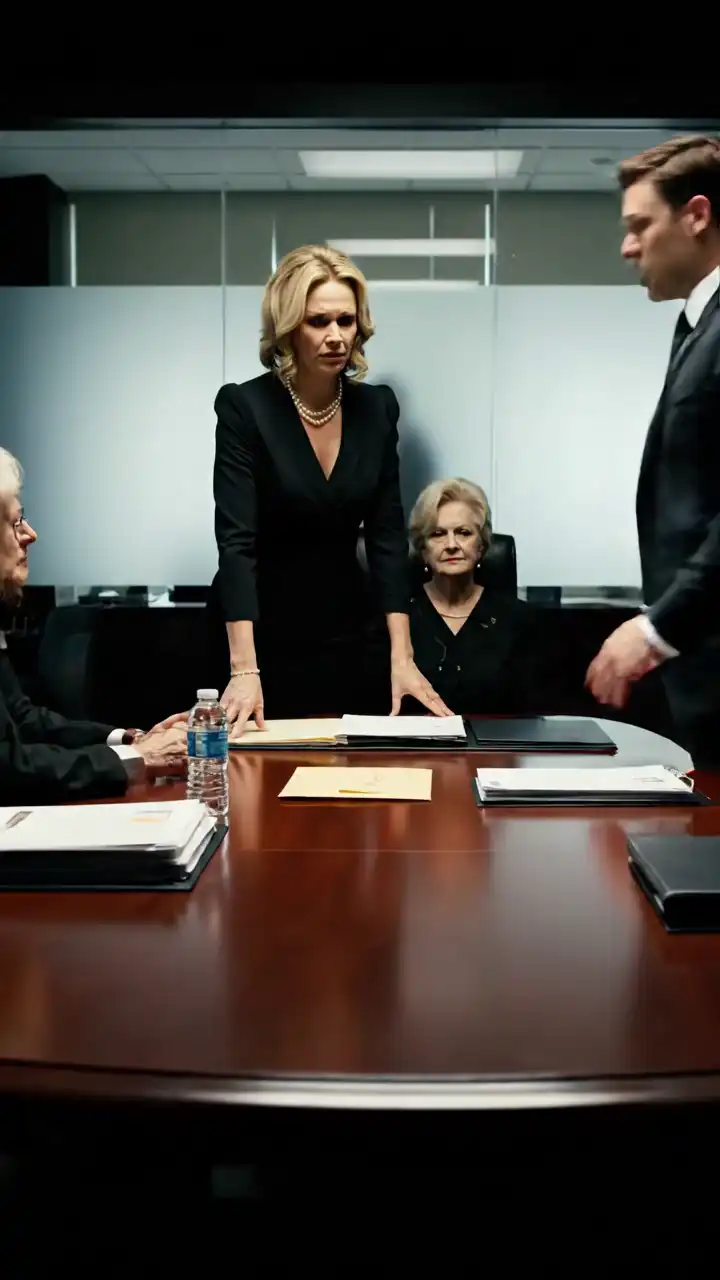
HE CALLED ME A THIEF IN THE CONFERENCE ROOM WHILE I WAS STILL WEARING HIS SONS RING
Chapter 1
The sealed envelope slid out of my purse and onto the polished conference table right when my son-in-law pointed at me and said, “Don’t let her leave with anything.”
Every head in the room turned.
I can still hear the soft slap that envelope made against the walnut table at Hensley Pike Law Offices in Marrow Ridge, Kentucky. It landed between the bottled water, the silver speakerphone, and the stack of papers no one had invited me to touch. My late husband’s wedding ring felt suddenly heavy on my finger. The room smelled like coffee gone stale and the lemon cleaner they used too early in the morning.
My daughter’s husband, Brent Kessler, stood at the far end of the table in a pressed blue shirt with his jaw set so tight it looked painful. He wasn’t shouting. That made it worse. It made him sound certain.
“She’s been going through files,” he said. “I saw her by Dad’s cabinet. Now there’s an envelope in her purse.”
I opened my mouth, but my mother-in-law beat me to it.
“Lorraine,” Odessa Kessler said, in that quiet church voice that always carried farther than a yell, “if there is anything belonging to this family, put it back on the table.”
I looked at her and forgot how to breathe for a second.
For eleven years, I had called her Mama Odessa. Through pregnancies, funerals, Sunday suppers, broken pipes, and one hard winter when we all shared groceries from one pantry, she had never spoken to me like I was a stranger. But my husband, Caleb, had been dead for eight months, and grief had turned every room in that family into a place with new rules.
“I didn’t steal anything,” I said.
It came out thin. I hated that.
Outside the glass wall of the conference room, two receptionists had gone still. A young paralegal carrying folders slowed down enough to stare. Brent’s sister, Fallon, crossed her arms and shifted against the wall like she had been waiting for this exact moment.
Brent reached for the envelope before I did. I put my hand on it first.
“Don’t,” I said.
That made the room tighten.
“There,” Fallon snapped. “Why would she say don’t if it isn’t hers?”
Because it wasn’t mine. Because it also wasn’t his. Because the person who gave it to me told me not to let Brent see it first.
But I couldn’t say that yet, not without blowing open something I had barely begun to understand myself.
Attorney Millie Voss, a spare woman with silver-blond hair cut sharp at the chin, held up a hand. “Everyone sit down.”
No one did.
I stood at the side of the table in the same black cardigan I had worn to church and probate meetings and too many mercy dinners. I knew what I looked like to them: widow, uncertain, carrying a sealed envelope into a legal meeting about property and business holdings after months of rumors that Caleb had wanted to make changes before he died.
Rumors I had never fed.
Rumors Brent clearly had.
“This meeting was to review the transfer schedule for Kessler Farm Supply and the trust distributions,” Millie said. “Not to stage accusations.”
Brent gave a humorless laugh. “That depends what she brought in here.”
He kept saying she. Not Lorraine. Not Caleb’s wife. Just she, as if I had become a problem to manage.
I pressed my palm over the envelope. My hand was trembling hard enough for the paper under it to quiver. I wished Caleb were there. Then, because that wish had nowhere to go anymore, I wished I were invisible.
I had not wanted to come to that meeting in the first place. After Caleb’s stroke, after the hospital nights at Mercy Vale Medical Center, after signing papers while his right hand lay still in the blanket, I had learned the danger of rooms where everyone speaks in calm voices and no one says the one thing that matters. He had died before he could straighten out several accounts tied to the family business. Since then, every “discussion” had been about timing, fairness, interpretation, memory.
Never truth.
My phone vibrated in my purse. I already knew who it was before I checked.
Tessa Boone.
I had ignored her first three calls that morning because Tessa always sounded like trouble arriving in practical shoes. She had been my closest friend since before I married Caleb, and she was the only person who knew why I had that envelope.
At 8:12 a.m., she had knocked on my kitchen door in the Maple Brake subdivision with rain on her shoulders and said, “Don’t open this in your house.”
Then she had pressed the thick sealed envelope into my hands.
“What is it?”
“Something Ellis found in storage at the old South Annex office,” she said. Her brother Ellis did maintenance for half the businesses in town, including Kessler Farm Supply. “It has Caleb’s handwriting on the outer sleeve. And Lorraine—Brent was asking around about missing files yesterday.”
I stared at the envelope then, too. Heavy cream paper. My husband’s blocky handwriting in blue ink: FOR REVIEW IF I DONT MAKE IT TO THE MEETING.
A punch of cold went through me.
“What meeting?”
Tessa shook her head. “I don’t know. But listen to me. Don’t let Brent get his hands on it before a lawyer sees it.”
Now, standing in that conference room with Brent’s eyes on me, I heard Tessa’s words again like a second pulse.
“Lorraine,” Odessa said, “you are making this uglier.”
I looked at her face and saw not just anger but fear. That unsettled me more than Brent’s accusation. Odessa had always feared one thing above all others: public shame.
“This envelope was given to me this morning,” I said. “I brought it here because I thought it might matter.”
“Convenient,” Fallon muttered.
Brent leaned over the table. “Open it.”
Millie stepped closer. “If the document is relevant, I will review it.”
“No,” Brent said quickly. Too quickly. “We all get to see what she’s been hiding.”
There it was. Not just suspicion. Urgency.
I turned to Millie. “Can you tell me honestly whether I should hand this over in front of everyone?”
She met my eyes. In that room full of heat and history, hers were the only steady ones.
“Legally?” she said. “Yes, if it concerns the estate or the company. Wisely? I’d like to know where it came from first.”
“Storage at South Annex,” I said. “Found this morning.”
Brent’s face changed just enough for me to catch it. A flicker. Something near alarm. Gone in a blink.
I saw it. So did Millie.
And just like that, the room shifted from me being a widow who might have crossed a line to a widow standing near a line somebody else desperately did not want crossed.
Before I could speak again, the conference room door opened.
Tessa Boone stood there in a rust-colored raincoat, damp curls plastered to her forehead, one hand braced on the frame.
“Don’t let him touch that envelope,” she said.
No one invited her in.
She walked in anyway.
Chapter 2
The whole room stared at Tessa as if she had tracked mud onto a church carpet.
Her raincoat dripped lightly onto the conference room tile. She didn’t apologize. Tessa had spent forty-six years in Marrow Ridge being underestimated by people in better shoes, and she had built a personality out of not caring.
Brent looked furious. “This is a private family meeting.”
Tessa shut the door behind her. “Then maybe your family should stop conducting business through unlocked storage rooms.”
Millie Voss straightened. “And you are?”
“Tessa Boone. Lorraine’s friend. My brother found the envelope while cleaning out the old annex file cabinets. He called me because Caleb’s name was on it and because Brent had just told him to report any folders marked legal directly to him.”
Brent gave a cold smile. “That’s called protecting company records.”
“No,” Tessa said. “That sounded more like hunting.”
The word hung there.
I wanted to disappear and hug her at the same time.
Odessa sat down first, very slowly, which somehow made everyone else follow. Chairs scraped. Water bottles clicked. The air-conditioning hummed overhead. Through the glass wall, the receptionist pretended to type while watching every second.
I remained standing because I didn’t trust my knees.
Millie held out her hand toward me. “Let me see the exterior.”
I slid the envelope to her. Brent moved forward again, and this time Odessa caught his sleeve.
“Sit down,” she said.
He did, but his eyes never left that paper.
Millie read the front silently, then aloud. “For review if I don’t make it to the meeting.”
Fallon let out a sharp breath. “That could mean anything.”
“It could,” Millie said.
She turned the envelope over. The flap was sealed with old adhesive, yellowed at the edge. No signs of tampering. On the back was a second line in Caleb’s handwriting, smaller and more hurried.
M VOSS ONLY IF CONFLICT
Millie’s eyes lifted.
I felt heat rise up my neck. “I hadn’t seen the back.”
“Of course you hadn’t,” Brent said. “Because apparently you didn’t open it.”
“No,” I said, and for the first time my voice came out clear, “I didn’t.”
He looked irritated by that.
Millie set the envelope on the table in front of her but didn’t open it yet. “If Caleb intended this for counsel only in the event of conflict, I’m the appropriate person to review it.”
“Then review it,” Brent said. “Right now.”
Tessa folded her arms. “You sound nervous.”
He turned on her. “You don’t belong here.”
“Neither does a lie,” she said.
That was when my daughter, Maren, finally came in.
She had been down the hall on a call with a lender, which I knew because she still held her phone in one hand and her yellow legal pad in the other. Her hair was twisted into the loose knot she made when she was stressed. The minute she took in the room—my face, Tessa’s raincoat, Brent’s posture, Odessa sitting stiff and white around the mouth—her expression dropped.
“What happened?”
No one answered immediately.
Then Fallon did what Fallon always did. She supplied the ugliest version first.
“Your mother brought a secret envelope into the estate meeting, and nobody knows what she was doing with it.”
Maren looked at me. Not at Fallon. Not at Brent. At me.
“Mom?”
That one word hurt the most.
Because it wasn’t accusing. It was scared.
I had raised my daughter to trust me. Yet there we were in a conference room where even her husband was positioning himself on one side and me on the other, and all she had to go on was what the room looked like.
“I was given it this morning,” I said. “I brought it here because it has your dad’s handwriting on it.”
Brent gave a little scoff. “After keeping it in your purse.”
Maren turned to him. “Would you stop?”
He blinked like he hadn’t expected resistance from her in public.
Millie touched the envelope with two fingers. “Before I open this, I need one thing clear. Has anyone else seen the contents?”
“No,” I said.
“No,” Tessa said.
Brent didn’t answer.
Millie noticed. “Mr. Kessler?”
“I said no.”
But he said it too late.
That tiny pause settled over me like dust after a shelf collapses. Small, but impossible not to see.
Maren saw it too. I watched her body go still.
“Brent,” she said quietly, “what pause was that?”
He looked offended. “Seriously?”
No one spoke.
He spread his hands. “I’m being attacked because I’m trying to keep this company from turning into chaos. Caleb died without finalizing three operating transfers and half a dozen property notes. Since then, every person in this family has had an opinion. Yes, I tried to locate documents. Somebody had to.”
Millie nodded once. “Locating is not the same as suppressing.”
His jaw jumped.
For months after Caleb’s death, I had avoided putting words to the change in Brent. At first I told myself he was grieving too. He had worked beside Caleb at Kessler Farm Supply for seven years and liked to talk as if he were the natural son Caleb never had, even though Caleb had never lacked for daughters. Then I told myself pressure was making Brent sharp. Business debt. Equipment leases. Fuel costs. The old feed warehouse roof. But pressure alone doesn’t create a look like the one on a man’s face when a sealed envelope from a dead man appears in front of him.
It reveals something that was already there.
Maren set her legal pad on the table. “Open it, Millie.”
Odessa closed her eyes for a moment. “Please let this not be another humiliation.”
I almost laughed at the cruelty of that sentence. Not because Odessa meant it cruelly. Because she still thought the humiliation to be avoided was the family’s. Not mine. Not Caleb’s memory. The family’s reputation in town.
Millie slid a letter opener from her leather portfolio and slipped it under the flap.
The room went so quiet I could hear the receptionist’s printer outside.
Then Millie stopped.
“There’s more than one item in here,” she said. “A letter, at least one legal document, and—”
She angled the contents.
“A flash drive.”
Brent pushed back from the table hard enough to rattle his chair. “This is ridiculous.”
“Sit,” Odessa said again.
He didn’t. “No. If this is some setup—”
“By a dead man?” Tessa asked.
He turned red.
Millie removed the first page carefully. Her eyes moved across it. She went back to the top and read again, slower.
Whatever she was seeing, she had not expected it.
“Read it,” Fallon said.
Millie’s expression hardened. “I will review all materials before discussing contents.”
Brent slapped his palm on the table. “That’s not acceptable.”
“Actually,” Millie said, without raising her voice, “it is exactly acceptable. And if you continue interrupting, I will ask building security to remove you from your own meeting.”
The receptionist outside definitely stopped pretending not to watch.
Maren stared at her husband. “Why are you acting like this?”
He ran a hand over his mouth. “Because your mother has been circling this estate for months and now suddenly a mystery packet appears with Dad’s handwriting? You want me calm?”
Dad.
He called Caleb Dad when it benefited him.
I sat down then because my legs finally gave up pretending. The leather chair was cold through my skirt. I folded my hands in my lap to hide their shaking.
Millie scanned another page. Then the flash drive. Then the signature line on what looked like an affidavit.
Her face changed.
Not shock exactly. Recognition mixed with dread.
“Ms. Boone,” she said, “who else knows this was found?”
“Just Ellis, me, and Lorraine.”
“No one else?”
Tessa shook her head. “Not unless somebody was already looking for it.”
Brent let out a breath through his nose. “This is absurd.”
Millie put the papers back into the envelope, but not before I caught two words upside down on one page.
Transfer hold.
The room tilted for a second.
Because Caleb had used those exact words one night in the hospital, when the monitors glowed blue and green and his speech had started slipping around the edges.
“Hold the transfer,” he had whispered.
I leaned close. “Which transfer?”
His fingers moved weakly over the blanket. “Not Brent.”
I had thought he meant not now. Or maybe not with Brent in the room. He’d been exhausted. Drugged. Frightened. I had kissed his forehead and told him we could talk in the morning.
There had been no morning clear enough.
Now I looked up at my son-in-law and felt, for the first time, the shape of something truly ugly moving under all our grief.
Chapter 3
Millie suspended the meeting “pending document review,” which sounded formal enough to quiet the room but solved nothing.
No one really left.
They drifted into corners and doorways, into low arguments and rigid silence, all within sight of that glass-walled conference room on the second floor. Rain had stopped outside, leaving the parking lot slick and bright. The gold letters on the office door reflected backward in the glass so that HENSLEY PIKE looked ghostly and reversed behind us.
Maren followed me into the smaller side room where clients usually signed papers in private. It had one framed print of a horse pasture, a ficus in the corner, and a box of tissues placed with such obvious intent it irritated me.
She shut the door. “Mom, tell me everything.”
I wanted to protect her.
That instinct had lived inside me since the first time I held her, slippery and furious and pink-faced at Cresswell County Hospital. It had survived divorce from her father, remarriage to Caleb, the years she swore she didn’t need me, the years she suddenly did again, and every one of the six months after Caleb’s funeral when I sensed Brent steering conversations away whenever money, signatures, or old files came up.
But daughters grow up. Protection changes shape. Sometimes truth is the only thing left to hand them.
“Tessa came by this morning,” I said. “Ellis found the envelope in storage. He thought Brent had been looking for legal folders. Tessa told me not to open it in the house.”
Maren’s eyes filled, but she blinked the tears back. “Why didn’t you tell me right away?”
“Because I didn’t know what it was, and because the minute Brent saw it, he accused me in front of everyone.”
“I know.” She looked down. “I should’ve come in stronger.”
“You came in scared.”
She nodded once.
I studied her face. She looked tired in a way that had become familiar over the past year. Not just grief-tired. Marriage-tired. Cautious in her own skin. There had been signs. Brent checking in too often. Brent speaking for her. Brent joking about how she forgot figures unless he repeated them. Little things respectable people overlook because they are packaged as concern.
“Are you okay?” I asked.
“Right this second?”
“In general.”
Her mouth trembled. “I don’t know anymore.”
That answer hit me harder than any accusation in the conference room.
Before I could say more, a knock came at the door. Not Brent. Not Millie. Odessa.
My mother-in-law entered without waiting, carrying herself as if posture alone could hold her life together. Her pearl earrings looked too formal for the strain in her face.
“Maren,” she said softly, “would you give me a minute with Lorraine?”
Maren hesitated. “Grandma—”
“Please.”
Maren looked at me. I nodded. She stepped out, though not happily.
Odessa closed the door and remained standing. For a few seconds she only stared at the ficus, as if speaking to a plant might be easier than speaking to me.
Finally she said, “If there is something ugly in those papers, I need to hear it from you before it destroys what remains of this family.”
I laughed then. A dry, cracked sound that surprised both of us.
“You think I’m the one carrying destruction into the room?”
Her eyes flashed. “Don’t be cruel.”
Cruel. The word settled badly between us.
“I’m not being cruel,” I said. “I’m being blamed.”
She sat down across from me with a tired exhale. “You think I don’t know what that feels like? I buried a husband and then a son. The town watched me come to church in black twice in seven years. People count what is left of you with their eyes.”
I softened despite myself. Odessa had lost her husband, then her only son. Pain had sharpened her, but it had also hollowed places in her no one could see.
She folded her hands over her handbag. “I need you to answer me plainly. Did Caleb ever tell you he planned to change the business transfer?”
I thought of that hospital room. The dry heat. The plastic cup with untouched ice chips. Caleb trying to force words around weakness and urgency.
“He tried,” I said. “But he couldn’t finish it.”
Odessa’s gaze dropped.
“Did he tell you why?”
“No.”
That was the worst part. I had fragments. A warning, not an explanation. Instinct, not proof.
Odessa looked up again. “Then you understand why Brent believes—”
“No,” I said. “I understand why Brent wants everyone to believe.”
She flinched.
I hadn’t meant to speak so hard, but once it came out I couldn’t stop.
“He didn’t accuse me because he was protecting the company. He accused me because he was afraid of what was in that envelope.”
“You don’t know that.”
“I know what fear looks like.”
That landed. Odessa’s mouth tightened.
For years she had ruled her family through gentleness edged with steel. She cooked for grief, paid for braces quietly, sent birthday checks with scripture verses, and made all important disapproval sound like concern. But she had one fatal habit: if a man stood up straight and spoke confidently, she often mistook control for competence.
She had done it with her husband. Sometimes with Caleb. And lately, I feared, with Brent.
The door opened again before she could answer. Fallon stepped in, not bothering with politeness.
“Millie wants everybody back in the conference room.”
Odessa rose. Fallon looked at me with open dislike.
“You really should’ve thought this through better,” she said.
I stood slowly. “Thought what through?”
“However you planned this.” She shrugged. “People talk, Lorraine. Everybody knows Caleb doted on you. Everybody knows you were with him at the end. If papers suddenly appear that help you and hurt the rest of us, what do you think it looks like?”
There it was. The wrong-looking thing. Not just widow in a legal room. Widow who must have manipulated a dying man.
I felt something cold settle in me.
Caleb had been twenty years older than I was. When we married, people in Marrow Ridge whispered anyway. I had been thirty-seven, working reception at a veterinary clinic on Crestline Road, with one daughter already half grown and a divorce that had burned through my savings. He had been kind in a plain, steady way that never needed witnesses. He repaired fence posts for neighbors without charging them. He brought me seed catalogs because I once mentioned liking zinnias. He listened.
Some people called it love. Some called it convenience. A few never stopped calling me lucky.
Now, in one sentence, Fallon had reduced eleven years of marriage to influence at a bedside.
Odessa said sharply, “Fallon.”
But Fallon was already committed. “No, Mama, let’s just say it. We all watched her become everything around Caleb. His appointments, his meals, his pills, his signatures. You expect us not to wonder?”
I walked past her and opened the door.
“You can wonder,” I said. “But don’t confuse your wondering with proof.”
Back in the conference room, the chairs had shifted. Brent was at the window speaking low into his phone. He ended the call the second he saw me. Millie sat with the envelope contents spread in neat rows before her and a laptop open beside the flash drive. Tessa leaned against the wall near the coffee station like a woman prepared to stay all day if necessary.
Maren had taken a seat two chairs away from Brent.
Not beside him.
That small distance caught my eye before anything else.
Millie folded her hands. “I’m going to summarize what I can confirm so far.”
Brent sat. “Finally.”
She ignored his tone. “The envelope contains three relevant items. First, a signed letter from Caleb Kessler addressed to me in the event he did not survive his medical decline before a scheduled transfer meeting. Second, a notarized directive instructing a temporary hold on any transfer of controlling operational authority in Kessler Farm Supply pending review of certain financial irregularities. Third, a flash drive containing accounting exports and recorded notes.”
Silence.
Then Brent laughed once, sharp and disbelieving. “Recorded notes?”
“Yes.”
“That could be anything.”
“It could,” Millie said. “Which is why I checked metadata. The files were created across a six-week period before Caleb’s stroke and copied to that drive two days before he was hospitalized.”
My heart pounded so hard it made my fingertips numb.
Fallon spoke first. “Financial irregularities involving what?”
Millie looked at Brent.
He looked back at her without blinking. “Say it.”
Millie did.
“Unauthorized diversions from a company operating line into a private account tied to B K Agricultural Logistics.”
Maren went pale. “That’s Brent’s side company.”
He turned to her instantly. “It’s not my side company. It was an expansion vehicle your dad knew about.”
Millie’s voice remained flat. “Then you should have no difficulty proving authorization.”
Odessa had gone very still. “Brent?”
He leaned forward, suddenly all injured professionalism. “This is exactly what I’ve been warning about. Caleb got confused toward the end. He was suspicious of everybody. He heard half a conversation and started documenting nonsense.”
“He was not confused,” I said.
Brent cut me off. “You would say that.”
Tessa pushed off the wall. “Because it’s true.”
He snapped at her. “Stay out of family business.”
She stepped closer. “You made it public when you called a widow a thief in a conference room.”
That line silenced even Fallon.
Maren looked from her husband to Millie. “How much money?”
Millie answered carefully. “The documents reference just over three hundred twelve thousand dollars moved in segments over eleven months.”
Odessa made a sound I had never heard from her before. Small. Broken.
Brent spread his hands. “Operating reallocations. Temporary. We all benefited from keeping things fluid.”
“Who is we?” Maren asked.
Her voice had changed. It was very quiet now, and because of that, everyone heard it.
“Who is we, Brent?”
He looked at her with what was supposed to be calm. “Your father knew margins were tightening. I was trying to protect the company.”
Millie tapped the letter. “Caleb’s written statement says he confronted you privately and that you denied moving funds beyond approved channels.”
Brent’s face hardened. “He misunderstood.”
“Then why,” Millie asked, “did you try to intercept legal folders in storage yesterday?”
No one moved.
Brent looked around the room as if measuring who might still stand with him.
That was when I realized something worse than greed might be sitting under all of this.
Desperation.
And desperate people do not unravel cleanly.
Chapter 4
Millie asked for a brief recess before accessing the audio files on the flash drive. She said it was prudent. She said everyone needed a moment. What she meant was: if this gets worse, I want witnesses sitting down.
No one argued.
The conference room emptied into the hall again, but now the tension had changed. Before, people watched me. Now they watched Brent. Even the receptionist’s pity had moved off me and landed somewhere else.
He paced near the windows overlooking Court Street, phone in hand, not calling anyone now. Just gripping it. Maren stood by the copy machine with her arms wrapped around herself. Odessa sat on a bench under a framed map of Cresswell County, staring at nothing. Fallon whispered angrily to her husband Dean, who had arrived halfway through the meeting and was still trying to catch up.
Tessa handed me a cup of vending machine coffee.
“It’s terrible,” she said.
I took it anyway. “Thank you.”
She lowered her voice. “You all right?”
“No.”
“Good. Means you’re still paying attention.”
That almost made me smile.
Across the hall, Brent looked up and caught us talking. He came straight over.
“Can I speak to Lorraine alone?”
“No,” Tessa said.
He ignored her and looked at me. “Please.”
There was something new in his face. Not softness. Calculation, stripped of polish.
I should have refused. Instead, I nodded toward an empty records room with the door ajar. Maybe some part of me still wanted to hear him explain himself into something less ugly.
Tessa touched my elbow. “Door stays open.”
Brent gave her a look of disgust but said nothing.
Inside the records room, metal shelves lined the walls, half-filled with labeled bankers boxes. Dust and paper and old toner hung in the air. The fluorescent light buzzed overhead. Brent stayed near the doorway, perhaps because Tessa had meant what she said.
He kept his voice low. “You need to stop this before it gets out.”
I stared at him. “You think I started it?”
“You brought the envelope.”
“I brought your father-in-law’s words into a room where they belonged.”
He exhaled hard. “You don’t understand business.”
“No,” I said. “I understand panic.”
His eyes flashed. “I moved money, yes. Temporarily. Caleb was old-school. He didn’t know how to scale. Every growth decision felt like betrayal to him.”
“Into your private account?”
“Because I had to move fast.”
I almost laughed from disbelief. “You call that a growth decision?”
He dropped the polished tone. “Do you know what was happening six months before he died? Equipment notes stacking up. Fertilizer contract penalties. The Boone Creek expansion bleeding cash. I covered gaps any way I could. Once the spring accounts landed, I was going to settle it.”
“And he found out.”
Brent looked away.
That was answer enough.
“Did Maren know?” I asked.
“No.”
A dull ache opened in my chest for my daughter.
“Then you lied to her too.”
He rubbed his forehead. “I was handling it.”
“You were hiding it.”
“Same difference if it gets fixed.”
“That’s not true and you know it.”
For the first time, fear pierced his anger. “If this turns into an investigation, we lose lender confidence. Vendors hear about it, they tighten terms. Employees panic. The company can fold over perception before facts are even sorted.”
“Then you should’ve thought about that before you called me a thief.”
His mouth thinned. “I said that because you left me no room.”
The sheer wrongness of that sentence took my breath for a second. He had accused me publicly and then reframed it as my doing. I had seen men do that before. My first husband had been a smaller version of the same breed—never openly monstrous, just steadily rearranging the truth until your own memory had to ask permission to breathe.
“Listen to me,” Brent said. “If you tell Millie you misunderstood the envelope’s importance and ask for a private accounting review, we can contain this.”
“We.”
“Lorraine—”
“No.”
He stepped closer. “Think about Maren.”
“I am.”
“Then think harder.” His voice dropped to a whisper. “Because if the company takes a hit, she takes a hit. The house. The school tuition for Ava. The lines of credit. All of it.”
There it was. Not a plea. A threat dressed as realism.
My granddaughter’s name hanging in a dust-filled records room.
I felt my spine straighten.
“Don’t use my granddaughter to bargain with me.”
He held my gaze a second too long, then leaned back as if he hadn’t said anything improper at all. “I’m telling you the consequences.”
Tessa’s voice came from the doorway. “And I’m telling you I heard enough.”
Brent swore under his breath and walked past us into the hall.
When we returned to the conference room, Millie already had the flash drive files loaded onto her laptop and patched into the room speaker. Everyone was seated. Even Dean looked tense now. Rainlight washed the glass a dull silver.
Millie folded her glasses and set them down. “Before I play the first file, I want to state for the record that if these materials are authentic, then this matter extends beyond family inheritance. It concerns fiduciary misconduct and possible fraud.”
Odessa closed her eyes.
Brent spoke with forced calm. “Play it.”
A click. Static. Then Caleb’s voice filled the room.
Thin, tired, but unmistakably his.
“If this is the version Millie hears,” he said on the recording, “then I did not get enough time.”
My hand flew to my mouth.
Maren made a strangled sound. Odessa gripped the edge of the table.
The room changed in one instant from legal conflict to haunting. Death sat down among us.
Caleb went on, pausing sometimes as if catching breath.
“This is Caleb Kessler. Date is May twelfth. I am recording because I have concerns I do not want dismissed as confusion if my health gets worse.”
A rustle of fabric. A cough.
“Brent says the transfers are procedural. They are not. I asked for source support on two vendor reroutes and got delays, then partial printouts. I believe money has been moved through his logistics entity without proper approval.”
Brent looked at the table.
Maren was crying silently now, one hand against her lips.
Caleb’s voice softened for a moment. “If I’m wrong, I’m old and embarrassed. If I’m right, do not let pressure replace proof.”
I closed my eyes.
That was Caleb exactly. Plain. Humble. Careful not to accuse beyond what he could support. Even in fear, he left room for being wrong.
Millie played a second file.
This one was shorter, more strained.
“Lorraine doesn’t know all this,” he said. “I didn’t want her carrying it before I had records clean. If I don’t get there, don’t let anybody use her grief to cover for what was done.”
Across the table, Brent went white.
I opened my eyes and stared at him.
Everything in the room rearranged itself around that sentence.
Not just the money. Not just the transfer hold.
Caleb had anticipated the shape of the lie. He knew someone might let me take the blame because widowhood is soft-looking from a distance. Easy to lean on. Easy to stain.
Fallon whispered, “Oh my God.”
Millie let the silence sit. She was wise enough not to talk over the dead.
Then she opened the scanned accounting files. Even to my untrained eye, the pattern was visible. Repeated transfers. Round figures. Short-term routing through B K Agricultural Logistics. Some returned. Some not. Notes attached to internal ledger lines that had later been altered.
Dean muttered, “Brent, what the hell is this?”
Brent finally lifted his head. “You all act like there’s context in a spreadsheet.”
Maren turned toward him with tears still on her face. “Then give it.”
He looked at her, and for one suspended second I think he considered telling the truth. A full one. The kind that comes out ugly and complete.
But fear got there first.
“I was covering for your father,” he said.
The room erupted.
“What?” Odessa said.
Brent pushed on, grabbing at the lie as it formed. “He had side obligations you people don’t know about. He asked me to smooth cash flow and keep it off the books until after the spring valuation. He didn’t want Mama upset.”
Odessa recoiled as if struck.
I stood before I realized I was moving. “Don’t.”
My voice cracked through the room.
Brent looked at me with a strange mix of rage and triumph, as if he had found the dirtiest possible place to throw mud and had decided to do it anyway.
“He wasn’t as clean as everybody thinks.”
“Don’t,” I said again, louder. “You do not get to rewrite him because you are cornered.”
Maren whispered, “Brent, stop.”
But he kept going. “Ask her. Ask Lorraine how much private time she had with him at the end. Ask what papers she handled. Ask why he’d leave secret messages instead of doing things properly if he wasn’t already tangled in—”
Odessa stood.
In all the years I had known her, I had never seen her stand in anger without trembling.
Now she did.
“That is enough.”
Even Brent stopped.
Her voice was low and raw. “You accused this woman of theft in public. You moved money without authority. And now, when my son’s own voice warns us, you put filth in his mouth to save yourself.”
He tried to answer. “Mama, I—”
“No.”
The word cut like a blade.
For the first time all day, Brent looked like a man who understood he might truly be alone.
Chapter 5
If the story had ended there, people in Marrow Ridge would still have talked for years.
The son-in-law exposed in the conference room. The dead man’s voice on a speaker. The widow vindicated. It would have been enough for most families. Enough scandal, enough pain.
But truth is rarely satisfied with one layer.
Millie asked everyone to remain seated while she reviewed the final item in the envelope: the signed letter addressed to her. She had skimmed it before, but now she read it fully, lips tightening as she moved through the pages. When she finished, she set it down with extraordinary care.
“There is more,” she said.
The room had become so exhausted it almost failed to react.
Brent let out a harsh laugh. “Of course there is.”
Millie looked at me first, and that frightened me more than anything yet. “Lorraine, I need to ask: did Caleb ever mention updating his will in the weeks before his stroke?”
“No.”
Odessa turned sharply toward me.
Millie continued, “This letter states that Caleb intended to execute revised estate documents at a meeting that never happened. He believed there was active pressure around both the company and certain personal assets. He did not complete the revision before hospitalization. However, he attached instructions and a signed memorandum that affect interpretation of the existing trust.”
Fallon frowned. “What personal assets?”
Millie took a slow breath. “The house on Larkspur Road. The farm acreage east of Boone Creek. And the life insurance carve-out.”
I stared at her.
The room blurred at the edges.
The house on Larkspur Road was mine and Caleb’s home. The one with the porch swing he reinforced every spring because he said I leaned too hard on one side. The Boone Creek acreage was the tract Brent had been pushing to leverage for expansion loans since before Caleb got sick.
Maren looked from Millie to Brent. “What pressure?”
Millie opened the letter again. “Caleb writes that Brent repeatedly urged him to accelerate authority transfers and use the Boone Creek acreage as collateral through a structure Caleb believed would place family property at unnecessary risk. He further states that if conflict arose after his death, he wanted Lorraine’s housing security protected first and operational control delayed until a full audit was conducted.”
Brent swore.
Odessa’s face had gone ashy.
“You mean,” Dean said slowly, “Caleb tried to block Brent from taking control.”
“Yes,” Millie said.
“And the house?”
Millie nodded. “Under the current trust, Lorraine has lifetime occupancy, but there are clauses that allow pressure through maintenance burden and debt allocation. Caleb’s memorandum directs counsel to petition for conversion of that occupancy into protected ownership if misconduct related to the estate or company is confirmed.”
Nobody spoke.
What I felt then was not triumph.
It was grief, pure and hot and late.
Because Caleb had known. He had known enough to try to protect me after he was gone. He had known enough to put it in writing when his body was failing him. And I had not understood him in time.
I pressed my hand over my mouth and looked down at his ring on my finger.
Maren whispered, “He was trying to save Mom from us.”
“No,” I said hoarsely. “From pressure.”
But even as I said it, I knew pressure had a face. Sometimes several.
Brent pushed his chair back. “This is insanity. A memo is not a will. Half of this is precaution language. You can’t just hand her property because he was paranoid.”
Millie’s voice cooled another degree. “No one said hand. I said petition. And your use of the word paranoid in reference to a man whose suspicions are materially supported is unwise.”
“Materially supported by partials and recordings curated by—”
“By your father,” Maren said.
He whipped toward her. “He was not my father.”
The room went dead.
There are sentences that expose more than confession. They reveal loyalty’s true shape when panic strips the disguise away.
Maren looked at him as if she had never seen him before.
“You called him Dad for seven years,” she said.
He opened his mouth, then shut it.
Her voice trembled but did not break. “At his funeral. In front of Ava. In front of everyone.”
Brent’s face changed from anger to something more naked. “Maren—”
“No. Don’t say my name like that.”
Odessa sat down very carefully, one hand pressed to her chest.
Tessa moved closer to her, and to my surprise Odessa let her.
Millie tapped the second page of Caleb’s letter. “There is one more matter. Caleb writes that he believed someone inside the family was sharing selective information about his decline and legal uncertainty in order to increase pressure before documents were finalized.”
Everybody’s gaze turned instinctively toward Brent.
But Millie did not stop there.
“He was not certain who.”
Now all the air seemed to leave the room at once.
Fallon looked stunned. “You think there was somebody else?”
“I think Caleb did,” Millie said. “And I think we should all be very cautious before simplifying this.”
That hit Odessa differently than the rest. Her eyes flicked, just once, toward Fallon. Then away.
I saw it.
So did Fallon.
“Mama?”
Odessa’s mouth trembled. “I only told Brent Caleb was delaying again. I thought—”
Fallon stared. “What do you mean, you told Brent?”
Odessa folded inward in her chair. “He asked after every hospital visit. He said the lenders were anxious. He said Caleb trusted him with the future and only needed reassurance that things would stay on track.” She looked at me then, and the shame in her face was terrible. “I told him when Caleb was weaker. When he was too tired to review papers. I thought I was helping hold things together.”
No one blamed her out loud. We didn’t need to. She had already done it to herself.
Brent said quickly, “That proves nothing.”
“No,” Millie said. “But it explains access.”
Maren was still staring at her husband. “Did you marry me for this?”
He flinched as if she had struck him.
“No.”
“Then when did it become acceptable to use my family like inventory?”
“It wasn’t like that.”
“Wasn’t it?”
He looked around the room, searching for one sympathetic face. He found none.
Finally his shoulders dropped. Not in surrender exactly. More in fatigue. The kind that comes when a lie can no longer outrun the number of people holding it.
“I didn’t mean for it to go this far,” he said.
That sentence enraged me more than his shouting had.
Of course he hadn’t meant for it to go this far. People like Brent never do. They mean for just enough hidden money, just enough redirected authority, just enough pressure, just enough theater to keep everyone manageable. The damage only becomes visible later, when grief and trust and family are already split open.
Maren stood up. “I’m taking Ava to my apartment over the garage tonight.”
He blinked. “What?”
“I said I’m taking Ava.”
“You’re overreacting.”
She gave a broken laugh. “You accused my mother of stealing. You moved money behind my father’s back. You lied to me in front of his voice. What would the correct reaction look like?”
He had no answer.
Millie began organizing documents into separate folders. “Here is what happens next. I will file for an emergency hold on any pending authority transfer and notify the relevant financial institutions that internal questions are under review. A forensic accountant will be brought in. No one destroys records. No one contacts staff with explanations not reviewed by counsel. And no one removes property from the Boone Creek tract or the South Annex until instructed.”
Brent stood. “You can’t shut me out of operations.”
Millie met his stare. “Watch me.”
For a second I thought he might explode. Instead he turned and walked out of the conference room without another word.
No one followed him.
The door swung shut behind him with a soft click that felt louder than anything all day.
After that, the room seemed to sag under the weight of what had been said.
Odessa looked at me with eyes I had never seen so bare. “Lorraine,” she whispered, “I let them make you stand there alone.”
I wanted to say something gracious. Something noble. But pain is not always elegant.
“Yes,” I said.
She closed her eyes.
Then, after a long moment, I reached across the table and set my hand over hers anyway.
Because truth had landed, and it was heavier than pride.
Chapter 6
Three months later, the conference room at Hensley Pike looked smaller.
Maybe because this time no one was standing over me.
The audit had confirmed what Caleb suspected. Funds had been diverted through Brent’s logistics company, partially masked as temporary operating offsets and equipment bridge payments. There were enough records to force repayment actions and enough deceit to make lenders listen to Millie instead of Brent. Kessler Farm Supply did not collapse. It survived the way wounded things survive in small towns: slowly, publicly, with everybody pretending not to stare while staring anyway.
Maren filed for separation before the month was out.
That was not the ending I would have chosen for my daughter, but it was the truthful one. She moved into the apartment over the detached garage on Larkspur Road with Ava for a while, and every evening I heard my granddaughter’s feet above the kitchen ceiling like proof that not every broken thing leaves.
Odessa came to the house on a Tuesday with a pie she had clearly not baked herself.
We both noticed.
We both decided not to mention it.
She stood on my porch in a pale blue cardigan, clutching the dish with both hands. The zinnias along the walkway had finally come up, bright and shameless in the August heat.
“I don’t know how to do this properly,” she said.
“Neither do I.”
She nodded. “Then maybe improper is fine.”
We sat on the porch swing Caleb had reinforced and watched evening settle over the yard. After a while she said, “I kept thinking shame was the heaviest thing a family could carry.”
I looked out toward the road. “It isn’t.”
“No.” She swallowed. “Truth is heavier. But at least it doesn’t rot.”
That was as close to a sermon as Odessa had ever come without opening a Bible.
Inside the house, Ava laughed at something Maren said. The sound drifted through the screen door, light and quick. Odessa listened to it with wet eyes.
“I was wrong about you,” she said.
“Yes,” I said again, gentler this time.
She took that without flinching.
The legal process moved on in its own language—petitions, amendments, accountings, corrective filings. Caleb’s memorandum did what he had hoped it might. The court approved a restructuring of the trust protections due to confirmed misconduct tied to pressure against the estate. The house became mine outright. Not because I won something. Because he had tried, in the last clear stretch of his life, to make sure I would not be cornered after he was gone.
The day Millie handed me the finalized order, she said, “He was a careful man.”
I smiled through tears. “He was.”
The Boone Creek acreage stayed in the family but outside Brent’s reach. Dean stepped in temporarily with Millie’s oversight while Odessa, to everyone’s surprise, insisted on an independent manager instead of another relative. Fallout teaches some people nothing. It taught her enough.
As for Brent, people still ask in lowered voices what really happened, as if there must be one secret sentence that explains all betrayal neatly. There isn’t. He wanted more control than belonged to him, more money than was his, and more trust than he deserved. By the time anyone said no, he had already built a life inside everyone else’s assumptions.
That is how many disasters begin.
Late one afternoon in September, I went through the hall closet and found the black cardigan I had worn that day in the conference room. In the pocket was a folded sticky note with Tessa’s handwriting.
DON’T LET HIM TOUCH THAT ENVELOPE
I laughed so hard I had to sit down on the cedar chest.
Then I cried.
Not because I was weak. Not because I missed the humiliation. But because I remembered exactly how it felt to stand in that room with every eye on me, one sealed envelope under my hand, and no way to prove yet that the truth was on my side.
That is the hardest part of truth.
When it first arrives, it often makes you look guilty.
That evening, Maren came downstairs after putting Ava to bed. She found me at the kitchen table with the note in one hand and Caleb’s ring turned slowly with the other.
“You okay?” she asked.
I looked up at my daughter, at the tiredness still in her and the steadiness returning under it.
“Yes,” I said. “I think I finally am.”
She sat down beside me. Not across. Beside.
For a minute we said nothing.
Then she leaned her head on my shoulder the way she used to when she was small and storms rolled over Maple Brake at night.
“I’m sorry I didn’t speak faster that day,” she whispered.
I kissed the top of her head. “You came back to the truth.”
Outside, cicadas hummed in the trees. The kitchen light cast a warm square over the old table Caleb had sanded and refinished himself. It struck me then that grief had changed shape again. It was still heavy. It probably always would be. But it no longer felt like a room full of people deciding who I was without asking me.
It felt like a man’s careful handwriting on a sealed envelope.
A warning.
A protection.
A last act of love strong enough to outlive the worst misunderstanding.
And in the end, that was what remained.
Not the accusation in the conference room. Not the stare of strangers through glass. Not the betrayal dressed up as family business.
What remained was simpler and heavier than all of it.
The truth.
Disclaimer: Mention of any brand or trademark is for identification only and does not imply partnership or endorsement
MY HUSBAND USED MY MONEY, GOT ENGAGED TO HIS MISTRESS, AND STOOD THERE WHILE SHE SLAPPED ME

THE MAID OF HONOR POURED WINE ON ME AT MY BRIDAL SHOWER AFTER STEALING MY FIANCÉ. SHE DIDN'T KNOW THE ROOM WAS ABOUT TO HEAR WHAT HE'D BEEN SAYING TO BOTH OF US.

THE MAID OF HONOR POURED WINE ON ME AT MY WEDDING AND CALLED ME CRAZY. SHE FORGOT I STILL HAD THE VOICE NOTE SHE SENT MY FIANCÉ.