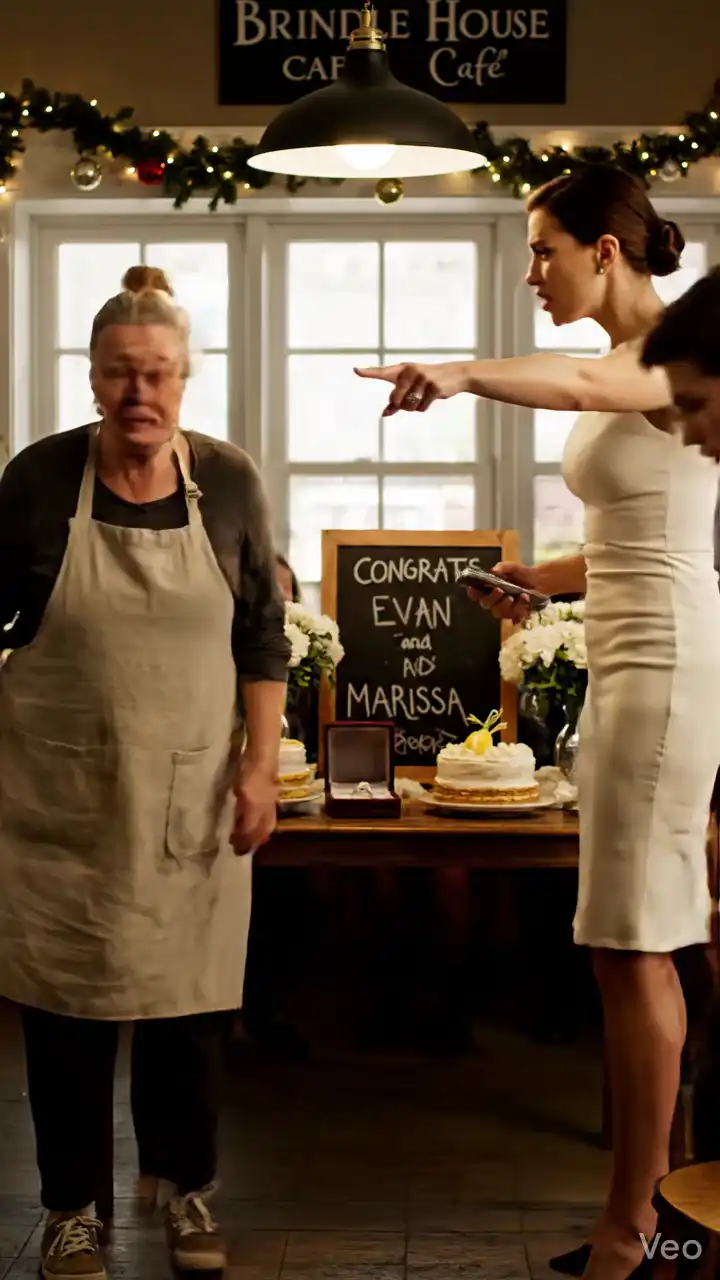
HE INVITED ME TO HIS ENGAGEMENT PARTY THEN LET THEM CALL ME THE OTHER WOMAN
Chapter 1
The first thing I saw was the ring box.
It sat open on the center table at Brindle House Café, catching the yellow light from the hanging bulbs like it had its own little stage. Around it were white flowers in mason jars, a tray of tiny lemon cakes, and a chalkboard sign that read CONGRATS EVAN AND MARISSA in looping gold marker.
Then my son’s fiancée pointed at me with one hand and held her phone in the other.
“She’s the woman from the messages,” Marissa said.
The whole café went quiet in the ugliest way. Not silent, exactly. The espresso machine still hissed in the back. Ice still rattled in somebody’s glass. But every face turned toward me so fast I felt it like heat on my skin.
I was still wearing my work apron from the morning shift at Dunley Linen Supply. I had rolled it down and tied it around my waist because I hadn’t had time to change. I had come straight from work because Evan said it mattered that I be there on time.
“Mom,” he had texted. “Please. Just show up tonight.”
So I had shown up.
And now thirty people were watching me stand by the pastry case with my cheap purse hanging from my shoulder and my son looking at the floor.
“I think you made a mistake,” I said, though my throat had gone dry.
Marissa took two fast steps toward me. She was beautiful in the clean, bright way some women seem to be beautiful even when they’re angry. Her dress was cream-colored, too close to bridal white for a party, and maybe that was the point.
“No,” she said. “I made a mistake trusting him. You’re not a mistake. You’re a secret.”
A few people drew in breath. Somebody near the window whispered, “Oh my God.”
I looked at Evan. My son was thirty-one years old, broad-shouldered like his father had been, with the same habit of pressing his lips tight when he was cornered. I had seen that face when he was twelve and broke a neighbor’s window. At nineteen when he dropped out of community college without telling me. At twenty-six when he lost a job and pretended for three weeks he was still going.
He still made that face when he lied.
“Evan,” I said quietly. “Say something.”
He rubbed a hand over his mouth. “Marissa, not here.”
“Here is perfect,” she snapped. “You picked here. You invited everyone here. You put a ring on my finger in front of all these people, then I found months of messages to a woman saved as L.”
Her eyes cut back to me.
“Lila.”
That hit the room harder than if she had slapped me.
Someone behind me made a small sound of disgust. One of Evan’s friends looked away. A woman I recognized from Marissa’s family folded her arms and stared right at my shoes.
I should say this now: my name is Lila Voss. I was twenty-two when Evan was born and twenty-three when his father walked out. I had been a single mother almost longer than I had been anything else. I learned to live with tiredness the way people live with weather. I learned not to explain my life unless I absolutely had to, because explanations from women like me always seemed to sound like excuses to people who had never missed rent by fourteen dollars.
So when Marissa said my name in that room, with judgment wrapped around it, I felt an old instinct rise in me.
Leave.
Take the humiliation and leave before it gets bigger.
But Evan had asked me to come. He had sounded strained on the phone. He had said, “I need you there, Mom,” and there had been something frightened under the words. I had heard it. That was why I came.
Marissa lifted her phone. “Do you want me to read them?”
“Stop.” Evan’s voice came out sharp enough to make everyone flinch.
For one second, I thought he was going to tell the truth.
Instead he looked at me with anger I did not deserve and said, “Why did you come?”
It was so cruel, and so cowardly, that I actually forgot to breathe.
A few heads turned from him back to me, and in that one motion I understood the shape of what he was doing. He wasn’t protecting me. He was placing me where the blow would land easiest.
My son was letting the room think exactly what Marissa thought.
I heard myself say, “You asked me to.”
“That’s not what I meant.” His voice was low, desperate. “I told you this was important.”
“It is important,” Marissa said. “Apparently she’s very important.”
Someone laughed under their breath, the mean kind of laugh people use when they think they already know the whole story.
Marissa’s thumb moved over her phone screen. “You want important? Here. ‘I miss you. I can’t do this without you. Don’t leave before I see you.’ That was sent three nights ago.”
My stomach dropped, not because of the words, but because I knew them. I had sent them. Every one.
Not to a lover.
To my son.
The blood rushed in my ears.
Evan looked at me then, finally, and I saw panic. Real panic. Not for me. For himself.
I understood at once that he had not told Marissa the truth about who L was in his phone. Maybe he had enjoyed the secrecy. Maybe he thought it made him look free, unattached in some emotional way. Maybe he had built parts of himself out of omission for so long that full honesty felt impossible.
But there was more in his face than embarrassment. There was fear.
Marissa took another breath to speak, and just then my phone started ringing in my purse.
The sound cut through the café like a spoon dropped on tile.
I almost didn’t answer. All those eyes. My shaking hands. The way humiliation makes the simplest movement feel staged.
But the caller ID said NORA JEAN.
My younger sister never called twice in a row unless something was wrong.
I pulled out the phone.
Marissa gave a short laugh. “Of course. Is that him too?”
“It’s my sister,” I said.
“Take it,” she said, folding her arms. “Maybe she knows what kind of woman does this to her own son’s—”
She stopped herself half a second too late. The word son hung in the air, unfinished but heard.
A few people frowned. Marissa blinked, then looked irritated, as if the moment had slipped from her control.
I answered. “Nora?”
All I heard at first was wind and traffic and my sister breathing hard.
Then she said, “Lila, where are you?”
“At Brindle House. Why?”
“Don’t leave,” she said. “I’m five minutes away, and I have the file.”
The file.
My fingers tightened around the phone.
“What file?” Evan asked too quickly.
Nora’s voice dropped. “The one his father swore I burned.”
A cold line ran down my back.
“Don’t say another word,” I whispered.
But it was too late. The room had already changed. Not softened. Not better. Just sharper.
Marissa looked from me to Evan. “What file?”
Evan’s face had gone pale in a way I had never seen before.
“Mom,” he said. “Hang up.”
I looked at him, really looked at him, and for the first time that night I did not see my little boy cornered by a mistake. I saw a grown man who had hidden something so long it had started to rot.
Nora came back on the line. “I’m serious, Lila. Don’t let him walk out.”
“Why?” I asked.
There was a pause.
Then my sister said, “Because if Marissa marries him before she knows who he really is, she’ll be marrying the same kind of betrayal that broke you.”
Chapter 2
Nobody moved for a second after I lowered the phone.
The front windows of Brindle House reflected all of us back at ourselves: the barista frozen behind the register, Marissa standing beside the engagement cake with her phone still raised, Evan by the gift table with his shoulders gone stiff, and me in the middle of a room that smelled like burnt sugar and coffee grounds.
“What does that mean?” Marissa asked.
Her voice was quieter now, which made it more dangerous.
Evan stepped forward. “It means my aunt likes drama.”
“That’s not enough,” Marissa said without looking at him. “Not anymore.”
I should have spoken then. I should have ended it with one clean sentence.
I’m his mother. Those messages were to him. This is all a misunderstanding.
But the minute I imagined saying it in front of everyone, another thought crashed into it: if I said only that, Evan would escape again. The deeper lie would stay buried. Marissa would apologize to me, cry, maybe blame stress, and then she would still marry a man who had built his engagement on hidden things.
And Nora had said file.
There are some words that open old rooms in your mind whether you want them to or not.
File took me back to a winter kitchen in Millhaven, to my ex-husband Gareth slamming a drawer shut and saying, “You don’t need to know everything.” It took me back to unpaid bills with another woman’s perfume on the envelope, to lies told in the calm voice of a man who trusted my exhaustion more than my judgment. It took me back to the day I learned that betrayal is almost never one moment. It is a structure. It has beams and nails and locks.
“Lila?”
Marissa’s voice pulled me back.
I looked at her. For the first time that night I saw more than her anger. Under it was humiliation. This party had been arranged like a little public promise. Her cousins had driven in from Red Clay Crossing. Her mother, Doreen, wore a silk scarf and the careful smile of a woman already halfway into wedding planning. There were framed photos on one side table—Marissa and Evan by Lake Barlow, Marissa and Evan at the winter market, Marissa leaning into him while he grinned at the camera like he had never held back a truth in his life.
She was not just accusing me.
She was trying not to be the fool in her own story.
“I’m not sleeping with your fiancé,” I said.
The room released a strange breath all at once. Some people looked embarrassed. Others looked annoyed, like they’d been denied the scene they expected.
Marissa’s chin lifted. “Then why are your messages hidden under one letter?”
I turned to Evan. “Tell her.”
He stared at me with something like warning.
“Tell her,” I repeated.
He swallowed. “She’s my mother.”
The words landed, but they didn’t settle. Not with the phone call sitting there like a live wire.
A few people gasped. Someone muttered, “Jesus.” Marissa’s face changed so quickly it hurt to see. Her anger dropped into shock, then into shame.
“Oh,” she said. “Oh my God.”
She lowered the phone at last.
For one full beat I could have let it end there.
Then Doreen, Marissa’s mother, spoke from the back.
“If that’s true,” she said, “why would there be a file?”
Every head turned again.
I wanted to hate her for that question, but I couldn’t. It was the right question. It was the one I had lived beside for years without being able to name.
Evan exhaled hard. “Because Aunt Nora has hated me since I was a kid.”
“That’s a lie,” I said.
His eyes flashed. “You don’t know everything.”
The sentence struck me like an open hand because it was his father’s voice in his mouth.
Nora and I had been raised six years apart on Sycamore Lane in a house that leaned slightly to the left and smelled like starch. She had always been the loud one, the one willing to say what everybody else was trying to smooth over. When Gareth left me, she was the one who stood in my doorway and said, “You didn’t lose a husband. You lost a performance.” I was too raw then to understand her. Years later, I did.
“Maybe we should take this somewhere private,” one of Evan’s friends offered.
“No,” Marissa said.
Simple. Flat. Final.
No one argued with that.
A server carrying a tray of cappuccinos backed into the kitchen and didn’t come back out.
Marissa looked at me again. “Did you know he kept your name hidden?”
“No.”
“Did you know he never told me why his father disappeared?”
At that, Evan cut in fast. “He left. That’s what happened.”
But Marissa didn’t take her eyes off me.
I answered carefully. “I knew he told people his father left. That part is true.”
“Only that?”
I could feel the room leaning in.
Evan stepped closer. “Mom, stop.”
There it was again. Not fear of hurting me. Fear of being uncovered.
My son had always been good at presenting the version of himself that fit the room. As a teenager, he could charm teachers after missing three assignments. As an adult, he could apologize without admitting enough to change. He wasn’t evil. That would have been easier. He was weak in the places that matter most, and weakness can break people just as badly.
“He asked me not to talk about family things,” I said.
Marissa gave a thin, painful laugh. “Of course he did.”
The front bell jingled. Everyone turned.
My sister came in wearing a rain-spotted green coat and carrying a bulging manila folder under one arm. Her gray curls were escaping from a clip, and she looked like she had driven too fast and cursed at every light. Behind her trailed my daughter Lena’s boy, my great-nephew Toby, lanky and red-cheeked from the cold, clutching a paper bag from Bellman Pharmacy.
He was sixteen and looked confused by every adult in the room.
“Sorry,” Nora said, slightly out of breath. “Traffic on Mercer was a nightmare.”
Then she saw the party tables, the flowers, the faces, and her expression hardened.
“So he really did it,” she said.
“Nora,” I warned.
But she was already looking at Marissa. “You should sit down, honey.”
“I don’t want to sit down,” Marissa said.
Doreen took a step toward her daughter. “What is in that folder?”
Nora held it tighter. “Proof.”
Evan started moving toward her. “Give me that.”
Toby, of all people, stepped between them.
“Don’t,” the boy said.
It was such a small word, but the room stilled around it.
Evan stopped. “Move.”
Toby shook his head. “I heard enough in the car.”
Evan looked almost offended that a child had blocked him.
“He’s not a child,” Nora said sharply. “And he’s got more decency than most men twice his age.”
I was tired all the way to my bones. The kind of tired that doesn’t come from one bad night but from years of swallowing what should have been said. I looked at the file in my sister’s arms and understood that the night had crossed the point where dignity could be saved by silence.
“Open it,” Marissa said.
Evan turned to me one last time. “Mom, if you love me, don’t.”
That almost undid me.
Because I did love him. I loved him with the body-memory of labor pains and night fevers and his little hand gripping my coat in grocery store lines. I loved the boy who used to leave dandelions on my pillow. I loved the nineteen-year-old who cried in the garage when his father failed to come to his birthday dinner. I loved him even now.
But love is not the same as protection.
And I had spent too many years confusing the two.
Nora opened the folder.
Chapter 3
The first thing that slid out was not a letter or a legal paper.
It was a photograph.
Old, bent at the corners, glossy in the cheap way drugstore prints used to be. Nora handed it to Marissa, who stared down at it without speaking.
“What is it?” Doreen asked.
Marissa turned it slowly so the rest of us could see.
It was Evan at twenty-three, standing outside the county clerk’s office in Grayfen. He looked thinner, younger, almost boyish. Beside him was a woman I had never met in person but recognized instantly from one old Christmas card and three years of half-answers.
Cassidy Vane.
His ex.
No—his not-ex, I realized a second later, because they were both holding a marriage certificate folder.
A sound went through the café like a current.
Marissa blinked once. “What is this?”
Evan’s mouth opened, then shut.
Nora pulled another paper from the folder. “This is the filing copy from Grayfen County. Marriage license issued to Evan Voss and Cassidy Elaine Vane. Nine years ago.”
Doreen made a strangled noise.
“No,” Evan said quickly. “That’s not—”
“Not what?” Nora snapped. “Not legal? Not real? Not convenient?”
My knees felt weak. I reached for the back of a chair and held on.
I had known there had been secrets around Cassidy. I had known Evan had lived with her for a while in Grayfen after he left Millhaven. I had known he came home one summer with a hollow face and said only, “It’s over.” I had asked if he needed help. He said no. I asked if there was anything I should know. He said no.
And I had believed him because by then I was so relieved to have him speaking to me at all that I took the scraps he offered and called it enough.
Marissa’s voice came out thin. “You’re married?”
“No,” Evan said. “Not really.”
The café erupted in overlapping reactions.
“Not really?” somebody repeated.
“How are you not really married?”
“Oh my God, Marissa—”
Doreen stepped forward so fast her chair nearly tipped. “Take that ring off.”
Marissa didn’t move. She was still staring at Evan.
“Explain it,” she said.
He ran both hands through his hair. “It was years ago. We were kids. Cassidy needed insurance after a car accident, and we—”
Nora barked out a bitter laugh. “There it is. The heroic version.”
“It’s true,” he shot back.
“Then finish it,” Nora said. “Tell her why the marriage still exists.”
He didn’t.
Toby stood near the front window clutching the pharmacy bag to his chest like he wished he could disappear. His eyes kept moving between me and Evan, trying to understand how adults could become strangers in public.
Marissa finally pulled the ring off her finger. She didn’t throw it. She just held it in her palm and looked at it with a stunned kind of disgust.
“You proposed to me while you were still married to someone else.”
“We were separated.”
“You said you’d never been married.”
“I was going to fix it.”
“When?”
He had no answer.
That was the first reveal, but not the worst one.
Because the room was already shifting into a familiar pattern: yes, he lied, but maybe it was old, maybe it was paperwork, maybe it was youthful stupidity. People love a lie they can shrink into inconvenience.
Nora knew that too. She pulled out a second bundle, this one tied with a faded rubber band.
“These are the money orders Lila sent him over three years,” she said. “These are copies of cashier’s checks. These are texts he sent her when Cassidy threatened to contest the divorce unless he paid the debt he racked up using her name.”
Marissa looked at me. “You knew?”
I swallowed. “Not the whole truth.”
“Tell it,” Nora said, gentler now.
I took a breath that felt too small. “He told me he had made a financial mistake. He said a woman from his old life was trying to ruin him. He said if I helped him clear it, he could finally move on.”
Doreen stared at me. “And you paid?”
I nodded.
“With what?”
I almost laughed. It was such a clean question for such a dirty answer.
“With everything,” I said.
The words came flat and tired. “Extra shifts. My car title loan. The savings I had put away for surgery I kept postponing. I took in night mending for a bridal shop on Halston Avenue. I sold my mother’s silver set.”
Nobody spoke.
In the kitchen, someone dropped a cup.
Marissa covered her mouth with one hand.
Evan looked furious now, which was almost unbearable. Guilt might have saved something. Fury meant he was still trying to survive the scene, not tell the truth inside it.
“You offered,” he said.
I turned to him slowly.
That line. That shameless, childish line.
I saw several faces in the room change at once. People who had been half-sympathetic to him a moment ago stiffened.
“I offered,” I repeated. “Because you said if I didn’t help, you’d lose your apartment and your job. Because you said you were trying to clean up your past before starting a future. Because you let me believe I was helping you become honest.”
His jaw worked. “I was.”
Nora pulled out one more paper and handed it to Marissa.
“That,” she said, “is a hotel receipt from two months ago. Same city where Cassidy lives. Same weekend Evan told you he was at a sales conference in Glenhurst.”
Marissa looked at the receipt, then at him. “Were you with her?”
“It wasn’t like that.”
“Were you with her?”
He said nothing.
And that silence answered more clearly than any confession.
Someone near the pastry counter whispered, “He’s been playing both of them.”
The words made my stomach turn, because I had not let myself think it in full before that moment.
Not just me and Marissa.
Cassidy too, maybe. Maybe all of us arranged in separate rooms around one man’s avoidance.
Marissa put the ring box lid down with a soft click. “Did you sleep with your wife?”
At last Evan looked ashamed.
Only for a second. But it was there.
“That was before—”
She slapped him.
The sound cracked through the café so sharply that even the refrigerator hum seemed to stop.
No one spoke.
Marissa lowered her hand slowly, as if it surprised even her. Tears filled her eyes but did not fall yet.
“You let me taste wedding cake,” she said. “You let my mother order flowers. You let me send save-the-dates.”
“It’s not like that,” he said again, weaker now.
She gave a broken little laugh. “It is exactly like that.”
I thought then that the night had reached its peak. I was wrong.
Because Doreen turned on me next.
“And you,” she said. “You were sending him money, secret messages, meeting him alone—how was my daughter supposed to know what this looked like?”
The old shame flared. The public kind. The kind that makes you responsible not just for what you did, but for what others were willing to imagine.
Before I could answer, Toby spoke from the window.
“She wasn’t meeting him alone.”
We all looked at him.
His cheeks went red, but he kept going. “I drove Aunt Lila to the bank twice when my mom was working. She cried after. I thought it was medical bills.” He swallowed. “And that phone call tonight? Miss Nora got one from Grayfen County because the divorce papers were finally processed this week.”
Marissa frowned. “What?”
Nora closed her eyes briefly, like she wished the boy had not had to be the one to say it.
Toby went on in a rush. “The clerk called because Aunt Lila’s number was on an emergency contact sheet from years ago. They said there was a problem because Mr. Evan Voss tried to request a certified copy under a different mailing address.”
Evan snapped, “You don’t understand what you heard.”
But the boy’s voice got steadier.
“I understand you were trying to get proof of your divorce before tonight.”
The whole café seemed to lean backward at once, as if truth had finally pushed too close.
Marissa stared at Evan with open horror. “You were going to tell me after the engagement party.”
“No,” he said, and then failed to add anything believable.
I looked at my son and felt something inside me go still.
This was why he had begged me to come early. This was why he had wanted me in the room. He had needed to watch me. To make sure Nora did not reach Marissa first. To keep control over the story until he could patch it into something survivable.
And when that failed, he let them call me the other woman.
Not because he thought it was true.
Because for one terrible minute, it was useful.
Chapter 4
A crowd can turn cruel fast, but it can also turn righteous just as quickly when it realizes it backed the wrong side.
That was the danger now.
Voices rose from all directions.
“You lied to everybody.”
“You let your mother stand there.”
“This is sick.”
Marissa’s cousin Shea pulled her close. Doreen kept saying, “We’re leaving, we’re leaving,” though her daughter still stood rooted to the floor. One of Evan’s coworkers muttered that he had to get out of there. Another whispered, “I knew something was off.”
I hated that part. The after-knowledge. The way people rewrite themselves as wiser than they were five seconds ago.
Evan looked around the café and saw what I saw: the room was gone. Not physically. The tables, the flowers, the cake, the little white lights wound around the shelf of coffee beans. But the social room, the one he had arranged so carefully, had collapsed.
He reached for me.
“Mom.”
Just that. One word. The old one.
Not because he was sorry yet. Because he was drowning.
I stepped back.
His hand fell.
The movement was small, but several people noticed. I could feel it. There are moments when a mother’s body tells the truth before her mouth does.
Marissa wiped at her face angrily. “Was any of it real?”
He looked at her, and for the first time all night he did not have a ready shape for his answer.
“I love you,” he said.
She shut her eyes as if the words hurt more than the lie.
“Then why did you keep going back to her?”
Nora answered before he could. “Because some people don’t go back for love. They go back where their lies are already known.”
Evan glared at her. “Stay out of this.”
“I was in it the minute my sister mortgaged her peace to cover your cowardice.”
He looked at me again. “I was going to make it right.”
“How?” I asked.
He did not answer.
“How?” I said again, louder now. “By marrying Marissa while your divorce papers were still incomplete? By telling Cassidy one more story? By letting me stand here and be humiliated so you could buy ten minutes?”
His face folded then, just slightly. Not in remorse. In exposure.
“I panicked,” he said.
It was too little, too late, and still I felt my heart break.
Because panic I understood. I had lived half my life in panic—rent panic, health panic, school call panic, late bus panic, empty fridge panic. But panic is not an excuse for betrayal. It is only the weather in which some people reveal what they are willing to do.
Marissa opened her hand and looked down at the ring one last time. Then she placed it, very carefully, in the ring box and pushed the box across the table toward him.
“I’m not your exit strategy,” she said.
Nobody moved.
A tear finally slipped down her cheek, and she swiped it away with such force it left a red mark near her eye.
Doreen put an arm around her. “Come on.”
But Marissa stayed where she was. “I want to hear the rest.”
There was one more thing. We all knew it.
Nora looked at me, asking without words if I wanted her to say it. I didn’t. I did and I didn’t. Some truths rot in darkness, but bringing them into light still smells like death.
“Tell her about the apartment,” Nora said softly.
Evan’s eyes flashed. “No.”
Marissa’s voice was exhausted now. “What apartment?”
I had to force the words out.
“Cassidy wasn’t just an old mess he was cleaning up. She was still on the lease for a place in Grayfen until last month. I found out because a collections notice came to my address by mistake.”
Marissa turned back to him in disbelief. “You had another apartment?”
“It was old paperwork.”
Nora pulled a folded envelope from the file. “Utility statements. Current through six weeks ago.”
Doreen actually sat down then, as if her legs gave out beneath her.
Marissa whispered, “Were you living two lives?”
“No.”
But yes. Maybe not in the glamorous way people use that phrase. Not with secret passports and hidden families. Just the ordinary ugly version: one woman for comfort, one for future, one mother for money, one story for each room.
Toby shifted his weight and looked at me. In his young face I saw the horror of first understanding that adults can fail on purpose.
The barista in the back quietly turned the chalkboard sign around so the congratulations wouldn’t face the room anymore. That little gesture nearly made me cry.
A man from Marissa’s side of the family came over and began gathering gift bags off the side table. Tissue paper crackled in the silence.
Evan seemed to realize then that this was not a scene he could outtalk.
He turned to me with a different expression. Harder. More naked.
“You don’t get it,” he said.
“Then make me.”
He laughed once, bitterly. “You always think truth fixes things.”
“I think lies destroy them.”
“You destroyed things too.”
That stunned me enough that I just stared.
He took a step toward me. “You hid things my whole childhood. About Dad. About money. About why we moved. About why you cried in the laundry room so I wouldn’t hear.”
The words came faster, angrier.
“You taught me secrets. You just taught them with sad eyes instead of smooth words.”
I felt something shift in the room again. Not in his favor. Just into a harder territory where blame starts looking for wider ground.
And the terrible part was that a splinter of what he said was true.
I had hidden overdue notices in cookie tins. I had said “We’re fine” when we were not. I had covered bruises left by stress, not fists, but hidden all the same. I had protected him from every ugly fact I could.
Not to manipulate.
To preserve childhood.
Still, secrecy has children of its own. They grow in the dark too.
“I hid pain,” I said. “You hid betrayal.”
He flinched.
“That is not the same.”
For the first time all night, he had no argument.
Marissa straightened and looked at me with tear-bright eyes. “Did you know he was seeing Cassidy?”
“No.” I shook my head. “If I had known, I would have come to you myself.”
She searched my face, and I saw her deciding whether I was one more actor in the same ugly play.
Then she nodded once.
“I believe you,” she said.
The simple mercy of that almost buckled me.
At that exact moment, my phone rang again.
The whole café froze as if the sound had become a character of its own.
Nora glanced at the screen and inhaled sharply. “It’s Grayfen Regional.”
Evan went pale.
I answered on speaker before I could think better of it.
“This is Lila Voss.”
A woman’s clipped professional voice filled the room. “Ms. Voss, I’m calling from records at Grayfen Regional Medical. We’ve been trying to reach Mr. Evan Voss regarding his spouse notification form from this morning’s emergency admission.”
No one moved. No one breathed.
I felt every eye in the café lock onto my face.
“I think you have the wrong number,” I said slowly.
“Possibly,” the woman said. “Mr. Voss listed you as the family contact if we could not reach his wife, Cassidy Vane. Ms. Vane was admitted early this morning after a fall. She’s stable, but there’s a consent form pending.”
Marissa stared at Evan as if the floor had opened under him.
“This morning,” she said.
The records clerk kept talking. “If you are able to contact Mr. Voss, please ask him to call us immediately.”
The line ended.
No one spoke for several seconds.
Then Marissa asked, in a voice so thin it hardly sounded human, “You were with her this morning?”
Evan looked wrecked now, truly wrecked. The practiced layers had split. Underneath them was a man who had tried to manage too many lies at once and had run out of hands.
“She fell,” he said. “She called me.”
“And you went.”
“Yes.”
“Before our engagement party.”
He closed his eyes.
“Yes.”
There it was.
The final shape.
He had gone from one woman’s emergency to another woman’s celebration carrying the same hidden life under both arms.
Nora murmured, “Lord help us.”
But I was past needing heaven to intervene. I only needed the truth to stay standing.
Chapter 5
After the call from Grayfen Regional, nobody in Brindle House pretended anymore.
There are scenes where anger scatters in every direction. This wasn’t one. This was the rare, terrible moment when every thread pulled toward the same center.
Evan sat down in the nearest chair like his knees had quit on him. The engagement ring box stayed in front of him on the table, lid open now, looking less like a promise than an accusation.
Marissa remained standing.
“So tell me plainly,” she said. “No trimming. No fixing. No versioning. Plainly.”
Her voice had gone calm. I think that frightened him more than the slap.
He pressed his hands together so hard his knuckles whitened. “Cassidy and I got married when we were young. It was stupid and fast. We fought all the time. We split up. She said she’d file. She didn’t. Then I said I would. I didn’t.”
“Why not?”
“Because every time we were almost done, something happened.”
Nora made a disgusted sound. “Something always happens for cowards.”
He ignored her. “Then I met you.”
Marissa’s laugh was hollow. “While you were married.”
“Yes.”
“And you said nothing.”
“I wanted a clean start.”
“No,” she said. “You wanted the benefits of one.”
That landed.
He rubbed at his forehead. “At first I thought I could handle it. Get the divorce done quietly. Never drag you into old mess. Then Cassidy started calling again. She needed money. She said she’d sign if I helped with debt. Then she got hurt. Then she’d disappear. Then she’d come back.”
“Did you love her?” Marissa asked.
He looked up, trapped by how simple the question was.
“I don’t know.”
Marissa nodded once, as if that answer completed something.
“Did you sleep with her while we were together?”
He didn’t answer quickly enough.
Marissa turned away from him and covered her mouth. Doreen rose and held her shoulders.
I stood still, feeling my whole life split into two impossible loyalties: the mother in me wanting to spare him from this public ruin, and the woman in me knowing public ruin was the first honest thing that had happened to him in years.
Toby set the pharmacy bag down on a chair and looked out the front window. A teenage boy shouldn’t have had to witness any of this, but there he was, getting his education in adult failure one sentence at a time.
“Mom helped you pay Cassidy,” Marissa said after a moment, still not looking at him. “What did you tell her?”
He looked at me and finally, finally shame came fully into his face.
“I told her Cassidy was blackmailing me.”
“Was she?”
“Sometimes.”
“That’s not an answer.”
He swallowed. “Not exactly.”
I felt cold all over.
“So what was it?” I asked.
He stared at the tabletop. “I owed money. I used Cassidy’s credit years ago. Then there were fees and rent and—”
“And hotel rooms?” Nora said.
His silence answered.
My voice came out rough. “You took money from me to maintain lies.”
He shut his eyes.
“Yes.”
The word hung there like smoke.
I had thought the pain would peak at discovery. It didn’t. It peaked there, in the plainness of a small confession. Yes. No excuse attached. No fog around it. Just the fact that my labor, my skipped treatments, my pawned heirlooms had become fuel for deception.
I sat down because I suddenly could not trust my legs.
Marissa turned back at last. Her tears had stopped. In their place was something steadier, sadder, more adult than rage.
“Why ask me to marry you now?” she said.
And I knew, somehow, that this was the real center of the night.
He looked up at her with red-rimmed eyes.
“Because I wanted out.”
No one in the room made a sound.
Marissa’s face changed, not into surprise but into confirmation. She had known. Somewhere under every strange pause, every deflection, every half-story, she had known.
“Out of what?” she asked.
“Myself,” he said, then shook his head as if even now he was reaching for the prettier answer. “Out of Cassidy. Out of all of it. I thought if I built something real fast enough, the old life would die.”
Nora whispered, “That’s not how truth works.”
“No,” Marissa said. “It’s not.”
She took one slow breath. “You didn’t ask me to marry you because you were ready to be honest. You asked because you wanted a cleaner woman to stand in front of a dirtier past.”
He lowered his head.
And there it was, the hidden truth in its fullest shape. Not just that he was secretly still married. Not just that he had been seeing Cassidy. But that he had used Marissa as a doorway and me as a shield. He had arranged women around his fear and called it love, necessity, timing, pressure—anything but betrayal.
Doreen looked at me then with eyes that had finally lost their suspicion.
“I’m sorry,” she said quietly.
I nodded because I couldn’t yet trust myself to speak.
Marissa picked up one of the framed photos from the table. It was the one by Lake Barlow, where she was laughing at the camera and Evan had his hand around her waist. She stared at it for a moment, then laid it face down.
“My father cheated on my mother for eleven years,” she said. “Do you know what she told me after she left him?”
Nobody answered.
“She said infidelity doesn’t begin in a bed. It begins in the place where someone decides your reality is theirs to edit.”
The room stayed very still.
She looked at Evan as if she could finally see him clearly enough to stop loving the version she had made.
“I will survive being embarrassed,” she said. “I will survive canceling a wedding that never should have existed. But I will not build a marriage inside someone else’s deception.”
Then she slipped her engagement party bracelet off and set it beside the ring box.
Doreen drew her close. Shea came to one side. The women around her formed a quiet wall.
Evan turned to me again, desperate now in a way that seemed less manipulative and more broken.
“Mom.”
I hated that he still sounded like my little boy when he said that.
“I’m sorry.”
The words were real this time. I believe that. But remorse is not repair. Not when it arrives only after exposure.
I looked at him and saw every year at once—the feverish toddler, the lanky teen, the tired young man on my couch, the stranger who let a room call me the other woman. Love and grief can live in the same body without canceling each other. That is one of the crueler things I know.
“I believe you’re sorry,” I said.
Hope flickered in his face.
Then I said, “But sorry is not trust.”
He broke then. Not dramatically. No shouting, no collapse to the floor. Just a slow bend forward, elbows on knees, face in his hands. The kind of breaking that happens when a person loses the story they have been using to avoid themselves.
Nora came to stand beside me. She touched my shoulder once, light and fierce.
Toby, still by the window, asked the saddest question of the whole night.
“Was any part of the party real?”
Every adult in the room felt that.
Marissa answered him.
“Yes,” she said softly. “The part where I found out before it was too late.”
Chapter 6
By the time the party ended, the cakes had gone dry on their tray.
People left in clusters, speaking in the hushed, stunned voices used outside hospital rooms and court buildings. Gift bags were carried back out unopened. The flowers stayed behind. Someone from the café staff quietly boxed the untouched pastry tower and set it in the kitchen like they didn’t know what else to do with it.
Rain had started while we were inside. It streaked the front windows and blurred the lights on Mercer Street into yellow smears.
Marissa left with her mother and cousins without looking back.
Before she went, she paused in front of me.
“I’m sorry for what I said to you,” she said.
“You were hurt.”
“I was wrong.”
I shook my head. “You were lied to. That makes people reach for the wrong target.”
Her face softened then, and for one second I saw the life she had expected to be stepping into tonight. The dresses, the menu tastings, the little apartment upgrades, the ordinary happiness. Not gone forever. Just gone from this man.
“I hope you heal fast,” I told her.
“No,” she said, glancing once toward Evan. “I hope I heal right.”
Then she walked out into the rain.
Those words stayed with me.
Nora busied herself gathering papers back into the folder. Toby took the pharmacy bag and finally remembered why he had come with her in the first place. He handed it to me.
“Your refill,” he said awkwardly. “Aunt Nora forgot it on the table.”
I looked inside. Blood pressure medication. The prescription I kept stretching because every extra dollar had gone elsewhere.
I almost laughed at the cruel neatness of it.
“Thank you, baby.”
He hesitated. “You okay?”
No one had asked me that all night.
I put my hand on his cheek. “Not yet.”
He nodded like he understood more than he should have needed to.
When the café had nearly emptied, Evan stood. He looked older than he had three hours before.
“I need to go to Grayfen,” he said.
It wasn’t a defense. Just a fact. Cassidy was in the hospital. Legal wife or not, wounded person or not, unfinished truths were still waiting there too.
“Yes,” I said. “You do.”
He stared at me. “Are you coming?”
That was the final turn.
Not dramatic. Not loud. Just a son, after everything, still expecting his mother to stand beside him while he entered the consequences of his own choices.
And maybe there was a time I would have done it. Maybe I would have climbed into the passenger seat with my sore back and my medicine in my purse and my heart in pieces, telling myself mothers do not abandon.
But there is a difference between abandoning someone and refusing to keep carrying what they refuse to carry themselves.
“No,” I said.
He looked like I had struck him.
“Please.”
A short plea. Childlike. Almost unbearable.
I loved him.
I said no anyway.
“You need to go as the man who made this,” I told him. “Not as the boy I keep rescuing.”
Tears stood in his eyes. “You’re my mother.”
“Yes,” I said. “And that is exactly why I should have stopped protecting your lies sooner.”
Nora went still beside me.
Outside, a car horn sounded somewhere down the block. The barista stacked chairs on the empty side of the room and pretended not to hear.
Evan looked at me for a long time. I don’t know what he saw. Maybe not the woman who used to fix everything with overtime and silence. Maybe just a tired mother in a work apron, finally standing where she should have stood years ago.
He nodded once.
Then he took the ring box off the table, slid the old photograph and the hospital note into his coat pocket, and walked out into the rain alone.
I watched him cross the street under the weak glow of the lamps until he disappeared past the bus stop.
Nora let out a breath. “You did the right thing.”
“I did a late thing,” I said.
“Late still counts.”
Maybe she was right.
She drove me home through the wet streets of Millhaven Heights. We passed the bridal shop on Halston Avenue where I had once sewn beads back onto strangers’ gowns for extra money. We passed St. Celine’s, where wedding bells were ringing for someone else. We passed row houses with warm lit windows, each one holding private truths no one on the sidewalk could guess.
At my apartment on Bell Street, I stood for a while in the kitchen without turning on the overhead light. The silence felt new. Not peaceful exactly. But honest.
My phone lit up once near midnight.
A message from Evan.
I’m sorry I let them do that to you.
I looked at the words for a long time.
Then I typed back the only answer that felt clean enough to keep.
Marriage cannot be built on betrayal
A minute later, three dots appeared, then vanished. No reply came.
I set the phone face down on the table and took my medication with a glass of tap water. Outside, rain tapped the fire escape in a slow steady rhythm.
For years I had believed love meant helping someone avoid collapse.
That night I learned something harsher and truer.
Sometimes love means stepping out of the way and letting the ruin speak for itself.
Disclaimer: Mention of any brand or trademark is for identification only and does not imply partnership or endorsement
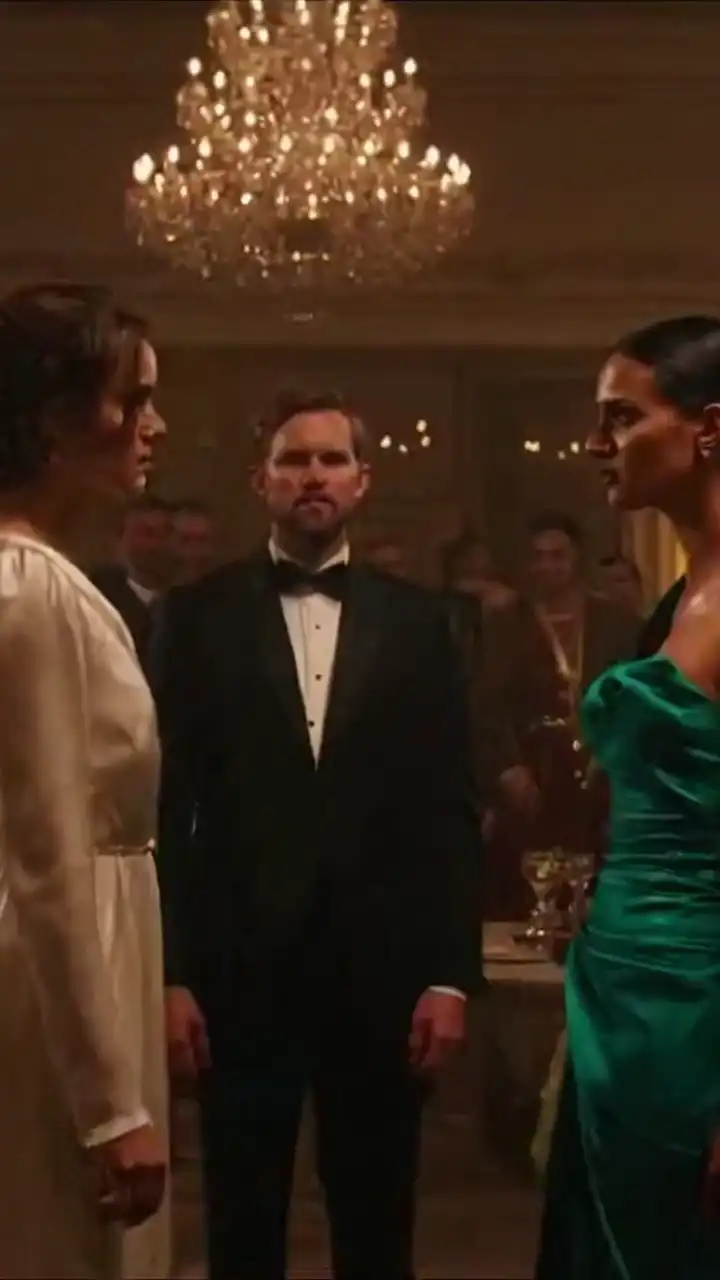
MY HUSBAND USED MY MONEY, GOT ENGAGED TO HIS MISTRESS, AND STOOD THERE WHILE SHE SLAPPED ME

THE MAID OF HONOR POURED WINE ON ME AT MY BRIDAL SHOWER AFTER STEALING MY FIANCÉ. SHE DIDN'T KNOW THE ROOM WAS ABOUT TO HEAR WHAT HE'D BEEN SAYING TO BOTH OF US.

THE MAID OF HONOR POURED WINE ON ME AT MY WEDDING AND CALLED ME CRAZY. SHE FORGOT I STILL HAD THE VOICE NOTE SHE SENT MY FIANCÉ.