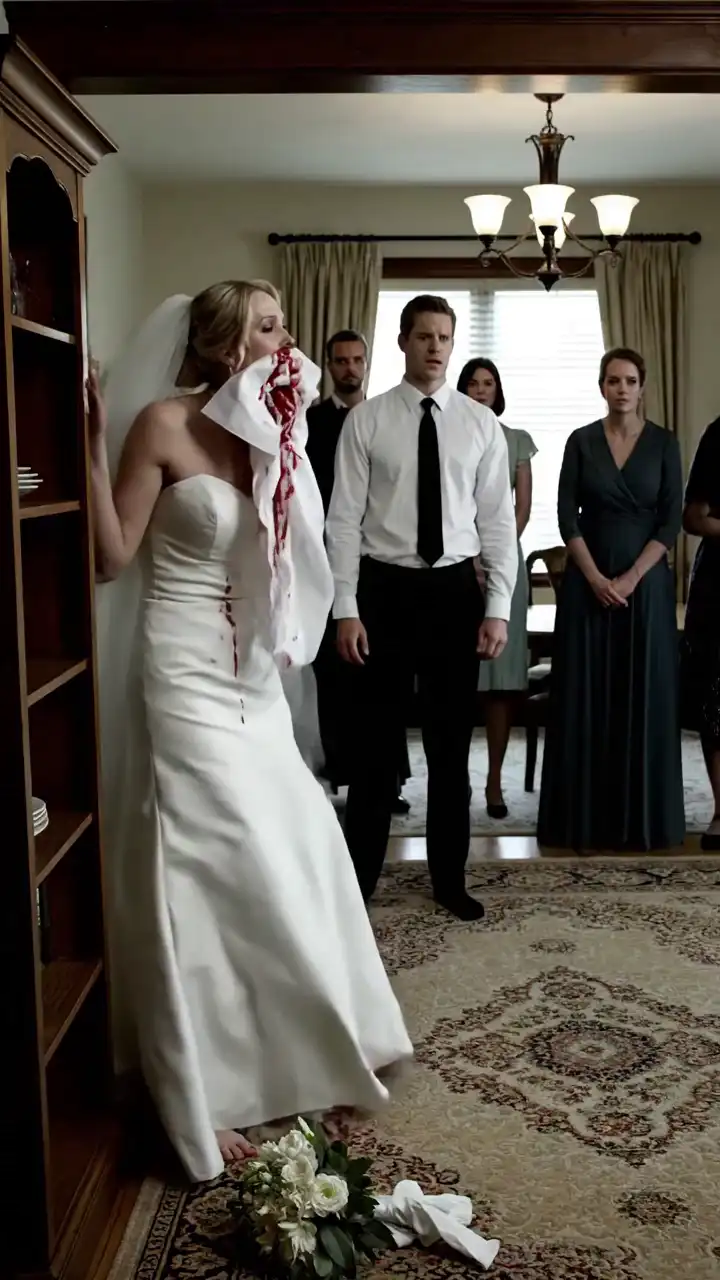
MY FATHER SAW ME IN MY WEDDING DRESS HOLDING ANOTHER MANS SHIRT
Chapter 1
The first thing my father saw when he stepped into our living room was me in my wedding dress, barefoot on the hardwood floor, pressing a strange man’s white dress shirt against my face while the room tilted under me.
The shirt had a dark smear on the collar.
My knees buckled.
Someone dropped a serving spoon in the kitchen, and the metal clatter snapped every head toward me.
“Elena,” my father said.
He did not say my name like a question. He said it like a verdict.
I grabbed the edge of the bookshelf to stay standing. The veil my cousin had pinned into my hair an hour earlier slid sideways over one eye. My bouquet lay where I had dropped it, pale roses scattered across the rug beside a half-opened garment bag.
Around me, my husband’s family froze in pieces of motion. His aunt Delia still held a tray of little almond cakes. His younger sister Pru stood by the arch of white streamers we had taped over the dining room doorway. My new husband, Grant, was halfway down the hall with his tie undone, a phone in one hand and panic all over his face.
And in the middle of all of them stood Nolan Kerr, Grant’s best man, wearing only a white undershirt and black slacks, staring at me like he had no idea how his shirt had ended up in my hands.
“What is this?” my father asked.
The room smelled like perfume, hot food, and the sharp iron scent I suddenly realized was blood.
I looked down.
The smear on the collar wasn’t lipstick.
It was blood.
“I—I got dizzy,” I said.
No one moved.
The shirt trembled in my hands. I had grabbed it off the back of a dining chair because when the room started spinning, I reached for the nearest thing that wasn’t the floor. Nolan had thrown his jacket and shirt there while trying to get red punch out of the cuff in the kitchen sink. I knew that. I knew what had happened.
But when I opened my mouth, nothing came out in the right order.
My father, Wade Mercer, took one slow step into the room. He had driven down from Brant Hollow that morning with the careful stiffness of a man trying to attend his daughter’s wedding without admitting she had married too fast and too young. I had felt that stiffness all week. In every phone call. In every silence.
Now it hardened.
“You got dizzy,” he repeated.
Grant finally moved. “Wade, hold on.”
“No,” my father said, never taking his eyes off me. “I’d like my daughter to answer.”
I should have put the shirt down right then. I should have stepped away from Nolan, straightened my dress, and said something clear enough to survive a room full of people already hungry for a story. Instead the floor gave one sickening roll under me, and I pressed the shirt harder against my mouth because I thought I might throw up.
Pru whispered, “Oh my God.”
From the kitchen doorway, Grant’s mother, Sheila, folded her arms. She was dressed in silver satin and disapproval. She had been smiling too brightly all day, the kind of smile that shows teeth but no mercy. She looked from me to Nolan and then to the blood on the shirt collar.
“Well,” she said softly, “that’s one way to ruin a wedding.”
“Mom,” Grant snapped.
But it was too late. The room had found its meaning.
I shook my head. “It’s not what it looks like.”
Sheila gave a humorless laugh. “Then help us, Elena. What exactly does it look like?”
I could feel my scalp tightening under the pins in my hair. My ears rang. I knew everyone could see me sway, but in that moment even the swaying looked guilty. Weakness always does, when people have decided you’re hiding something.
Nolan took a step forward. “This is my shirt. She almost fell.”
“And she needed your shirt for that?” my father asked.
“It was right there,” Nolan said.
He sounded defensive, which made everything worse.
Grant came to my side and reached for my arm. “Lena, sit down.”
“I’m fine.”
I wasn’t fine. The walls breathed in and out. A bright silver spot flashed across my vision.
My father looked at Grant then, and his voice dropped low. “You bring me into your house for my daughter’s wedding, and this is what I find?”
“Our house,” I said automatically, then wished I hadn’t. The correction sounded childish and absurd.
Sheila caught it and pounced. “Yes, Elena is very quick to claim what’s hers.”
Grant turned on her. “Stop.”
But people had started murmuring already. Aunt Delia set the tray down without taking her eyes off me. Pru moved closer to her mother. Nolan stood rigid, hands open, like a suspect trying not to look like one.
I realized with a burst of shame that there was blood on my upper lip. I touched it and my fingers came away red.
Grant saw it. “You’re bleeding.”
“It’s just my nose.” My voice sounded far away to me. “I get dry air and—”
“In June?” Sheila said.
My father’s face changed. Not softened. Not yet. Just sharpened, like he was trying to fit a new detail into the wrong picture.
He looked at the blood. Then at my unsteady legs. Then at the shirt.
“Elena,” he said, “did you marry this man today because you wanted to, or because you needed somewhere to land?”
The question hit harder than the room’s spin.
That had always been his fear. Not that I would be loved badly. That I would accept being tolerated if it came with a roof and a promise. My mother died when I was sixteen. My father raised me with clenched hands and a tired heart, always worried I would choose the first person who sounded certain.
I stared at him. “That’s not fair.”
“Is it true?”
Grant said, “Wade, enough.”
“No,” Sheila said, almost eagerly now. “Actually, I’d like to hear that too.”
I looked at her, and in her face I saw exactly how the last six months had looked from the outside. I met Grant after moving to Ashcreek Terrace for my medical billing job at Bellmere Outpatient. We married fast. I was twenty-four. Grant was thirty-two. He had a nice house in Maple Glen, a polished career in real estate, a mother who thought every woman wanted a rescue dressed as stability.
And now I was in a wedding dress, clutching his best man’s shirt while blood ran from my nose.
I wiped under my nose with the back of my hand and tasted metal.
“Can someone please get me some water,” I said.
No one moved for one beat too long.
Then from the den, where the TV had been muttering sports highlights all morning, a small voice broke the silence.
“Daddy,” said Miri, Grant’s seven-year-old daughter, “why is Elena falling down?”
Every adult in the room seemed to remember her at once.
Grant’s face collapsed into alarm. “Miri, stay there.”
But she had already walked into the living room in white tights and a blue party dress, carrying the little lace basket she was supposed to use for petals. She stopped in front of us, looking up at me with the awful clear gaze children have when they have not learned how adults hide their cruelty.
“Are you sick?” she asked.
I swallowed. “Just a little dizzy.”
She frowned at the blood on my fingers. “You’re white.”
That was when I felt the room tip hard to the left.
The last thing I saw before I hit the floor was my father lunging toward me and Nolan’s bloody shirt slipping from my hands like a surrendered secret.
Chapter 2
When I opened my eyes, I was on the couch beneath the front window, still in my dress, with an ice pack against the back of my neck and my veil removed.
The wedding music was gone. So were half the decorations. Someone had turned off the string lights over the mantel, and in the sudden plain daylight our living room looked less like a celebration and more like evidence.
Grant knelt by the coffee table with a glass of water and a wet washcloth. My father stood near the fireplace with his arms crossed so tightly his hands disappeared under his sleeves. Sheila sat upright in the armchair like a judge waiting for testimony. Nolan leaned against the doorway to the hall, now wearing a spare button-down from Grant’s closet.
Miri was missing. That alone made the room colder. Someone had removed the child from the scene.
“You passed out,” Grant said quietly.
My head pounded behind my eyes. “How long?”
“Less than a minute.”
I sat up too fast and the nausea came back in a wave. Grant put a hand on my shoulder.
“Slow.”
My father’s voice cut in. “How often does this happen?”
I knew what he was asking. Not just the fainting. The fragility. The secrets. The things a daughter should tell a father if she trusted him enough. The things a bride should tell a husband before vows.
“Not often,” I said.
Sheila let out a breath through her nose. “That’s not an answer.”
Grant shot her a warning look, but she ignored him.
“It happened during your fitting last month too, didn’t it?” she said. “You sat down in the bridal shop and said you were overheated.”
I looked at her. I had not known she remembered.
“And at Easter,” Aunt Delia added softly from the doorway. I hadn’t heard her come back. “You got pale at the table.”
“That was nothing,” I said.
“People keep saying that,” Sheila replied. “Then there’s blood on someone else’s shirt.”
Nolan straightened. “Can we stop saying it like that?”
My father turned to him. “Then tell me why your shirt was in my daughter’s hands.”
“Because she started falling,” Nolan said. “She grabbed it. I was in the kitchen. I got cut on a broken glass. That’s the blood.”
He held up his hand. A strip of paper towel was wrapped around his palm.
No one had noticed before. Or maybe they had and ignored it because scandal is easier to believe than injury.
Grant exhaled hard. “There. Happy?”
But my father wasn’t done. “Why was she near you at all?”
I shut my eyes. “Dad.”
“No. I need to know what’s happening in this house.”
That word again. House. Not home.
Grant rose to his feet. “Nothing is happening.”
My father looked around at the wilted flowers, the abandoned champagne flutes, the bride on the couch with a split lip and a nosebleed. “It sure looks like something is.”
The room tightened.
Then Sheila said the thing she had been waiting to say.
“Maybe she should tell us where she went Tuesday afternoon.”
Every face turned to me.
Grant blinked. “What?”
I stared at her. My pulse thudded painfully in my throat. “You followed me?”
“No,” she said. “I called the house and you said you were at the pharmacy. But I was passing Bellmere Outpatient and saw you come out the side entrance. Alone. Looking upset.”
Grant looked at me. “You told me you had a migraine.”
I had. I had lied because I was tired of being watched for flaws, tired of explaining appointments, tired of saying “It’s nothing” and having doctors either shrug or order one more test.
“It was a doctor’s visit,” I said.
Silence.
Grant’s face changed first. Not anger yet. Hurt. Hurt was worse.
“You had a doctor’s visit and didn’t tell me?”
“It was follow-up. I didn’t want to make a thing out of it.”
“A thing?” Sheila repeated. “You faint on your wedding day and you think private medical visits are not a thing?”
My father stared at me with something deeper than accusation now. Fear. Old fear. I knew it because I had seen it years ago in hospital hallways when my mother’s cough stopped sounding ordinary.
“What doctor?” he asked.
I looked at the floor.
“Elena.” His voice cracked around my name. “What doctor?”
I should have answered him. I should have answered all of them. But the problem with hiding one fear for too long is that it grows teeth. Mine had started small eight months earlier with a dizzy spell at work, then another on the bus, then headaches, nosebleeds, blurring vision if I stood too quickly. I had gone to Bellmere because my insurance was decent and my courage was not. Tests had begun. Then more tests. Then specialist referrals. Each one had come with phrases doctors use when they are trying not to scare you before they know enough.
likely benign
need monitoring
could explain symptoms
not urgent but important
I had not told Grant because we were already rushing toward marriage, and I wanted at least one season of my life not shaped by a waiting room.
I had not told my father because he had already buried one wife and would start burying me in his mind before any doctor asked him to.
So I chose silence.
Now silence looked exactly like deceit.
“It’s not what you think,” I said, and heard immediately how useless that sounded.
Sheila stood. “That sentence should be printed on your bouquet.”
“Mom,” Grant said sharply.
But she had found momentum. “You appear in this family with your sweet smile and your hard luck history, and now my son learns on his wedding day that you’ve been sneaking around medical offices and collapsing in the living room while clutching another man’s shirt?”
I flinched.
My father took one step toward her. “Watch how you speak to my daughter.”
For the first time all day, someone was on my side.
It should have comforted me. Instead it made my throat burn.
Grant rubbed his face. “Elena, just tell me. Please.”
His please was quiet. That nearly broke me.
Before I could answer, a brittle cough came from the hallway.
It was Bea Tully, Grant’s great-aunt, the family ghost no one remembered until she spoke. She was eighty-three, narrow as a coat rack, and had spent most of the morning in the den with a blanket over her knees, ignoring everyone. Now she stood with one hand on the hall table, peering at me over thick glasses.
“She’s swaying again,” Bea said.
I wasn’t. Not yet. But the fact that Bea had noticed before anyone else chilled me.
“She did it last Sunday too.”
“What?” Grant asked.
Bea shrugged. “In the kitchen. Reached for the counter. Thought no one saw.”
All eyes came back to me.
I felt suddenly stripped bare, not by what I had done, but by all the little moments I had tried to hide and failed.
“Lena,” Grant said, softer now. “How long?”
I looked at him, then at my father, then at the ruined softness of my wedding day.
“Long enough,” I whispered.
No one spoke.
Then my father said, in the tired voice of a man stepping toward pain he never wanted, “We are not finishing this wedding celebration until I know whether my daughter is lying to us, dying in front of us, or both.”
Chapter 3
By evening, the flowers had been taken down from the doorway, but my wedding dress was still on.
That felt fitting somehow. Humiliation has a costume, and mine was ivory silk with tiny pearl buttons no one had bothered to undo.
The house had split into camps without anyone announcing it. Aunt Delia and Pru stayed mostly in the kitchen, whispering over half-packed food trays. Nolan fixed things that didn’t need fixing just to have somewhere to put his hands. Bea returned to the den but kept appearing at thresholds like a witness the story had not finished with. Sheila moved through rooms with rigid purpose, collecting rented cake stands and folded tablecloths as if she could tidy the scandal into neat corners.
Grant and my father remained in the living room with me, where the air felt strained enough to crack.
The officiant had left hours ago after an awkward handshake and a promise to “file what needed filing.” So yes, Grant and I were married. The legal part had happened just before the collapse. Two minutes of vows, a ring on my finger, applause that now felt borrowed from another woman’s life.
I sat in the armchair wrapped in a throw blanket over my dress. My head still hurt. My nose had stopped bleeding. Every now and then a light pulse went through my vision, as if someone were flicking a switch inside my skull.
Grant stood by the window. My father sat on the couch, elbows on his knees. Neither man looked comfortable in his own body.
Finally Grant said, “Did a doctor tell you something serious?”
“No.”
“Then why hide it?”
“Because they didn’t know enough yet.”
My father lifted his head. “Yet?”
I nodded once.
Grant turned from the window. “What tests?”
“Bloodwork. Scans.”
“What kind of scans?”
I pressed my lips together.
“Elena.” My father’s patience was gone now. “You don’t get to choose silence after today.”
Something in me flared at that. Maybe because I had been quiet for so long. Maybe because fear can curdle into anger when cornered.
“I didn’t owe a room full of people my private medical file,” I said.
“No,” he replied, “but you owed your husband the truth.”
The word husband landed hard.
Grant’s face did not change, but I saw the wound open in it.
“I know,” I said.
He gave a small, tired laugh with no humor in it. “Did you? Because this feels less like a secret and more like a second life.”
Sheila appeared in the doorway right on time to hear that. “That’s what I said.”
“Please leave,” Grant said without looking at her.
“This affects me too.”
“It affects everyone,” my father said. “Which is why you can stop feeding on it for one minute.”
Her mouth tightened. She stepped farther into the room anyway.
“Fine. Then let’s talk about all of it.” She looked at me. “The doctor visits. The fainting. The lies. And Nolan.”
“There is no Nolan,” I said.
She folded her arms. “A mother notices chemistry.”
Nolan, who had been halfway through the hall carrying flattened cardboard boxes, stopped dead. “No, she doesn’t,” he muttered.
That would have been almost funny if my chest didn’t hurt.
“There was no chemistry,” I said. “There was a broken glass. I got dizzy. I grabbed the nearest thing.”
“Then why did you look guilty?” Sheila asked.
I stared at her. “Because everyone in this house was looking at me like I was filth.”
For a moment, the room went completely still.
Grant shut his eyes.
My father leaned back slowly, and when he spoke his voice was low. “You should have called me.”
The old child in me almost answered before the adult woman did.
“You would have panicked.”
“Yes.”
“You would have driven down every week.”
“Yes.”
“You would have looked at me the way you looked at Mom.”
That landed where I knew it would.
His jaw moved once. He looked away.
No one said my mother’s name, but she entered the room anyway. Lorna Mercer. Forty-two when they found the shadow in her lung. Gone ten months later. After that, my father treated every headache like prophecy.
“I am not your mother,” I said, softer now.
His answer came rough. “I know that. I’m saying I already know what fear does to a family when no one says things out loud.”
Sheila shifted, suddenly less triumphant than uneasy. Even she knew grief when it stood up.
Grant came closer and crouched in front of me. “What are the doctors checking?”
I looked at him and saw what I had done to him. Not with betrayal, not the kind they thought. But with withholding. With making him stand in a room and defend a woman he did not fully know.
There are ways to break trust without ever touching another person. I had found one.
“I’ve been having episodes,” I said. “Dizziness. Nosebleeds. Pressure behind my eyes. They found something on imaging.”
Grant went still. “Something?”
“A vascular mass. That’s what they called it at first.”
My father inhaled sharply.
“A mass where?” he asked.
I touched the side of my head.
No one spoke.
The refrigerator hummed in the kitchen. A car passed outside on Larcher Street. Somewhere upstairs a floorboard clicked as the house cooled.
Grant’s hand dropped from his knee. “In your brain?”
“They weren’t sure what it was,” I said quickly. “Then they thought maybe a malformation. Then maybe a tumor. Then they said it could be slow-growing and operable. Then they said we needed more tests before they’d say anything else.”
I had not meant to say it all in one rush. Once it started, though, the words came like floodwater through a cracked dam.
“I didn’t know what to tell people because every appointment changed something, and I was tired of hearing scared voices when no one knew anything. So I kept saying it was fine. I told myself I’d wait until after the wedding because maybe by then I’d have real answers instead of half-answers, and I wanted one day that belonged to joy.”
Grant stared at me as if the room had shifted under him.
Sheila was the one who spoke first. Her voice had lost some of its bite. “And you still married him.”
I almost laughed at the cruelty of that sentence.
“Yes,” I said. “I still married him.”
“As if that proves anything,” she said weakly.
“It proves I didn’t marry him for convenience,” I replied. “If I were trapping someone, I picked a strange way to do it.”
Nolan looked down at the boxes in his hands. Aunt Delia made a tiny sound in the kitchen that might have been shame.
My father rubbed both palms over his face. “Who else knows?”
“Dr. Harlan Reeve at Bellmere Neurology. The imaging tech, I assume. A nurse named Tasha. That’s about it.”
“And me now,” Bea said from the den.
I looked over. She had not moved from her recliner, but she was listening with terrible precision.
Grant stood up and walked three steps away, then back again, as if he could not find a position where his body made sense.
“When was the last appointment?” he asked.
“Tuesday.”
“And what did they say?”
“They wanted me to schedule another angiogram and consult with a surgeon in Foxmere.”
My father’s head came up. “A surgeon.”
I nodded.
He looked like he had been punched.
Grant said, very carefully, “And when were you planning to tell me?”
I had no answer that did not sound monstrous.
“When I had something firm,” I said finally.
He laughed once again, broken this time. “So maybe after the honeymoon? Or after the first seizure? Or after I found discharge papers in a drawer?”
“Grant—”
“No, I need to understand the scale of this. Did you think marriage was the safe place to hide it?”
I opened my mouth. Closed it. Opened it again.
“Yes,” I whispered.
That hurt him more than anything else I had said.
He turned away.
Behind him, Sheila exhaled as if all her suspicions had been given shape. “So she did use you.”
“No,” my father said sharply.
She looked at him in surprise.
He stood. “She handled this badly. She lied. She was wrong. But being afraid is not the same as using someone.”
Grant said nothing.
I watched the muscles in his back shift beneath his dress shirt. This was the betrayal at the center of everything. Not an affair. Not Nolan’s shirt. Not a bride collapsing for drama in a crowded room. It was this: I had chosen fear over trust, and on the first day of our marriage, I handed my husband a stranger where his wife should have been.
Before anyone could say more, the room flashed white.
Not with light. With absence.
My hearing went muffled. My stomach dropped. I gripped the arms of the chair.
“Elena?” Grant said, distant and warped.
Then a hard pain burst behind my left eye.
I bent forward with a gasp.
My father was beside me in an instant. “Look at me.”
“I can’t see right,” I said.
That sentence changed the room more than any accusation had.
Grant crouched in front of me again, his anger gone under panic. “We’re going to the hospital.”
“No.” I clutched his sleeve. “Not unless it stays.”
“She cannot be serious,” Sheila said.
“I said no.” The thought of emergency lights, waiting rooms, more explanations while still wearing my wedding dress made me want to crawl out of my own skin.
Then Bea’s voice drifted from the den, calm as weather.
“Last time it lasted six minutes.”
Everyone turned.
Grant stared at her. “Last time?”
Bea adjusted the blanket on her lap. “Tuesday night. She sat on the back steps because she didn’t want anyone fussing. I found her there.”
I looked at her, stunned. “You never said—”
“You never asked,” Bea replied.
And in that one dry sentence, the whole house heard the truth of me.
Chapter 4
Bea Tully had become invisible by surviving long enough around louder people.
That night, she saved me by refusing to stay invisible.
Everyone gathered in the living room again, the way families do when fear finally becomes more important than pride. Grant sat on the ottoman in front of me. My father stood at my shoulder. Sheila remained by the mantel, but for once she had no performance left. Nolan brought Bea from the den with slow careful steps, and when she settled into the armchair, she looked around as if mildly irritated that she had to do the job the rest of us had failed to do.
“You knew?” Grant asked her.
Bea gave one tiny nod.
“She told me not to say anything.”
“She shouldn’t have had to,” my father muttered.
Bea ignored him. “I went outside for air on Tuesday. Found the bride on the back steps in the dark with one hand over her eye and blood on her blouse.”
The memory rushed back vivid and humiliating. The bricks cold under me. The citronella candle burned down to a blue nub. The pressure in my skull so fierce I thought if I moved, I would split open.
“She said it was a migraine,” Bea continued. “I said no migraine makes a girl hold still like she’s listening for death.”
No one breathed.
I looked at my hands.
Grant asked, “What else?”
Bea’s eyes cut to me. “Do you want me to stop?”
I should have said yes. I should have protected my little scraps of privacy to the end. But the room had already crossed into a place where secrets were poison.
“No,” I said.
Bea nodded. “Good.”
She folded her thin hands.
“She told me doctors had found something in her head. She said it might be bad, or might not. She said she didn’t want this wedding to become a funeral rehearsal.”
My father made a sound like air leaving a damaged tire.
I shut my eyes.
“I told her men can survive being frightened,” Bea said. “She said yes, but they start loving you differently. She didn’t want pity in her vows.”
Grant looked at me then, and the pain in his face was almost unbearable because it was mixed now with understanding.
“I never wanted pity,” I said.
“You could have had help,” he replied.
“I know.”
“No,” he said, voice shaking. “I don’t think you do.”
That was fair. More than fair.
My father spoke without taking his eyes off me. “Why didn’t you call me from those steps?”
I laughed once, and it came out ragged. “Because you would have heard one wrong word and started building my coffin in your head.”
He flinched as if struck.
No one defended him because no one needed to. It was true.
Sheila crossed her arms again, but this time it looked less like armor and more like self-comfort. “And what was Nolan doing in all this?”
Nolan answered before anyone else could. “Literally cutting fruit in the kitchen.”
Bea snorted. “Yes. The scandal was a cantaloupe.”
Even Grant let out a short breath of laughter at that, and the tension cracked just enough for us all to survive the next minute.
Then my phone buzzed on the side table.
Every eye went to it.
Screen lit.
DR HARLAN REEVE.
My stomach dropped.
Grant looked at me. “Answer.”
My fingers shook too hard, so he handed it to me and hit speaker when I nodded.
“Hello?”
“Ms. Mercer?” Dr. Reeve’s voice came through tinny and professional, then shifted when he heard the strain in mine. “Elena, I’m sorry for the late call. I was trying to reach you after your updated scans were reviewed.”
The room went silent in a way I had never heard before.
“This is a bad time,” I whispered.
“It’s important.” He paused. “Are you with someone?”
I looked at Grant. At my father. At the family that had nearly torn itself apart around a lie too small to carry a fear this large.
“Yes,” I said. “I’m with everyone.”
“Then I need to say this clearly. The lesion appears more active than we first believed. The episodes you described today are concerning. I don’t want to alarm you, but I do want you evaluated tonight if you’ve had vision changes, fainting, or recurrent bleeding.”
Grant closed his eyes.
My father gripped the back of the couch.
I asked the question I had been avoiding for months. “Do you think it’s cancer?”
A breath. Paper moving. The kind of pause doctors use when no answer is merciful.
“We still cannot confirm that from imaging alone,” he said. “But we are now concerned about a vascular tumor with increased pressure effects. You need urgent assessment, Elena.”
The room had no room left for shame after that.
Only fear.
Grant took the phone from my hand gently. “This is her husband.”
The word husband sounded different now. Not ceremonial. Steady.
“Grant Holloway,” he said. “We’re bringing her in.”
“Good,” Dr. Reeve replied. “Go to Foxmere Regional if possible. I’ll call ahead.”
Grant thanked him and ended the call.
No one moved for two full seconds.
Then the house sprang into motion.
Nolan got my shoes. Aunt Delia found a coat. Pru ran upstairs for my overnight bag without being asked. Sheila disappeared and came back with wipes, tissues, and a small zip pouch of medical cards I had left on the kitchen counter weeks ago, unnoticed until now. My father held my bouquet ribbon in one hand for a strange bewildered second before setting it down like something from another life.
Grant knelt in front of me and took both my hands.
“We’re going,” he said.
I nodded.
“I’m angry.”
“I know.”
“I’m scared.”
“I know.”
“You don’t get to do this alone anymore.”
That undid me.
I started crying with ugly, breathless force, the kind that bends your ribs and steals speech. Grant pulled me forward carefully so I wouldn’t crush the dress, and I buried my face in his shoulder.
“I’m sorry,” I said into the fabric. “I’m so sorry.”
He held the back of my head. “I know.”
Behind us, my father said quietly, “I’m driving behind you.”
Grant answered without turning. “Good.”
As Nolan helped me stand, the room went gray for a second. My legs trembled.
Miri appeared on the stairs in her little blue dress, clutching the railing.
No one had noticed her listening.
“Is Elena going away?” she asked.
Grant straightened. “We’re taking her to the doctor.”
Miri looked at my face, then at the wedding dress, then at the adults who had spent the day speaking in knives.
“Did somebody say mean things again?” she asked.
No one answered.
She came down the last two steps, walked to me, and held up the little lace basket from the ceremony. Inside was one crushed white rose petal and a wrapped peppermint.
“You can have this,” she said. “For the ride.”
I took the peppermint with shaking fingers.
“Thank you.”
She looked at my father. “She really is sick.”
The child said it plainly. No accusation. No theater. Just sight.
My father’s face folded inward.
“Yes,” he said hoarsely. “She is.”
Something changed in him then. Not all the way. Men like my father do not transform in one glowing instant. But his judgment broke apart under the weight of what was real. Under the blood. The scans. The doctor’s call. The simple merciless honesty of a little girl.
He stepped in front of me and carefully fixed the veil clip still hanging crooked in my hair though the veil itself was gone.
“When you were six,” he said, not looking at anyone else, “you hid a broken wrist for two hours because you didn’t want to miss the county fair.”
I gave a wet laugh. “I still made you take me.”
“You threw up on the Tilt A Whirl.”
“After I rode it.”
That earned the smallest ghost of a smile from him.
Then his eyes filled.
“You should have told me,” he whispered.
“I know.”
He touched my cheek, just once. “I might have panicked. I still deserved the chance.”
I covered his hand with mine. “I know.”
That was all we had time for.
The ride to Foxmere Regional happened in pieces of reflected light on the windshield and the whisper of satin under a borrowed coat. Grant drove. I sat in the passenger seat with the peppermint from Miri untouched in my palm. Behind us, through the dark, my father’s truck stayed close all the way down Route 18.
I had begun the day afraid my marriage would not survive my silence.
By midnight, I was afraid survival itself had become the larger question.
Chapter 5
The emergency department at Foxmere Regional had seen everything except, apparently, a bride checking in after her wedding with neurological symptoms and dried blood on her sleeve.
The admitting nurse at triage looked at my dress, then at my chart, then at Grant.
“Long day?” she asked gently.
Grant answered, “You could say that.”
They took me back fast after Dr. Reeve’s call went through. That alone scared me more than any machine. Quick is not a comforting speed in a hospital.
My father waited with Grant in the curtained exam room while a nurse named Celeste cut off the pearl buttons at my wrist to place an IV. I hated the sound of thread snapping. It felt like something ceremonial being unmade.
Scans. Bloodwork. Questions repeated three times by three different people. When did the dizziness begin? How many fainting episodes? Any nausea? Changes in speech? Weakness? Family history?
At that one, I looked at my father.
“My wife died of lung cancer,” he said immediately, as if he needed to place his grief on the table in case it was relevant.
Hours passed that way, in fluorescent chunks.
Around two in the morning, a young resident told me they had identified increased swelling around the lesion and wanted neurosurgery to review the images. Around three, I was moved upstairs. Around four-fifteen, Dr. Nadine Solis, the neurosurgeon on call, walked into my room with a tablet in one hand and the kind of composed face that means the truth will be difficult but survivable.
She pulled up a stool and showed us the scan.
Even if I had not known what I was looking at, I would have understood one thing: there was something in my head that did not belong there.
“It is not behaving like a simple benign malformation,” she said carefully. “The imaging suggests a vascular tumor near the left sphenoid wing, with intermittent bleeding. That likely explains the nosebleeds, pressure, fainting, and visual symptoms.”
My father gripped the windowsill so hard his knuckles blanched.
Grant sat beside my bed, one hand over his mouth.
“Are you saying cancer?” I asked.
“I’m saying we need pathology to know exactly what it is,” Dr. Solis said. “But either way, this needs surgery soon.”
Soon.
I thought that word would sound dramatic. It sounded logistical. Almost ordinary. That was somehow worse.
“How soon?” Grant asked.
“Tomorrow morning if her neurological exam remains stable. Today, technically.”
The sky outside the window was just beginning to pale.
I laughed then. I don’t know why. Maybe because the day of my wedding had not ended and now it contained a brain surgery.
Tears ran into my ears.
Dr. Solis let me cry. Good doctors know when silence is part of the treatment.
When she left, the room stayed dim and raw. Machines ticked. Footsteps rolled past in the corridor. Somewhere a woman was laughing too loudly at 4:30 in the morning, the exhausted laugh of someone who had reached the end of normal behavior.
Grant stood and walked to the other side of the room. I thought he was falling apart. Instead he came back with the hospital consent clipboard, set it gently on my lap, and said, “I’m here.”
Three words. No speeches. No saintly forgiveness. Just presence.
That made me cry harder.
My father moved closer to the bed. He looked older than he had the day before. Much older. Men age strangely in hospitals. Their faces become versions of every vigil they have ever kept.
“I need to say something before they wheel you anywhere,” he said.
I wiped my face with the corner of the blanket and nodded.
He took a breath.
“When I walked into that house and saw you with that shirt, I thought the worst thing a daughter could do was betray the man she married.”
Grant lowered his eyes.
My father went on, voice rough. “Then I thought the worst thing was that you lied to us. I was wrong both times.” He looked directly at me. “The worst thing was that you were afraid to be sick where people could see you.”
That silence after he said it felt holy.
I started to shake.
He put his hand over mine on the consent form. “I helped build that fear. I know I did.”
“Dad—”
“Let me finish.” His eyes shone but did not spill. “Your mother’s illness turned me into a man who watches every room for loss before joy can enter. I call it caution. Maybe some of it is love. But some of it is fear dressed up like wisdom. And you learned to hide from it.”
The truth of that landed so cleanly it hurt.
Grant sat down again and leaned his elbows on his knees. “She hid from me too.”
“Yes,” my father said. “And she’ll have to answer for that in your marriage. But if this family learns nothing else from today, let it be this: fear grows in silence, and judgment grows even faster.”
He looked toward the door, where Sheila stood.
I had not heard her come in.
She must have driven after sleeping two hours, still in yesterday’s silver satin under a cardigan. Her face was bare, tired, and transformed by the simple fact that no one here had energy left for pretense.
In her hand was the little zip bag of my medical papers.
“I brought these,” she said quietly. “And… I brought coffee.”
No one mocked her for not knowing what else to bring.
She came to the bed but did not touch me.
“Elena,” she said, “I was cruel.”
I looked at her and saw that she meant it enough to hate saying it.
“I thought you were dangerous in one way,” she continued, “and I never considered you might be in danger in another. I’m sorry.”
It did not erase the day. But it mattered.
“Thank you,” I said.
She nodded once and set the papers down.
Then Bea shuffled in behind her in compression socks and house shoes, because apparently no force on earth could keep that woman from a scene she considered unfinished.
Nolan trailed her with two coffees and a hospital visitor badge hanging crooked from his collar.
“You all look terrible,” Bea said.
And for the first time since the living room, everyone laughed.
Even me.
Especially me.
The surgery happened at 8:10 a.m.
They rolled me down bright hallways while I stared at ceiling tiles and tried not to imagine my own skull opening. Grant walked on one side until they made him stop. My father on the other. At the double doors, everything narrowed into faces.
Grant bent down and kissed my forehead.
“You come back,” he said.
“I’ll try.”
“No,” he whispered. “You come back.”
My father touched my shoulder. “I’m right here.”
Then Bea, from behind them both: “Do not make us all wear those clothes twice.”
I laughed in spite of myself as they wheeled me through the doors.
When I woke, it was evening.
The first thing I saw was blurred light. The second was Grant asleep in a plastic chair with his cheek against the bedrail, one hand still wrapped around my fingers. My father sat by the window with a paper cup, chin on chest. Sheila was knitting badly in the corner. Nolan stood in the hall speaking softly to someone on the phone. Bea was nowhere visible, which probably meant she had been removed by force.
I moved my hand.
Grant woke instantly.
“Hey.”
His voice broke on the one syllable.
I tried to speak. My throat hurt. “Am I…”
“You’re here,” he said. “Surgery went well.”
My father was on his feet before Grant finished. “Lena?”
I turned my head toward him.
He laughed and cried at the same time, which I had never seen before.
A little later, Dr. Solis came in and explained that they had removed the tumor and controlled the bleeding. Pathology was still pending, but she felt hopeful from what she had seen. Cautious, but hopeful.
Hopeful.
I held that word like a fragile dish.
When the room settled again, Grant rested his forehead against the back of my hand.
“I was so angry at you,” he said softly.
“I know.”
“I still am a little.”
“I know.”
He looked up. “But I am not losing you over secrecy after almost losing you to surgery.”
I swallowed. “I’ll tell you everything.”
He nodded. “You will.”
Not because he commanded it. Because we both understood what silence had cost.
My father stood at the foot of the bed, eyes red, shoulders bowed in a way I had seen only once before at my mother’s grave. He looked at the bandage near my hairline and then at my face.
“When you’re stronger,” he said, “I’m taking down every wall in that guest room at my place and building whatever you need.”
I smiled faintly. “Dad, I live with my husband.”
“I know.” He cleared his throat. “Then I’ll build shelves or something. The point is, I’m available.”
That sent a tired laugh through the room.
The next morning, pathology came back.
Benign.
Not harmless. Not small. Not simple. But benign.
The word moved through the room like sunlight after weather.
Sheila cried openly. Nolan hugged Grant so hard they almost knocked over the IV pole. My father sat down without meaning to, one hand covering his face.
I just lay there and let relief wash through me in waves so deep they felt like grief.
The shirt in the living room. The blood. The accusations. The collapse. All of it looked different now, lit from behind by the truth that had almost broken me because I had been too afraid to share it.
And in that hospital room, still sore, still shaken, still newly married, I finally understood that love cannot protect what it is not allowed to see.
Chapter 6
Six months later, I stood in our living room on Larcher Street wearing a simple cream dress that had nothing to do with hospitals, and everything to do with beginning again.
We did not call it a second wedding. Grant said that made it sound like we were replacing something. We weren’t. We were reclaiming it.
The first ceremony had happened in shock and secrecy and blood. This one happened in daylight with my scar hidden under soft curls and no one pretending life was guaranteed.
Aunt Delia hung fresh flowers over the dining room arch. Pru fixed the ribbon on Miri’s basket. Nolan, fully clothed in a shirt no one would ever mention again, arranged chairs in the backyard. Sheila moved through the house asking if anyone needed ice, tape, plates, tea, sunscreen, or forgiveness. It was her new nervous habit, offering practical things in place of opinions.
I liked it.
Bea sat in the best chair by the window wearing a lavender jacket and an expression that suggested she had personally approved the weather.
My father came early.
I found him in the kitchen staring at the counter where the broken-glass confusion had started months earlier. He had both hands around a coffee mug but wasn’t drinking.
“You okay?” I asked.
He looked at me, and his eyes went immediately to the faint line near my temple.
That still happened. People who loved me looked there first.
“I’m learning,” he said.
“To do what?”
“To see you without searching for disaster before I see you.”
I leaned against the counter. “How’s that going?”
He considered it. “Badly. Better. Both.”
That was honest enough to make me smile.
He set the mug down. “I brought something.”
From his jacket pocket, he took out a small folded paper. It was old, creased, and soft at the edges. I opened it carefully.
It was a drawing I had made in first grade: me holding one giant hand labeled DAD, both of us standing beside a crooked yellow house under an impossible blue sun.
Across the top, in my uneven child handwriting, I had written: HE COMES WHEN I FALL.
I laughed with tears already rising. “Where did you find this?”
“In a Bible box your mother kept.” His voice thinned. “I almost threw it away years ago because I couldn’t look at things like that.”
I touched the paper.
“But I thought maybe today,” he said, “you should have it back.”
I folded it carefully and held it against my chest.
“Thank you.”
He nodded, then surprised me by opening his arms.
My father was not a hugging man by nature. Grief had made him even less so. But that day I stepped into his embrace and felt something settle in both of us. Not healing all at once. Just permission. Permission to stop performing strength as silence. Permission to love badly at times and still keep learning how to love better.
Outside, chairs scraped. Someone laughed. Miri ran through the hall calling, “It’s starting it’s starting.”
When we went into the backyard, the late afternoon sun made the string lights look asleep.
Grant stood under the maple tree in a blue suit, one hand in his pocket because he always forgot what to do with both. When he saw me, his whole face changed the way it had the first time I walked toward him, before any of this, before fear rearranged our lives and taught us what vows were for.
Miri scattered petals in a crooked line and whispered too loudly, “This time nobody falls.”
Everyone heard her.
Everyone laughed.
I nearly did too, but emotion caught in my throat and turned into something softer.
When I reached Grant, he took my hands and looked at me with the calm steadiness I had once mistaken for something I had to earn.
Our friend and neighbor Corinne, ordained online and proud of it, smiled at us and said, “Would either of you like to say something before we begin?”
Grant answered first.
“Yes.”
He kept his eyes on mine.
“The first day we got married,” he said, “I learned that loving someone is not the same as knowing how to carry their fear. I want to keep learning. Out loud.”
I squeezed his hands.
Then Corinne looked at me.
I took a breath.
“The first day we got married,” I said, “I thought hiding pain would protect everyone I loved. It didn’t. It only made room for judgment where trust should have been. So this is my vow now: no more brave silence.”
No one moved.
The maple leaves shifted overhead. Somewhere down the block, a dog barked and then stopped.
Grant’s eyes filled.
“Good,” Bea said from her chair, not quietly.
That broke the tension, and laughter rolled through the yard warm and human and grateful.
We said our vows. We exchanged rings we had never stopped wearing. Grant kissed me softly, carefully, as if joy itself had become precious from how nearly we had lost it.
Afterward, while everyone ate too much lemon cake and Miri made Nolan play a game involving bubbles and plastic crowns, my father sat beside Sheila on the patio.
It was a pairing I never thought I would see in peace.
As I passed with a tray of iced tea, I heard Sheila say, “I was wrong about her.”
My father answered, “So was I.”
She nodded toward me. “She scares us.”
He watched me across the yard. “That’s what loving someone does.”
There was no bitterness in it. Just truth.
At dusk, after most of the plates had been cleared and the lights came alive above the fence, I stood alone for a minute in the living room where the first collapse had happened. The rug had been cleaned. The flowers were different. The air held cake and coffee instead of suspicion.
Grant came up behind me.
“You vanished.”
“Just for a second.”
He slipped his hand into mine. “Bad memories?”
I looked around the room.
“Not exactly.”
The place where I had fallen was just floor again. The place where everyone stared was just a patch of evening light. The house had not changed. We had.
I leaned my head against his shoulder.
“Do you ever think about that shirt?” I asked.
He groaned softly. “Unfortunately, yes.”
I smiled. “Poor Nolan.”
“Poor all of us.”
Then he kissed my hair and said the truest thing anyone had said all year.
“We almost let fear write the whole story.”
Outside, Miri shouted for us to come cut another slice of cake. Bea yelled that no one had served her enough frosting. My father laughed at something Nolan said. Sheila was refilling glasses. The backyard glowed.
I looked at the life waiting for me just beyond the doorway and understood, finally, what should have been obvious from the start.
Judgment looks fast because it arrives before the facts.
Acceptance takes longer. It asks questions. It stays. It learns the scar. It carries the truth when the truth is ugly. It does not mistake secrecy for betrayal forever. It leaves room for people to be frightened and flawed and still loved.
I squeezed Grant’s hand and went back outside.
Disclaimer: Mention of any brand or trademark is for identification only and does not imply partnership or endorsement
MY HUSBAND USED MY MONEY, GOT ENGAGED TO HIS MISTRESS, AND STOOD THERE WHILE SHE SLAPPED ME
THE MAID OF HONOR POURED WINE ON ME AT MY BRIDAL SHOWER AFTER STEALING MY FIANCÉ. SHE DIDN'T KNOW THE ROOM WAS ABOUT TO HEAR WHAT HE'D BEEN SAYING TO BOTH OF US.
THE MAID OF HONOR POURED WINE ON ME AT MY WEDDING AND CALLED ME CRAZY. SHE FORGOT I STILL HAD THE VOICE NOTE SHE SENT MY FIANCÉ.