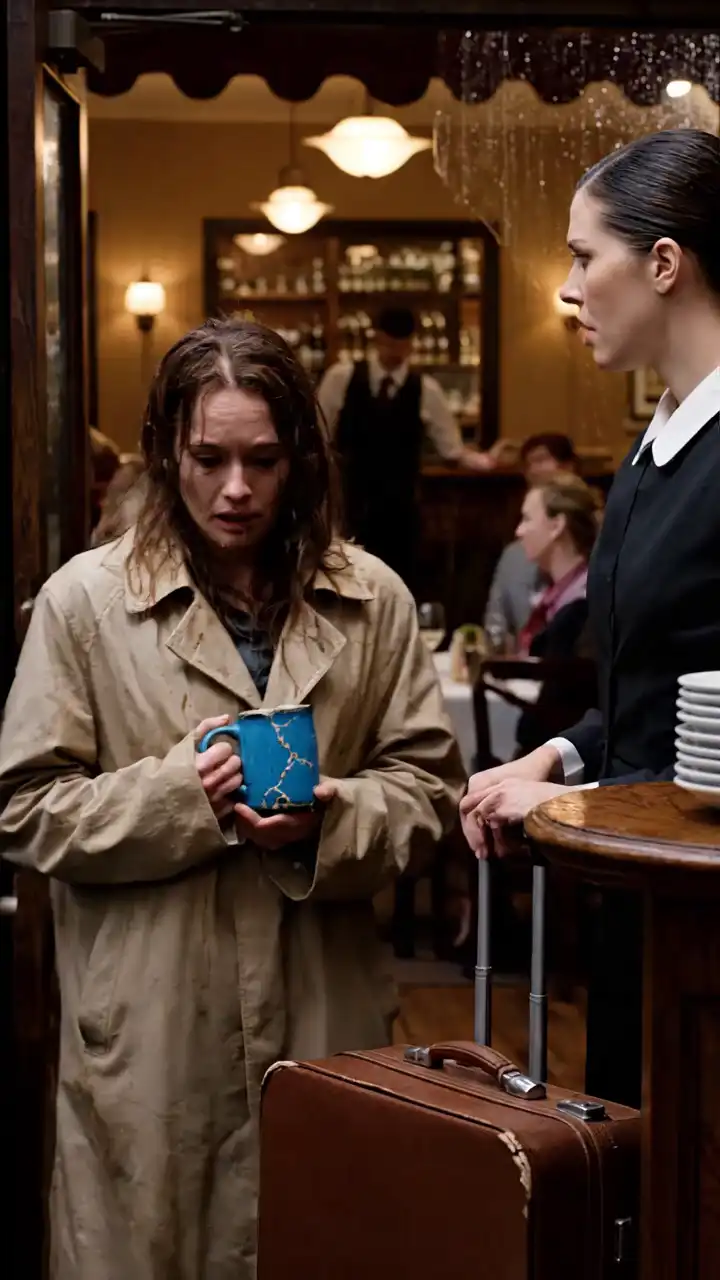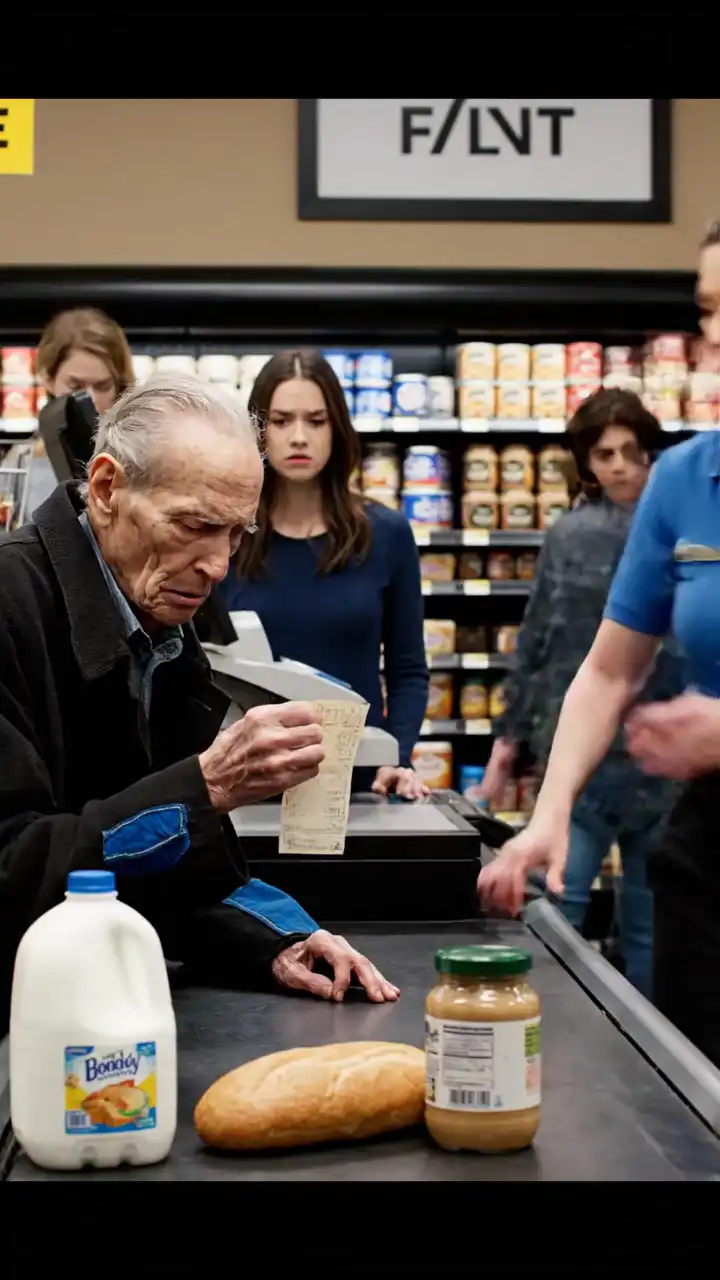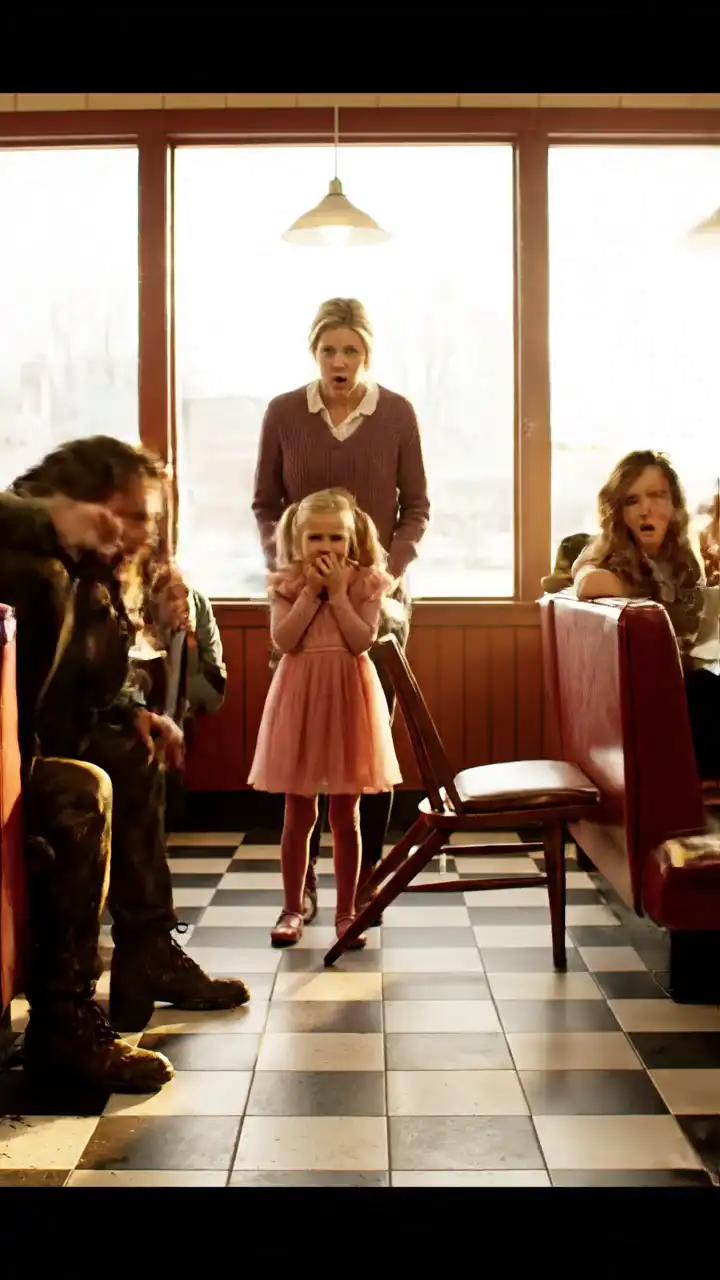
THE HOMELESS MAN THEY THREW OUT OF THE DINER WAS THE ONLY ONE WHO COULD SAVE HER
Chapter 1
The little girl was turning blue when the manager pointed at me and shouted, “Don’t touch her.”
For one second, nobody moved.
I was halfway out of my seat at the back of the Maple Turn Diner, my coffee still steaming beside a cracked sugar jar, my hands already raised because I had seen the child clutch her throat and stand up too fast. Her chair had tipped backward. A plastic cup rolled under the next table. The whole room had frozen in that ugly way people do when they want help but don’t want it from the wrong person.
And I was the wrong person.
I knew what I looked like. My beard had grown uneven over the last few months. My coat was army green and too thin at the elbows. My boots were caked with old mud from the service road behind the Cedar Ridge bus depot where I sometimes slept if the rain didn’t come in sideways. I had washed up that morning in the gas station restroom across Route 14, but it never mattered. Once people decide what you are, soap can’t reach it.
The girl made a thin, awful sound.
Her mother, a woman in a mauve sweater with one hand shaking over her own mouth, kept saying, “Breathe, sweetie. Breathe. Please breathe.”
The manager, a thick-necked man named Curtis Bell, moved faster toward me than he did toward the child. “Sit down,” he snapped. “You stay right there.”
“I know what to do,” I said.
He looked at me like I had barked.
At the window booth, two high school boys had their phones halfway out. An older couple stared over their pie. A waitress named Lila stood in the aisle with a tray balanced against her hip, too scared to set it down. The little girl’s face had gone from red to pale with a gray edge that made my stomach drop.
“She’s choking,” I said. “Now.”
Curtis shoved one arm toward me to block my path. “I said don’t touch her.”
The mother looked between us, wild-eyed and useless with panic. “Someone help her.”
I saw the girl’s hands. Both were at her throat. Classic. No sound now. Full airway block.
There are moments when your life splits into before and after, and nobody around you notices because to them it’s just another minute in a diner between lunch and dinner. But to you, every old mistake, every lost thing, every reason you stopped speaking unless necessary comes rushing back into your hands.
I stepped around Curtis.
He caught my sleeve. The motion yanked my coat open, and something fell from the inner pocket onto the black-and-white tile floor. A plastic badge on a frayed blue lanyard. It skidded under the edge of the girl’s table and landed face up.
I heard someone say, “What is that?”
But there was no time to look.
The child’s knees buckled. I dropped to one knee behind her and said, “Honey, I’m helping.”
Her mother made a noise like a sob and a protest tangled together. “Please—”
Curtis grabbed my shoulder. “Get away from her.”
“Then you do it,” I snapped.
He didn’t.
That was all the permission I needed.
I turned the girl carefully, made a fist, found the spot, and gave one quick abdominal thrust. Nothing. Her body was too small, too rigid. I adjusted. Second thrust. A wet choking cough. Third—and a chunk of sausage shot onto the floor near my boot.
The girl pulled in air so hard the whole room seemed to inhale with her.
Then came the crying. Her mother dropped to the floor and crushed the little girl against her chest. The child wailed and coughed and kept breathing. I leaned back on my heels, suddenly aware of the diner smell again—burned bacon grease, coffee, bleach from the morning mop—like the world had clicked back on.
For half a second, I thought maybe it was over.
Then Curtis looked at the sausage on the floor, looked at me kneeling there in my dirty coat, and chose his pride over the truth.
“You put your hands on a customer’s kid,” he said, loud enough for every booth to hear.
I stood slowly. “I saved her.”
“You had no right.”
The mother still hadn’t looked up. She was crying too hard, pressing her face into her daughter’s hair. The crowd had shifted from terror into that meaner thing, the search for who to blame now that disaster had passed them by.
The old badge was still under the table. Lila bent to pick it up before I could. She turned it over, frowned, and looked at me.
It was faded enough that details took a second to see. My younger face under fluorescent hospital lighting. My full name. RUSSELL DANE. The logo of St. Bartholomew Regional Medical Center in Briar Glen. The title line was scratched white where years and weather had rubbed at it.
Curtis snatched it from her hand. “You stole this?”
I felt heat climb up my neck. “No.”
He held it between two fingers like it was contaminated. “Then why does a guy like you have a hospital ID?”
A woman near the front counter said exactly what the room was thinking. “Probably picked it out of a trash can.”
A few people laughed softly, not because it was funny but because meanness likes company.
I reached for the badge. Curtis jerked it back.
“Give it to me.”
“You need to leave.”
“I paid for my coffee.”
“You heard me.”
The little girl finally lifted her face from her mother’s shoulder. She had freckles across the bridge of her nose and huge wet eyes. “Mommy,” she whispered, “that man helped me.”
Nobody answered her.
Curtis walked to the register and picked up the phone. “If you don’t go, I’ll call the police.”
I should have left. God knows I had enough practice walking away before things got worse. But the badge in his hand had become its own kind of emergency. It was all I had left from the life before the underpass, before the shelter cots, before losing my apartment and then my car and finally the right to be seen as harmless.
I took one step toward the counter.
A fork clattered somewhere behind me. Someone murmured, “Here we go.”
“I’m not causing trouble,” I said. “Just give me my ID.”
“Your ID?” Curtis barked a laugh. “You expect us to believe you worked in a hospital?”
At the edge of the dining room, the front bell over the door jingled, and a cold stripe of November air slid across the floor. Everyone glanced over.
The man who came in looked like he belonged to the street more than the diner too—thin black coat, knit cap, a cart parked outside with aluminum cans tied in clear bags. Folks in Ashwell always called him Professor because he read library books under the awning by the laundromat and talked to himself in complete sentences.
He squinted toward the commotion. Then his eyes landed on the badge in Curtis’s hand, and his whole face changed.
“Don’t throw that away,” he said quietly. “That’s his.”
Curtis frowned. “You know him?”
Professor stepped farther inside, rubbing his hands against the cold. “I know that badge. He kept it wrapped in a sandwich bag for six winters.”
The whole diner looked from him to me and back again.
Curtis tightened his grip on the phone. “Great. Another one.”
Professor ignored him. He looked at me with something close to hurt. “Russ,” he said, “tell them what you used to be.”
I stared at the old badge, dangling there above the counter, and felt every eye in the room waiting for me either to lie or to beg.
“I’m trying to find out,” I said, “who emptied my locker the night the fire alarm went off.”
Chapter 2
That was not the answer anyone expected.
Even Curtis blinked.
Lila set her tray down on an empty booth with careful hands. The mother lifted her head at last, one arm still wrapped tightly around her daughter. The room had the stretched silence of people realizing the story in front of them might be stranger than the one they had already chosen.
Curtis recovered first. “What are you even talking about?”
Professor took off his knit cap. His hair stood up in gray patches. “He’s talking about St. Bart’s.”
“I know what hospital is on the badge,” Curtis said. “That doesn’t mean anything.”
“It means enough,” Professor said.
I wished he hadn’t come in. I wished, more than anything, that he had stayed under the awning with his books and his collection cart and let me keep my private wreckage private. But Virgil Mays—Professor’s real name, though hardly anybody used it—had always had a habit of walking straight into the place people least wanted truth.
“Russell,” the mother said softly from the floor. “Did you really know how to help her?”
Her daughter was still breathing hard, little chest jerking under a pink jacket with sequined strawberries on it. Her name, stitched on the backpack hanging from the booth, was ELSIE.
“Yes,” I said.
Curtis folded his arms. “Anybody can watch a video online.”
I looked at him. “Then why didn’t you?”
That should have bought me some small moral ground. Instead it only made him redder. Men like Curtis hated being exposed more than they hated being wrong.
“Out,” he said. “Now.”
Virgil stepped beside me. He smelled like wet cardboard and the instant coffee packets the church pantry handed out on Thursdays. “He’s not stealing. He’s not drunk. He just saved that child.”
Curtis pointed to the door. “Both of you.”
Elsie’s mother got unsteadily to her feet. “Wait.”
Every head turned.
She held her daughter’s shoulders and looked at me the way people look at a scene after the danger has passed and they can finally see what was actually there. “Thank you,” she said, and then, because gratitude often loses ground to embarrassment in public, she added, “But maybe… maybe we should still call an ambulance.”
“That’s reasonable,” I said. “She should get checked. Not because of the maneuver. Because she was without air long enough to scare me.”
The simple, clinical wording changed something. It made the room hear me as a person with knowledge instead of just a man defending himself.
Curtis heard it too, and he hated that.
He jabbed at the phone. “I’m calling 911 and reporting a disturbance.”
Lila found her voice. “Curtis, stop. The little girl needs the call, not this.”
He ignored her.
Virgil tugged gently at my sleeve. “Come outside before this gets worse.”
I should have listened. Instead I said, “I’m not leaving without my badge.”
Curtis lifted it. “This thing?”
There was a crack in the laminate across my photograph, and the corner had been chewed once, years ago, by my old dog, Mercy. I had carried that badge long after it stopped opening doors. It was proof that once I had been trusted with them.
“Give it back.”
“No.”
The word came out childish and cruel.
Then the front booth by the window spoke up. A man in a navy jacket with county utility patches—broad shoulders, silver wedding band, the kind of face that expected obedience by habit—stood and said, “If the manager wants you out, you go out.”
His wife nodded without looking at me. “There are families here.”
The accusation slid under my skin because it was so old. Not just that I looked poor. That my presence itself dirtied a place meant for proper people.
Virgil squared up beside me, absurdly thin and stubborn. “Families are here because he helped one.”
Curtis slapped the badge onto the counter, snatched a rag, and wiped the spot as if I had left a stain. “I’m done arguing.”
I moved before I thought better of it. One stride to the register. Hand out.
Curtis shoved me hard in the chest.
It wasn’t a dramatic blow. Just enough. But when you’re hungry and running on diner coffee and pride, enough is all it takes. I stumbled back into a chair, which screeched over the tile. Elsie whimpered. Her mother clutched her tighter.
“Stop it,” Lila said.
The bell over the door jingled again, and this time the people entering wore dark green EMT jackets.
Small-town emergency response has its own rhythm. They came in carrying authority and practical bags. The taller one, a woman with a blond braid and tired eyes, scanned the room and went straight to the child. Her partner followed with the airway kit.
“I’m Dana Holt,” she said, kneeling by Elsie. “Who called?”
“I did,” Curtis said immediately. “She choked. A transient put his hands on her before we could stop him.”
Dana’s eyes flicked to me just once. Not judgmental. Just collecting facts.
Elsie pointed a trembling finger. “He got the food out.”
Children can cut through adult nonsense like a clean blade.
Dana nodded. “Okay, sweetheart. Good job telling me.”
Her partner, a younger man with a patch that read FISK, started checking the girl’s breathing and pulse. Dana asked the mother a few crisp questions, then looked at me again.
“You perform abdominal thrusts?”
“Yes.”
“Training?”
The whole diner went still.
Curtis answered for me. “He claims he worked at a hospital.”
Dana stood. “I didn’t ask you.”
A flush crawled up Curtis’s neck.
I hesitated. This was always the hinge. The moment where telling the truth invited the next questions. The ones about why I wasn’t there anymore, why I was in a shelter line instead of an ICU corridor, why I wore three shirts under a coat that smelled faintly of rain and bus diesel.
“Training,” Dana repeated.
“Yes,” I said. “A lot.”
She held my gaze one second longer than most people did. “Noted.”
While Fisk and Dana checked Elsie, the room softened around them the way rooms do around competence. No one likes uncertainty, but they love uniforms. I stood near the pie case feeling every inch of my frayed sleeves.
Virgil leaned close. “You don’t have to tell them the whole thing.”
“I know.”
“You came in here for soup, not a trial.”
I almost smiled. “Today it was coffee.”
He nodded solemnly, as if that made the situation graver.
Dana listened to Elsie’s lungs, then said to the mother, “I’d like to take her in just to be safe. She’s okay right now, but I don’t want to gamble with a child’s airway.”
The mother kissed Elsie’s hair. “Okay.”
Then she looked up at me. “My name is Maren,” she said. “I’m sorry I didn’t stop him.”
Curtis made a hard little sound. “Maren, come on.”
She ignored him. There was a red imprint on her cheek where Elsie’s glittery jacket had pressed against it. “When she couldn’t breathe, I couldn’t think. You could.”
I didn’t know what to do with forgiveness given in public. It felt too bright, almost painful.
“That’s all right,” I said.
“No,” she said. “It isn’t.”
Her husband wasn’t there. No ring on her hand. Just a pale line where one had once been. She carried herself like someone used to doing too much alone.
Dana asked, “Anyone have info on what she choked on?”
“Sausage,” Lila said. “Breakfast plate.”
Dana nodded, then pointed at the counter. “And that badge—whose is it?”
Curtis put a hand over it possessively. “Evidence, maybe.”
“Of what?” Dana asked.
He opened his mouth, but no good answer came out.
Virgil spoke in his mild professor voice. “It belongs to Russell Dane.”
Dana looked at me. “You want it back?”
“Yes.”
She held out her hand to Curtis. “Then give it back.”
It should have been simple. But shame, once it gets a crowd, doesn’t like to leave empty-handed.
Curtis said, “Not until I know it’s real.”
Dana’s expression changed just slightly. “That’s not your job.”
“I run this diner.”
“And I’m telling you to stop escalating.”
For the first time, I saw something close to uncertainty cross his face. But instead of backing down, he doubled down the way weak authority often does.
“Fine,” he said. “Then let the police sort it out.”
Virgil closed his eyes like he had expected exactly this. “Lord help stupid men with an audience.”
At the edge of the room, Lila looked at me and then at the badge. “Russell,” she said quietly, “what was your job?”
I opened my mouth.
But before I could answer, a voice came from booth seven, rough with age and memory.
“He was the one who worked nights,” said an old man in a feed-store cap. “At St. Bart’s. My wife had pneumonia three years ago. He sat with her until she stopped trying to pull the oxygen off.”
I turned so fast I nearly knocked into the pie case.
The old man pointed a shaking finger. “You told her, ‘One more breath, June. Stay with me.’ I know that voice.”
The diner went dead silent.
Curtis stared at me.
Maren stared at me.
And suddenly the faded title line on that old badge seemed a lot less invisible.
Chapter 3
The old man’s name was Hoyt Weller, and once he recognized me, he would not let the room forget it.
He pushed himself up from the booth with both hands flat on the table. He wore bib overalls under a winter jacket and had the stiff careful movement of a man whose body had negotiated with pain for years.
“That’s him,” Hoyt said. “Maybe a little thinner. Maybe a lot rougher. But that’s him.”
His wife, a bird-boned woman in a lavender scarf, looked at me through watery eyes. “The respiratory one,” she whispered. “The one with the low voice.”
Respiratory. She couldn’t remember the full title, but the word still hit me in the center of the chest.
Curtis laughed once, short and brittle. “You’re all just making guesses now.”
“I’m not guessing,” Hoyt said. “June nearly died.”
June nodded. “He put the mask back on me when I fought it.”
A teen server from the kitchen doorway muttered, “What is happening?”
What was happening was that the neat shape of the story had broken. I was supposed to be the filthy nuisance. Curtis was supposed to be the protector of paying customers. That version had clean edges. This one didn’t.
Maren stood with Elsie on her hip now, listening so hard she’d gone pale. Dana watched all of us with the wary patience of someone trained for both emergencies and human nonsense.
Curtis looked at the room, hunting for the crowd again. “Even if he worked there once, what then? Why is he here now? Why is he hanging around diners with hospital badges in his pocket?”
Because I still liked the smell of coffee poured by someone who called everybody honey. Because heat was heat. Because the world had narrowed and there were only so many places a man could sit for ninety minutes on two dollars and not be chased off immediately. Because shame is easier to survive in public if you choose the room before it chooses you.
But I didn’t say any of that.
Virgil, bless him, said, “Maybe because life can break a person faster than your imagination.”
Curtis ignored him. “Maybe he’s lying. Maybe he stole medications before he got fired. Maybe he watches people and plays hero.”
There it was. The upgraded accusation. Not just dirty, but dangerous.
A woman near the pie case moved her purse closer.
Lila flinched like she had heard herself implicated in whatever ugliness came next. She had the kind of face that showed every thought before she could hide it. I could see her trying to square the man who knew the Heimlich with the man who counted coins for coffee.
“Russell,” Dana said, steady and direct, “what was your role at the hospital?”
I met her eyes. “Respiratory therapist.”
Fisk looked up from packing Elsie’s things. “Seriously?”
“Yes.”
Curtis pounced. “Then say where. Say your unit. Say some medical thing.”
Dana’s jaw tightened. “Enough.”
But I was already too far in to step back. “Critical care float at first. Then nights in ICU and step-down. Mostly vents. Emergency airway response when they needed another set of hands.”
A silence followed that was different from the earlier one. This one wasn’t judgment. It was recalculation.
The teenage server whispered, “No way.”
Hoyt said, “Told you.”
Maren shifted Elsie against her shoulder. “That’s why you moved so fast.”
I nodded.
Dana asked, “How long since you practiced?”
The answer scraped. “Officially? Too long.”
“Unofficially?”
“Training sticks.”
Curtis folded his arms harder. “Convenient.”
Dana turned on him now, no patience left. “He cleared a complete obstruction in your dining room while you blocked him. That’s not convenient. That’s fact.”
Curtis looked around and found fewer allies than before. Humiliation had begun to nibble at him, and he responded by getting louder. “This is my business. I’m protecting people.”
Virgil said, “No. You’re protecting your ego.”
Lila made a tiny choking sound that might have been an accidental laugh.
Curtis wheeled toward her. “Back to work.”
She didn’t move.
The old badge still lay on the counter between the napkin dispenser and the register like a challenge no one wanted to touch. I took a step toward it. Dana did not stop me this time.
My fingers had almost reached the edge when the front door opened again.
This time it was Officer Tamsin Greer from Ashwell PD, one hand resting near her belt out of habit, not threat. Short dark hair, winter patrol jacket, face tired from a town where every shift had too much sadness and not enough budget. Behind her came Deputy Leon Purdy, younger and built like a barn door.
Curtis exhaled with relief. “Finally.”
Tamsin glanced around once and understood there was more ego than crime in the room. “What’s the issue?”
Curtis pointed at me. “Trespassing. Disturbance. Possible fraud.”
Virgil muttered, “He really hates losing.”
Dana stepped forward before I had to. “The child had an airway obstruction. This man intervened successfully. The patient is stable and headed in for evaluation. The rest seems to be about a badge and hurt feelings.”
Tamsin’s eyes went to the badge. “Whose?”
“Mine,” I said.
She looked at me a little longer. Not recognition exactly. Something adjacent. Small towns store faces even when they don’t know names.
Curtis thrust the badge toward her. “He says he was some kind of therapist.”
“Respiratory,” I said.
Purdy took the badge, turned it over, and squinted. “This is old.”
“Yes.”
“Why are you carrying it?”
Because without it, some days I thought I had imagined my whole first life. “Because it’s mine.”
Curtis said, “Ask him why he was talking about a locker.”
That made Tamsin look sharper. “What locker?”
I should have shut up. I knew that. But there’s a point where being treated like a stray animal can turn silence into its own form of surrender.
“My locker at St. Bart’s was cleared out the night of a false fire alarm,” I said. “My spare inhalers, my notes, my wallet backup, and some papers were gone. Two days later I was under review for narcotics discrepancy I didn’t cause. By the time it was done, I had no job and no way back in.”
Nobody spoke.
Dana said quietly, “You lost your license?”
“Not exactly.”
“Then exactly what?”
I looked at the floor for a second. The tile had tiny black triangles set in white, one chipped near the stool by the counter. Funny what details stick when your dignity is under inspection.
“I resigned during the investigation,” I said. “My mother was already sick. I had legal bills. Then she died. Then I couldn’t get another hospital to touch me while rumors were still floating. Then my apartment went. Then everything else.”
Curtis made a dismissive sound. “So there was an investigation.”
“Yes,” I said, and met his eyes. “There was. And they found nothing they could pin to me.”
“Couldn’t pin,” he repeated triumphantly, like the phrase proved guilt.
Tamsin held up a hand. “Enough.”
Maren had gone completely still. Elsie, exhausted, had laid her head on her mother’s shoulder and was playing with the seam of her sweater. “Why were you asking about the locker today?” Maren asked.
Because this morning I had seen someone.
I hadn’t meant to say it out loud. I had gone to the diner to warm up and think before I did anything stupid. But now every eye waited, and the truth had already started moving.
“I saw a man in the parking lot behind this diner,” I said. “Blue supply jacket from St. Bart’s laundry services. Older logo. He was carrying two trash bags to a pickup truck with a cracked taillight. When he turned, I recognized him.”
“Who?” Tamsin asked.
“Gideon Pike.”
Virgil sucked in a breath through his teeth. “Well now.”
Dana frowned. “Who’s that?”
“He worked maintenance nights,” I said. “He was near the lockers during the fire alarm.”
Curtis scoffed. “You’re accusing some random guy because you saw a jacket?”
“No,” I said. “I’m accusing him because he sold me my own winter coat outside a pawn-and-salvage place three weeks after I got fired.”
That landed.
Lila whispered, “Oh my God.”
I had not planned to tell anyone that part. It had sat in me like glass for years. I had been standing outside Ketter’s Salvage with thirty-seven dollars and nowhere decent to sleep. Gideon had pulled up in a truck bed full of junk and coats. He hadn’t recognized me at first. He’d offered me the army-green coat for ten bucks. Mine. Same burn mark near the cuff from a portable oxygen heater in room 312.
I bought it.
Humiliation does strange things to a man. Sometimes you buy back pieces of yourself without saying why.
Tamsin asked, “Did you report that?”
I laughed once, without humor. “To who? The same place that was done listening to me?”
Virgil rubbed the bridge of his nose. “I told you years ago to write it all down.”
“I know.”
Curtis saw the room slipping and lashed out one more time. “Even if any of that happened, this is still a diner. Not a courtroom. He should leave.”
Maren’s voice came out low and clear. “No.”
Everyone turned to her.
She shifted Elsie higher and looked at Curtis with the steadiness of someone who had just watched her child almost die and no longer had patience for borrowed authority. “He stays until he gets his badge back.”
Curtis stared at her. “Maren—”
“He saved my daughter.”
Dana nodded once. “Agreed.”
Hoyt said, “Agreed.”
June echoed, “Agreed.”
Lila reached over the counter, picked up the badge before Curtis could stop her, and walked it straight to me. She placed it in my palm carefully, as if returning something more fragile than plastic.
“I’m sorry,” she said.
The badge felt warm from her hand.
“Thank you,” I said.
For the first time since Elsie choked, I thought maybe the worst part of the afternoon was over.
I was wrong.
Because Tamsin’s radio crackled, and dispatch said there had been a fender-bender half a mile north on Route 14 involving a silver pickup with a cracked rear taillight.
Driver identified as Gideon Pike.
Chapter 4
Everything in the diner changed shape after that radio call.
Not louder. Sharper.
Tamsin lifted the radio to her mouth and asked two quick questions. The answers came in broken bursts through static. No major injuries. Driver agitated. Vehicle stopped near the service road by the old grain silos. One witness reported bags in the truck bed “spilling paperwork.”
Papers.
I felt it like a current through the soles of my boots.
Virgil saw my face. “Russ.”
Tamsin looked at me. “You know this man well enough to identify him on sight?”
“Yes.”
“Could you be mistaken?”
“No.”
Curtis threw up his hands. “This is insane.”
Dana ignored him. “If there are papers in the bed and they blow all over the road, county will need traffic control.”
Purdy was already moving toward the door. “I’ll head there.”
Tamsin nodded, then looked back at me. “You stay put.”
It was a reasonable order. I knew that. But reason had started losing ground to something older and harder inside me. For years I had told myself the past was gone, that no explanation would bring back my mother or my apartment or the pieces of myself I had watched disappear one practical loss at a time. Yet all at once the lost line from my life had a face again, a truck, a location less than a mile away.
Maren spoke before I could. “Officer, if this has something to do with what happened to him, shouldn’t he at least make a statement?”
“He can do that after,” Tamsin said.
Virgil put a hand on my arm. “Don’t bolt.”
“I’m not a dog,” I said.
“No,” he said gently. “You’re a man who’s been waiting too long.”
That shut me up.
Dana and Fisk started guiding Maren and Elsie toward the ambulance outside. Elsie looked over her mother’s shoulder at me and gave a tiny wave with two fingers. Children have a strange instinct for who to trust after fear. I waved back.
“Thank you,” Maren said again at the door. This time she did not lower her eyes.
When they were gone, the diner felt emptier and meaner. The crisis child had left, and what remained was adult debris—pride, curiosity, embarrassment, old damage no one knew where to set down.
Tamsin asked me to sit in booth three. Virgil sat across from me without being invited. Lila brought two fresh coffees and a plate with a grilled cheese cut diagonally.
“I didn’t order this,” I said.
“You need to eat,” she said.
“I can’t pay.”
“It’s on me.”
Curtis started to object, then apparently remembered the room had stopped admiring him.
I stared at the sandwich. It had been a while since someone put food in front of me without making me feel purchased.
Virgil nudged the plate. “Eat.”
So I did. Slow at first. Then not slow at all.
Tamsin stood beside the booth taking notes on a pad. “Start from the part about the coat,” she said.
And because the day had already cracked open, I told her.
Not every detail. Just enough. St. Bart’s in Briar Glen. Night shifts. My mother, Colleen, living alone in a trailer outside Dempsey Hollow while her lungs failed one winter at a time. The false fire alarm on a Thursday just before dawn. Staff and visitors pulled into hallways. Security confusion. My locker emptied. Then a medication discrepancy attached to my badge access in ICU supply.
“I didn’t take anything,” I said.
Tamsin wrote without interrupting.
“The camera outside the supply room was down that week,” I continued. “Conveniently. I said Gideon had been around the employee hall. I said someone had gone through my things. They treated me like I was buying time.”
Virgil added quietly, “He was caring for his mother then too.”
Tamsin glanced up. “That relevant?”
“It’s why he had no fight money,” Virgil said. “And why despair got a head start.”
He was right, and I hated him for saying it kindly.
I wiped my fingers on the paper napkin and kept going. “Three weeks later, outside Ketter’s Salvage, Gideon sold me this coat. Mine. I knew because of the burn on the cuff and a stitch repair inside the left pocket.”
“Did you confront him?”
“No.”
“Why not?”
Because I still thought if I kept my head down I might recover professionally. Because when you’ve been accused, every move you make starts to look like guilt. Because I was tired all the way down to the spine.
“I was trying not to drown,” I said.
She nodded, and for the first time I thought she understood.
At the counter, Curtis muttered to the cook in a voice meant to carry, “Funny how every homeless guy has a complicated story when police show up.”
Lila spun on him. “Funny how every coward thinks cruelty sounds like common sense.”
The cook pretended to be extremely busy with a spatula.
Virgil smiled into his coffee. “I underestimated her.”
Tamsin capped her pen. “If Pike’s truck has documents tied to St. Bart’s or property not belonging to him, this becomes more than your word. Until then, it’s a lead.”
A lead. I had not heard my past described with that much dignity in years.
Fifteen minutes passed.
Then twenty.
Outside, the sky dimmed toward that iron color late fall gets before dark. The diner lights reflected in the front windows, overlaying our faces on the parking lot. Every time headlights passed, I thought about getting up and walking to the service road anyway. Every time, Virgil watched me over the rim of his cup and said nothing, which was somehow more effective than an order.
Then Tamsin’s phone rang.
She listened. Said only “Mm-hm,” twice. Her expression did not change, but her shoulders did.
“What?” I asked before I could stop myself.
She ended the call. “Purdy says Pike’s truck bed was carrying old file boxes, loose clothing, and a lockbox. The boxes include hospital forms.”
My pulse kicked.
“Whose forms?” Virgil asked.
“Unknown yet.”
I was already halfway out of the booth. Tamsin put one hand out. “Sit.”
“I need to be there.”
“You need not to contaminate anything.”
“It’s my life.”
“And if it’s evidence, your life can wait ten more minutes.”
I sat because she was right, and because I had gotten so used to being powerless that obeying felt almost automatic.
Curtis sniffed. “Could still be stolen from anywhere.”
Tamsin turned to him with a look that would have frozen boiling water. “Do you want to help, Mr. Bell, or do you want to keep performing?”
He shut up.
Another ten minutes crawled past.
The grilled cheese was gone. My second coffee had gone cold. Virgil picked at a packet of salt like he was grading its texture. Lila kept glancing from me to the door, drying the same clean mug over and over.
When Tamsin’s phone rang again, nobody in the diner pretended not to listen.
This time her voice changed. Softer, but only by a notch.
“What name?” she asked.
She looked at me.
Then she said, “Send me a photo.”
A second later her phone chimed.
She held it chest-high and stared.
I knew before she spoke.
She turned the screen toward me.
It was a damp employee file, corners bent, half covered in road grit. But the name on the tab was still readable.
RUSSELL DANE.
The air left my body so fast I had to grab the edge of the booth.
Under my name was another file.
COLLEEN DANE.
My mother.
Virgil swore under his breath. I had heard him use that word only twice in six years.
“How would he have your mother’s file?” Lila whispered.
Because St. Bart’s charity office had handled some of her respiratory equipment paperwork after I lost insurance. Because when one person in a family falls through the floor, records of the whole collapse get stored somewhere. Because institutions leave paper trails even when people pretend not to.
Tamsin looked stricken in a professional, contained way. “Purdy says there are also old employee locker tags and laminated access cards in the box.”
My skin went cold.
“Locker tags,” I repeated.
Curtis, finally sensing the room had moved far beyond him, said nothing.
Virgil leaned forward. “Russ, listen to me. Whatever this is, it’s not in your head.”
I laughed once, and the sound broke in the middle. For years I had wondered whether memory was just grief wearing evidence-shaped clothes. Whether I had built a thief out of rage because I needed somewhere to put the ruin.
Now a truck half a mile away held my name in a wet file box.
The diner door opened again, and Maren came back in alone.
Dana must have kept Elsie in the ambulance or taken her on ahead, because Maren’s arms were empty and she looked strange without the child attached to her, as if adrenaline had been the only thing holding her upright.
“I told them Fisk could take her in,” she said breathlessly. “I couldn’t leave yet.”
Tamsin put the phone down. “Ma’am, this is no longer about your daughter.”
“I know,” Maren said. “I came back because I heard the dispatch over the ambulance radio. And because…” She looked at me, then at the phone in Tamsin’s hand. “Because sometimes if nobody stays, the truth gets packed away again.”
That line hit me harder than the file photo.
Tamsin exhaled. “Purdy is bringing the boxes here.”
“Here?” Curtis said, horrified.
“It’s warm, dry, and nearby.”
“This is a restaurant.”
“This is where the witness is.”
Virgil smiled faintly. “And where kindness just started charging interest.”
Curtis looked like he wanted to argue and understood at last that the room would not follow him into it.
So we waited for the boxes.
And I sat in the same diner where thirty minutes earlier I had nearly been thrown out like garbage, staring at the door like it might open onto the first real proof I had seen in years.
Chapter 5
Deputy Purdy carried in the first box with both arms wrapped around it, wet cardboard sagging at the bottom.
Every conversation in the diner died.
He set it on the counter beneath the pie specials sign. A second box followed. Then the lockbox. Tamsin put on gloves. Dana had apparently returned after handing Elsie off to the hospital team, because she stepped in behind Purdy and stood near Maren, her braid still damp from the mist outside.
No one asked Curtis if they could use his counter anymore.
The top box smelled like wet paper, rust, and truck bed dirt. Tamsin opened the flaps carefully. Inside were manila folders, old payroll envelopes, cracked plastic badge holders, and a cluster of metal locker tags on a ring.
I didn’t realize I was standing until Virgil touched my sleeve and said, “Easy.”
My knees had moved on their own.
Tamsin lifted the ring of tags. Each had a number punched into it. One tag had a strip of faded white tape across the back with my handwriting.
RT NIGHTS
Locker 214.
I reached for the counter to steady myself.
“That’s yours?” Tamsin asked.
“Yes.”
“How can you be sure?”
“Because I labeled it after the night porter kept mixing staff keys during the ICU renovation. My marker bled through cheap tape. See the shadow under the T?”
She looked. It was there.
Maren covered her mouth.
Lila whispered, “He was telling the truth.”
No one said, We know. The room had already crossed that bridge.
Tamsin opened the first file. Supply discrepancy review forms. Security interview summaries. Printouts of badge-access logs. Most were smeared, but enough remained to make shapes. Dates. Times. Employee initials.
Dana leaned in. “Can you read that line?”
Tamsin angled the page toward the light. “Manual override by maintenance due to corridor alarm.” She looked up at me. “Maintenance.”
“Gideon,” I said.
Purdy produced a clear evidence sleeve. Inside it was a laminated St. Bart’s maintenance badge with GIDEON PIKE printed under a younger, heavier face. The date stamped across the bottom matched the year I lost everything.
Curtis sat down hard on a stool.
The second file box held stranger things. Random clothing. Old wallets. A pair of women’s gloves. A toy ambulance. Two sealed packets of hospital socks. Pieces of lives, stolen in ways too petty to make headlines and too mean to be accidental.
Virgil stared at the mess. “He kept trophies.”
That word felt right and sickening.
Then Tamsin opened the file with my mother’s name.
I almost told her not to. But she had already seen enough to know we were past gentleness.
Inside were oxygen assistance forms, billing appeals, charity equipment requests, and a yellowed handwritten note clipped to the top. The note was not my mother’s.
I knew the writing before I knew the words. Gideon’s blocky all-caps script from the maintenance board where he used to leave vulgar jokes and fake work orders.
OWES TOO MUCH SON THINKS HES BETTER THAN US CAN WAIT
For a moment nobody breathed.
Maren said, “What does that mean?”
I could barely hear my own voice. “My mother’s concentrator replacement was delayed twice that winter.”
Virgil closed his eyes.
“There were paperwork issues,” I said, though now the phrase felt obscene. “That’s what they told us. I drove out after shifts and found her using the backup tank longer than she should have.”
The room had gone beyond sympathy into horror. Not theatrical horror. The quieter one. The kind people feel when cruelty turns out to have been organized by a real person in ordinary clothes.
Dana looked at the note again. “He interfered with her care?”
“I don’t know how much,” I said. “I don’t know what he had access to. But he had enough to move forms, enough to hold things, enough to be near staff lockers and supply halls. Enough.”
Purdy said, “There’s more.”
From the lockbox he removed a small stack of envelopes bundled with a rubber band. One had my name on it in hospital HR print. Another carried the logo of the state licensing board. The seal had been sliced open long ago.
My hand shook when I took the HR letter.
It was an offer for a follow-up hearing and a path to provisional reinstatement if I provided requested records and appeared by a certain date.
The date was six days after my mother’s funeral.
I had never seen it.
The licensing board letter was worse. It stated that because formal findings were inconclusive, I remained eligible to petition for review and reactivation after twelve months.
I had never seen that either.
For years I believed silence was the answer. That no letter meant no chance.
Virgil made a sound low in his throat. “He intercepted them.”
Tamsin looked at the envelopes. “Addressed to your residence?”
“Yes.”
“Then why would he have them?”
Because he had gone through my locker. Because he had my backup address card. Because after the fire alarm chaos, maybe my personal mail stop or paperwork had become visible to someone who knew exactly how far to reach without leaving a clean fingerprint.
I sat down because my legs could no longer negotiate with me.
Maren pulled out the booth across from mine and sat too, as if instinct told her some revelations should not be witnessed standing up.
“I’m sorry,” she said.
I laughed again, but this time tears came with it. Embarrassing, hot, impossible to stop. “I thought I quit on my life,” I said. “I thought I missed my chance because I was too tired and too weak and too late.”
Virgil’s own eyes were wet now. “No,” he said. “Someone held the door closed.”
Across the room, Curtis looked like he wanted to disappear into the pie case. Lila stood with both hands pressed flat to the counter, crying openly and not seeming to care who saw.
Tamsin stayed in work mode because somebody had to. “Purdy, chain of custody on everything. Dana, you witnessed the discovery. Maren, if you’re willing, I may need your statement about Mr. Dane’s intervention and what happened here prior to this.”
Maren nodded immediately. “Anything.”
Dana asked me, “Did you ever formally surrender your credential?”
“No.”
“Then there may still be a path.”
I looked at her through a blur. “After all this time?”
She did not offer fake certainty. “I said path, not promise.”
It was still more than I had carried this morning.
Then the door opened one last time.
Officer Becca Nunez from county came in with rain on her jacket and said, “Pike’s asking for a lawyer. Also asking if the boxes are still in the truck.”
Tamsin replied, “They’re not.”
Becca glanced at the counter, then at me. “He recognized the name Russell Dane when Purdy mentioned hospital files. He said, and I quote, ‘That crybaby RT ruined his own life.’”
Virgil muttered, “Good. Let him keep talking.”
“Then,” Becca continued, “he asked whether anyone found the little black notebook.”
My head jerked up. “Notebook?”
Purdy checked the lockbox again and pulled out a weather-warped pocket notebook. The elastic band had snapped. Pages were full of dates, room numbers, locker numbers, and shorthand notes. Some looked like petty theft. Some looked like work orders. Some looked worse.
One line froze all of us.
214 alarm chaos good cover Dane too proud to beg mail hold works
Another, weeks later:
mother papers teach him place
Maren made a broken sound.
Lila turned away completely.
I did not feel rage the way people describe it, hot and explosive. Mine came cold. Cold enough to clear every corner of my mind. Cold enough to let me see the whole shape at once—not a tragic misunderstanding, not bad luck, not my own failure alone, but a long deliberate cruelty by a man who enjoyed deciding who got delayed, humiliated, or quietly buried.
Tamsin closed the notebook. “That’s enough for tonight.”
But it wasn’t enough. Not emotionally. Not after years of carrying blame in my own bones. The truth had landed, but I still had to survive standing under it.
Curtis slid off his stool and came toward me, face pale. “Russell,” he began.
I looked up.
He swallowed. “I was wrong.”
Simple words. Too late. Still real.
I could have made him work harder for it. Maybe he deserved that. But exhaustion had started to settle over the shock, and I didn’t have room left for vengeance at the diner scale.
“Yes,” I said. “You were.”
His eyes dropped. “I’m sorry.”
Maren turned to him, not cruel but firm. “Next time believe what you see, not what you assume.”
He nodded once.
Virgil gave me a sideways look. “You hearing this? The room’s finally getting educated.”
For the first time all day, something like a smile reached my face.
Tamsin gathered the letters and notebook into evidence bags, then paused. “Russell, I can’t promise outcomes. But with these documents, your old case may be reviewable. If your license status is unresolved rather than revoked, there are legal aid groups that take professional reinstatement matters. I know one in Briar Glen.”
The words did not feel real.
“Why would they help me?”
“Because sometimes,” she said, glancing at the boxes, “the paper survives even when the person almost doesn’t.”
Maren reached into her purse and tore a receipt-sized sheet from the back of a grocery list. She wrote a number on it and slid it across the table.
“What’s this?” I asked.
“My cousin works intake at the Ashwell Community Clinic,” she said. “They need overnight respiratory support staff on contract sometimes. Not full reinstatement. But maybe a place to start talking to the right people. And if they can’t hire you yet, they’ll know where to point you.”
I stared at the number.
“You don’t even know me,” I said.
Her eyes filled, but she held steady. “I know my daughter is breathing.”
The whole day folded into that one sentence.
Good deeds do not always come back. Life isn’t tidy enough for that. But sometimes one act cracks open a space where other acts can finally enter.
I put the paper carefully behind my badge in my pocket.
And for the first time in years, the future did not look like a hallway with every door shut.
Chapter 6
Three months later, the smell of the Maple Turn Diner made me laugh the minute I stepped inside.
Same bacon grease. Same coffee. Same sugar jar with the cracked lid. But this time nobody flinched when I came in.
Lila waved from the counter. “He’s here.”
Curtis came out from the kitchen carrying a tray of cinnamon rolls and looked almost offended by how relieved he still seemed to see me upright and clean-shaven. “You’re late,” he said.
“By two minutes,” I answered.
“Which is late.”
It was how he apologized now—through coffee refills, saved booths, and gruff routine. Not elegant, but consistent. I had learned to accept repair in the language people actually spoke.
Virgil sat in our usual back booth reading a donated mystery paperback with three pages missing from the middle. He had on a new knit cap somebody from church had given him, dark green to match his eyes. He pointed at me over the top of the book.
“Look at that,” he said. “A man with a schedule.”
I slid into the booth and set my messenger bag down carefully. Not a fancy bag. Clinic issue. But mine.
Outside, slush lined the parking lot. Inside, the windows fogged from bodies and heat. The lunch crowd buzzed in low voices. Someone at booth six was arguing about tractor parts. The pie case glowed under warm lights. Ordinary life, full and unremarkable. I had missed it more than I knew.
Lila poured coffee. “How was your shift?”
“Tiring.”
“Good tiring or bad tiring?”
I thought of the clinic monitor alarms, the hiss of oxygen, the old instinct in my hands waking all the way back up. “Good.”
Ashwell Community Clinic had taken me first as a patient advocate volunteer while legal review moved. Then as a respiratory equipment coordinator under supervision. Last week, after emergency credential verification and a mountain of paperwork, I had been cleared for limited practice pending full state review. Not the life I had before. Not yet. But I wore scrubs again. I signed my name for a reason again. People looked at me and saw a role before they saw the coat.
St. Bart’s had opened an internal investigation once county handed over the notebook and the files. Gideon Pike had been charged with mail theft, evidence tampering, and a string of property crimes that stretched longer than anyone expected. Other staff came forward. Other missing things found shape. I was not his only target. Just one he had enjoyed ruining.
There would be hearings. More paper. More waiting. But now waiting had direction.
The bell over the door rang, and Maren walked in holding Elsie’s hand.
Elsie spotted me first. “Mommy, it’s him.”
Then she corrected herself with seven-year-old seriousness. “It’s Russell.”
She ran the last three steps and wrapped both arms around my side before remembering she was old enough to be shy. “Sorry,” she said into my jacket.
“It’s okay.”
Maren smiled, tired and warm. She looked different these days too. Less hunted. Maybe because fear shared is lighter than fear carried alone. “We had a follow-up in Briar Glen,” she said. “Lungs perfect.”
Elsie lifted her chin proudly. “I chew now.”
Virgil nodded solemnly. “A wise policy.”
They joined us in the booth next door because the diner had become that kind of place after all. Curtis brought Elsie a grilled cheese on the house and cut it into careful squares no larger than postage stamps. Everyone noticed. No one teased him.
Maren looked at me over her coffee. “My sister still tells the story wrong,” she said.
“How?”
“She says a homeless man saved Elsie.”
Virgil made a face. “Inaccurate and rude.”
Maren smiled faintly. “I tell her a stranger saved her. Then kindness brought the rest back.”
I didn’t answer right away.
The old badge was in my wallet now, behind my new clinic ID. I kept both. One for what was lost. One for what had returned.
At the counter, Curtis rang up a customer and then turned the CLOSED sign to reserve the back section for the evening support meeting the diner hosted once a week now—job leads, legal aid flyers, hot soup, no questions asked. His idea, though he’d never say it that way. Lila called it the Second Shift Table.
Funny what can grow in a place where humiliation used to sit.
Virgil closed his paperback and tucked it into his coat pocket. “You know,” he said to no one and everyone, “one decent act rarely changes the world by itself.”
Elsie looked at him. “Then what does it do?”
He smiled at her. “It changes the next thing.”
The diner fell quiet around that in the nicest way.
I looked at Maren, at Elsie chewing carefully, at Lila pouring coffee for two road workers, at Curtis pretending not to watch whether everyone had enough napkins, at Virgil with his library book and his patched sleeves and his impossible faith in damaged people.
Three months earlier, I had walked into this room as a man nobody wanted near their table. I had left with wet evidence, a phone number, and the first thin thread back to myself.
I still slept in a rented room above Dorsey Hardware, not a house. I still counted money. I still woke some nights with my heart running from old alarms.
But when the clinic called, I answered. When someone couldn’t breathe, I moved. When people looked at me now, many of them saw the truth before the surface.
That was enough to begin with.
Elsie held up half a sandwich square and asked, “Do heroes eat grilled cheese?”
I smiled. “Only the lucky ones.”
She thought about that, then broke the square in half and held one piece out to me.
In the old days, pride might have made me refuse.
Instead I took it.
And in that warm bright diner, with my old badge in my wallet and my new life still small but real, I understood something simple enough to trust.
Kindness had not erased what happened to me.
It had done something harder.
It had changed what happened next.
Disclaimer: Mention of any brand or trademark is for identification only and does not imply partnership or endorsement
MY HUSBAND USED MY MONEY, GOT ENGAGED TO HIS MISTRESS, AND STOOD THERE WHILE SHE SLAPPED ME

THE MAID OF HONOR POURED WINE ON ME AT MY BRIDAL SHOWER AFTER STEALING MY FIANCÉ. SHE DIDN'T KNOW THE ROOM WAS ABOUT TO HEAR WHAT HE'D BEEN SAYING TO BOTH OF US.

THE MAID OF HONOR POURED WINE ON ME AT MY WEDDING AND CALLED ME CRAZY. SHE FORGOT I STILL HAD THE VOICE NOTE SHE SENT MY FIANCÉ.