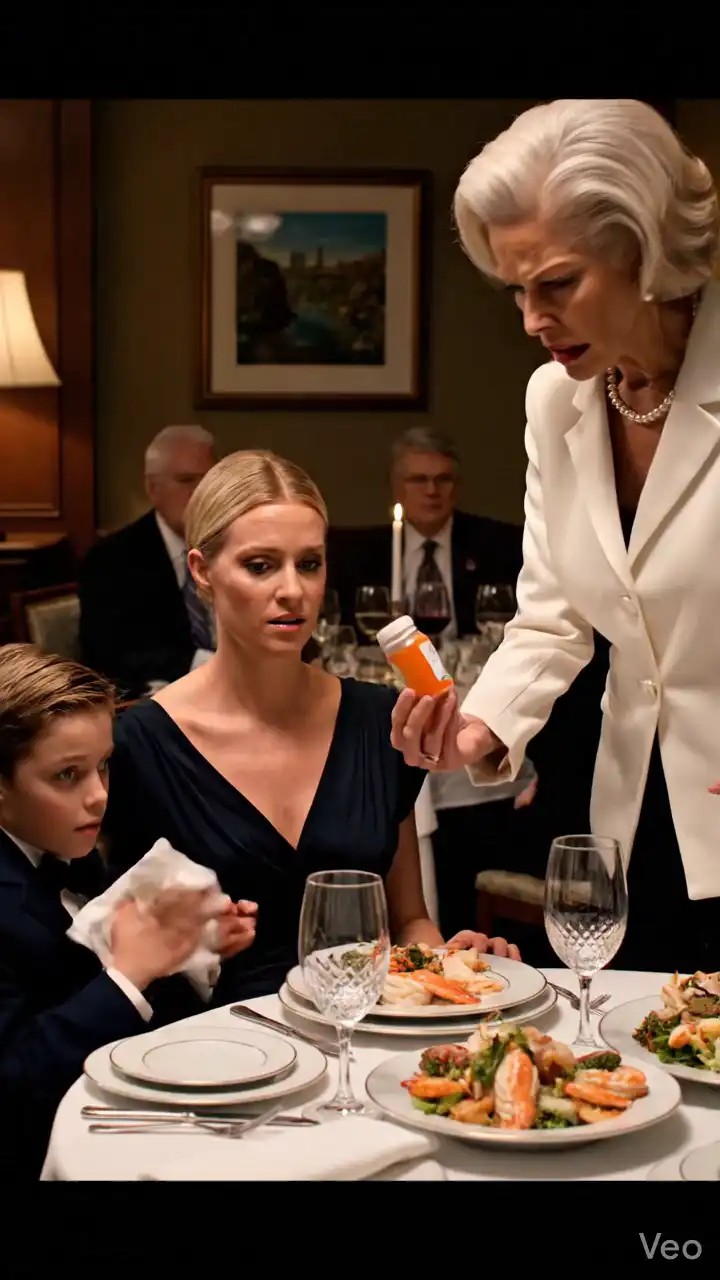
SHE OPENED MY PILL BOTTLE IN THE MIDDLE OF DINNER AND CALLED ME A LIAR
Chapter 1
The pill bottle hit the white plate with a hard plastic crack that made every fork stop moving.
I can still see it spinning beside the basket of rosemary rolls, my name on the pharmacy label turned toward the whole table like a little accusation.
MARA ELLISON
Take one tablet by mouth twice daily
My mother-in-law held it between two fingers as if it were dirty.
“So this is what you’ve been hiding,” Lenora Vance said.
The private room at Harbor Cane Oyster House had gone silent except for the muffled clink of dishes outside the door. My son, Eli, looked from her face to mine with his paper napkin still twisted in his hands. My husband Noah—my late husband, I still corrected people in my head even though he’d been gone four years—was not here to soften his mother’s edges. That was part of the problem. In his place sat his younger brother, Grady, and Grady’s wife Tessa, both suddenly very interested in their water glasses.
“Lenora,” I said quietly, “please give that back.”
She didn’t.
There are humiliations that happen fast, like tripping in public, and then there are humiliations that stretch out so slowly you can feel each person deciding what you must be.
Lenora looked around the table as if she were the only honest person left in the room. “My son left you his business shares to protect that boy. Now I find out you’re taking something serious enough to hide in your purse.”
“Grandma,” Eli said in a small voice, “that’s my mom’s.”
I put my hand over his knee under the table. He was nine and still thought adults stopped when children sounded scared.
Lenora slid the bottle away from me. “Don’t ‘please give it back’ me. We are family. Family does not keep secrets when a child is involved.”
I could feel eyes on us from the open crack in the private room door. One server paused with a tray tucked against her hip. The candle between us flickered in the draft from the hallway. I had never felt poorer in my life, though I had once counted quarters for gas and dinner in the same hour.
“We came here for Noah’s birthday dinner,” I said. “Not this.”
“No,” Lenora said, sharp enough to cut glass. “You came because you need this family to keep carrying you.”
The words landed where she intended them to. I was a single mother. I worked mornings at West Vale Elementary in the front office and picked up bookkeeping hours at a florist three nights a week. I lived in a duplex on Brinton Street with a leaky kitchen faucet and a porch light that blinked in bad weather. The Vances owned a marine supply company and a lake house and the kind of confidence that made other people step aside in doorways.
I had learned to survive being looked down on. What I had never learned was how to survive it when Eli was watching.
Grady cleared his throat. “Mom, maybe not here.”
“Then where?” Lenora snapped. “At another school recital while she smiles and says everything is fine?”
She shook the bottle once. The pills rattled, tiny and bright.
“Maybe that’s why she forgets things,” she said. “Maybe that’s why Eli was left waiting at soccer pickup last month.”
My face went hot. “I was seven minutes late.”
“You were late,” she said. “And now I’m supposed to pretend I didn’t find medication in your purse with no explanation? Should I wait until she faints in front of the child? Or forgets him somewhere worse?”
Eli’s fingers tightened around the napkin. “Mom doesn’t forget me.”
The room tilted in that strange way it does when you know if you speak too loudly, you will cry, and if you cry, people will hear weakness instead of truth.
“Lenora,” I said again, careful and steady, “give me the bottle.”
Across the table, Tessa finally looked up. Her eyes met mine, apologetic but useless. Grady stared at the tablecloth.
Lenora twisted the bottle to read the label. “You know what I hear when a person refuses to explain medication around a child? I hear danger.”
“It’s private.”
“Not when my grandson is involved.”
“He’s my son.”
It came out louder than I meant it to.
Several heads turned in the hallway. Eli flinched. For one awful second I thought he might cry, but instead he whispered, “Can we go home?”
That should have ended it. Any decent person would have ended it. But Lenora had found her audience and her reason.
“You always want to run the second someone asks a simple question,” she said. “Why? What are you on, Mara? What exactly are you taking?”
I stood up.
The chair legs scraped the floor so hard the room winced with me. “I am not doing this in front of my son.”
“Because you can’t answer?”
“Because I don’t owe you my medical file over crab cakes.”
Her mouth tightened. “If you’re unstable, I need to know.”
The word unstable moved through the room like a bad smell.
Eli looked up at me with the expression he got when thunderstorms started before bedtime. “Mom?”
I reached for the bottle. Lenora pulled it back toward her chest.
Then a man at the far end of the room, who had until then been just another guest from the larger birthday gathering, set down his napkin and leaned forward. I knew him only vaguely. His name was Calder Wynn, one of the attorneys who handled estate matters for the Vance family. He had been invited by Grady because he’d known Noah in college and happened to be in town for a property closing.
“Lenora,” he said, calm but firm, “that’s enough.”
She barely glanced at him. “This is a family matter.”
He looked at the bottle. Something changed in his face, not shock exactly, but recognition.
“May I see the label?” he asked.
“No,” I said instantly.
Lenora held it higher. “Why? Do you know something too?”
The candlelight threw a hard shine over the label. Calder’s eyes fixed on it for a second too long.
Eli tugged my sleeve. “Mom, please.”
That broke me more than anything Lenora had said. I took my purse, took Eli’s hand, and said the only thing I could manage.
“We’re leaving.”
Lenora rose halfway from her chair. “If you walk out instead of answering, don’t expect me to stay quiet about custody.”
The word custody froze everything.
Even the server in the hallway stopped moving.
I turned slowly. “What did you say?”
Her chin lifted. “If there is something medically wrong that affects Eli’s safety, I will do what Noah would have wanted.”
For a second all I heard was the blood pounding behind my ears.
Calder stood up now. “Lenora, sit down.”
She didn’t.
Eli’s voice came small and frightened beside me. “What’s custody?”
No child should have to ask that in a restaurant while adults stare.
I knelt beside him and tried to keep my face from breaking. “It’s nothing you need to worry about.”
But children know when a room turns dangerous. He pressed against me so hard I could feel his heart racing through his sweater.
Behind us, Lenora said, “Look at the label.”
I didn’t know if she meant me or the room or the attorney, but the words hung there like a threat.
And because fate has a cruel sense of timing, my purse slipped from my shoulder when I bent to hug Eli. The zipper had not been fully closed. A folded hospital discharge paper slid halfway out onto the carpet.
Calder saw it before I did.
So did Lenora.
Her expression sharpened with triumph.
“There,” she said softly. “I knew it.”
Chapter 2
If humiliation had a smell, it would be lemon polish and grilled butter and everyone else’s dinner going cold while your life spilled open on a carpet.
I snatched up the discharge paper before Lenora could reach it, but too late. She had already seen the hospital logo at the top. St. Damaris Neurology Center. Her mouth made the smallest, cruelest shape.
“A neurologist,” she said.
No one at the table touched their food now. The room had become one tight knot of discomfort. Through the doorway, the hostess pretended to rearrange menus while clearly listening.
Calder stepped around his chair. “Mara, do you need help getting out of here?”
That simple question nearly undid me. Not because I wanted help, but because he was the first person in the room who sounded like I was a person and not a problem.
“I’m fine,” I said.
It was a stupid answer. My hands were shaking so badly I could hardly get the paper back into my purse.
Lenora crossed her arms. “You are clearly not fine.”
Grady finally stood. “Mom, stop.”
She rounded on him. “You stop. You all let this go on because you feel sorry for her.”
“For her?” Tessa said softly, almost to herself.
Lenora turned back to me with that polished, church-lady calm she used when she wanted to sound reasonable while saying something brutal. “Mara, if there is a condition that could put Eli at risk, then I am not the villain for asking.”
“You are not asking,” I said. “You are performing.”
A muscle flickered in her cheek.
It was true, and she knew it. Lenora had not pulled that bottle out in concern. She had done it because she had spent four years disliking the fact that Noah had married me—a waitress then, pregnant at twenty-three, from the wrong side of town, with no rich family and no patience for polished insults. She had never forgiven me for making her son’s life smaller in her imagination, even though Noah had loved our small life more fiercely than anyone I had ever known.
After he died in an interstate wreck outside Fulton Ridge, she changed tactics. She could no longer claim I had trapped him. So she began acting like I was failing his memory instead.
Too tired. Too busy. Too emotional. Too ordinary. Too alone.
Now she had a bottle and a hospital paper and an audience.
Eli clung to my side. “Mom, are you sick?”
I looked at him. That was the question I had been trying not to answer for months.
Before I could speak, Lenora said, “That’s what we’re trying to find out.”
I felt something in me harden.
“No,” I said, turning to Eli. “That is not what we’re doing.”
He searched my face the way children do when they know adults are using words to hide the weather.
“Then what is it?” he asked.
I swallowed. “It’s a medicine I take. That’s all right now.”
He nodded because he wanted to believe me.
Calder had moved close enough to lower his voice. “Mara.”
I looked at him.
“The dosage on that label,” he said carefully, “I know I shouldn’t know this, but my late wife took something similar during treatment.”
The room narrowed around us.
Lenora heard the word treatment and leaned in. “Treatment for what?”
Calder ignored her and kept his eyes on me. His expression had changed from legal caution to human dread.
“If I’m wrong,” he said, “tell me I’m wrong.”
I stared at him. In another life, in another room, I might have asked him to keep quiet. But my son was shaking, my mother-in-law had just threatened custody in public, and the secret I had been carrying was no longer staying hidden through sheer will.
Still, I wasn’t ready. Not there. Not under those lights. Not while Lenora stood waiting to be right.
“I need to take Eli home,” I said.
Lenora let out a small laugh. “There it is again. Run.”
Grady muttered, “Jesus, Mom.”
She lifted her chin. “No. Enough. If there is a diagnosis, we discuss it now.”
I looked at Grady then, really looked at him. He had Noah’s eyes but not his spine. He loved peace so much he often sided with the loudest person just to make the noise stop. Tonight, for once, he looked ashamed.
“Will you drive us?” I asked him.
He blinked. “What?”
“Will you drive me and Eli home?”
Lenora cut in. “Why can’t she drive herself?”
Because there had been days recently when lights smeared at the edges. Because there had been mornings my left hand tingled so badly I dropped a mug. Because my doctor had told me not to drive if the episodes got worse. Because I had still driven anyway when I had no other choice and hated myself for it every time Eli buckled his seat belt.
I said none of that.
Calder did.
“Because maybe she shouldn’t,” he said.
Lenora swung toward him. “You have no standing here.”
He held her gaze. “No. But I have eyes.”
The room stayed suspended in that tight, airless way. Then Eli, who had been trying so hard to be quiet, asked the one question that split me open.
“Mom, are they trying to take me?”
Everything in me dropped.
I knelt and took his face in both hands. “No one is taking you.”
He looked at Lenora, then back at me. “Promise.”
“I promise.”
Lenora actually had the decency to look unsettled for half a second, but it passed. “Children need stability, Mara.”
“And they need kindness,” I said.
I stood. My knees were weak, but my voice wasn’t anymore.
“You don’t get to pull my medicine out at dinner and call that love. You don’t get to terrify my son and call that concern. And you do not get to use Noah’s name as a weapon against me.”
Tessa inhaled softly. Grady looked away.
Lenora’s face went pale with anger. “Everything I do is for this family.”
“No,” I said. “Everything you do is to feel in control of this family.”
For the first time that night, she had no quick answer.
Calder reached for his jacket. “I’ll take them.”
“I said I would,” Grady murmured, but it sounded like guilt, not resolve.
I should have refused. Instead, because Eli was trembling and I needed one person nearby who wasn’t trying to expose me, I nodded at Calder.
On our way out, the hostess stepped aside too fast, embarrassed to have been listening. The dining room beyond the private room glowed warm and golden, full of people laughing over oysters and wine, and the normalness of it felt offensive.
At the front doors, Eli whispered, “I don’t like Grandma tonight.”
I pushed open the heavy glass door to the damp April air of Bracken Hollow. “You don’t have to decide anything tonight.”
“Yes, I do,” he said with a child’s blunt logic. “She was mean.”
Rain had just started, making the sidewalks shine under the restaurant lights. Calder brought his car around from valet while I stood under the awning with Eli tucked beneath my arm.
When we were alone for one brief second, he looked up at me and asked, “Do I need to be brave?”
Children should not know to ask that either.
I smoothed his hair back. “No. You just need to be my boy.”
He nodded and leaned into me.
Calder’s sedan pulled up. He got out and opened the back door for Eli first, which I noticed because small respect can feel enormous on a terrible night.
Once Eli was buckled in, Calder looked at me over the roof of the car. Rain beaded on his coat shoulders.
“I’m going to ask one thing,” he said quietly. “Do you need a doctor tonight?”
“No.”
“Do you need a witness?”
I stared at him.
He added, “If Lenora follows through on what she said.”
That landed with chilling weight because it meant someone else had heard the threat as clearly as I had.
“I don’t know,” I said.
He nodded once. “Then keep the bottle. Keep every paper. And if she contacts a lawyer, call me before you panic.”
I almost laughed at the absurdity. “You are a lawyer.”
“Tonight I’m a man who remembers what treatment labels look like.”
I got into the passenger seat because my legs were starting to shake again. As we pulled away from Harbor Cane, I looked back through the rain-streaked window and saw Lenora standing just inside the doors, rigid and watchful, like she had not finished with me yet.
I was right.
By morning, she had left three voicemails.
The first was cold. The second was righteous. The third was dangerous.
“If you don’t tell me the truth by noon,” she said, “I’ll do what I have to do for Eli.”
Chapter 3
I didn’t tell the truth by noon.
I spent the morning at West Vale Elementary smiling at second graders with lost lunch cards while my phone buzzed inside my cardigan pocket like a trapped insect. Every time it vibrated, my stomach tightened. Lenora. Grady. Unknown number. Lenora again.
At ten-fifteen, I called my neurologist from the supply closet between reams of paper and dry-erase markers.
“I had a family incident,” I told the nurse, because I did not have the energy to describe being publicly dismantled over salmon and mashed potatoes.
The nurse, Celine, had one of those steady voices that made panic seem slightly embarrassed to be present. “Are you safe?”
“Yes.”
“Is your son safe?”
“Yes.”
“Do you need documentation of your restrictions and treatment plan?”
I closed my eyes. “Maybe.”
“Maybe means yes,” she said. “I’ll tell Dr. Kessler.”
By lunch, there was an envelope waiting for me at the front desk, brought by courier from St. Damaris. Formal language. Medical restrictions. Diagnosis. Compliance. Prognosis uncertain. It felt obscene to have my private fear translated into crisp, professional sentences.
I slipped it into my bag beside the pill bottle Lenora had turned into a spectacle.
At three o’clock, Eli came bouncing into the office with his backpack half-zipped and his shoelace trailing, as if the world had not almost shifted under him last night. Children do that. They step around adult wreckage because they still believe home can be made safe by routine.
“Can we get corn dogs?” he asked.
“Tonight?”
“Please.”
I smiled despite myself. “Maybe.”
Then I saw the sign-in tablet on the counter.
LENORA VANCE
Visitor badge issued 2:47 p.m.
A chill moved over my skin.
“Where’s Ms. Corinne?” I asked the substitute aide at pickup.
“She said Eli’s grandmother came by during recess to drop off cupcakes for Teacher Appreciation planning. Why?”
I looked at Eli. “Did Grandma talk to you today?”
His face changed just enough to answer before he spoke. “A little.”
“What did she say?”
He stared at the fish tank in the lobby. “She asked if I feel safe at home.”
The room around me seemed to go strangely far away.
“And what did you say?”
“That home is home.”
My hand gripped the counter.
“She asked if you sleep a lot,” he added. “And if I know where the neighbors are.”
I bent to his level. “Listen to me carefully. If anyone asks you questions like that again, you tell me right away. Okay?”
He nodded, uneasy now.
“She said she worries,” he murmured.
I wanted to tell him worry and control are not the same thing. I wanted to tell him adults can love badly. I wanted to tell him his grandmother had crossed a line so cleanly there was no pretending anymore.
Instead I said, “You did nothing wrong.”
That evening I skipped corn dogs and drove—against doctor’s advice, against my own better judgment—to Lenora’s house in the Crest Willows subdivision. The Vance house sat behind neat hedges and a fountain no one needed, all red brick and expensive calm. Noah used to joke that he grew up in a furniture showroom with rules.
I left Eli with my neighbor, Mrs. Dobbins, under the excuse that I had to run an errand. Then I stood on Lenora’s front step, fists clenched, and rang the bell.
She opened the door in a pale cashmere sweater as if she had been expecting a more civilized version of me.
“You don’t question my son at school,” I said before she could speak.
She did not even blink. “You don’t hide a neurological condition from family.”
There it was. The phrase, clean and ugly.
“Family?” I said. “You threatened custody in a restaurant.”
She folded her arms. “Because you forced my hand.”
My laugh came out thin and unbelieving. “By being sick?”
“By being secretive.”
A lamp glowed behind her in the foyer, lighting up framed photos of Noah at every age except the age he was with me. That had always been Lenora’s trick—editing reality until it matched her preference.
“It is not your business unless Eli is in danger,” I said.
“And is he?”
“No.”
Her eyes sharpened. “Then say the diagnosis.”
I should have walked away. I know that. But I was exhausted from fear and anger and months of carrying a thing too heavy by myself.
“Multiple sclerosis,” I said.
For a second, the words just sat there between us.
Lenora’s face changed, but not into pity. Into calculation.
“How long?”
“Since January.”
“And you said nothing.”
“I was trying to understand it myself.”
“You continued caring for Eli alone.”
“Yes.”
“You continued driving him.”
“When necessary.”
“Exactly.”
Her voice rose on that last word like she had caught me in a crime.
I stared at her. “Do you hear yourself?”
“You have numbness episodes,” she said. “Vision changes. Fatigue.”
I had not told her those symptoms. She must have looked them up.
“You researched me?”
“I researched what a responsible grandmother should know.”
My hands were shaking again, but not from weakness this time. “You are not entitled to my body because your son died.”
That one landed. She stiffened like I had slapped her.
“Noah would be horrified,” she said.
“Noah would be standing beside me.”
She looked away first.
I saw then what maybe had always been there underneath her control: grief hardened into possession. She had lost a son and decided no one else was allowed to make uncertain choices ever again. Especially not the woman he had chosen over her approval.
Still, pain does not excuse cruelty.
“I’m managing this,” I said. “With my doctor. Carefully.”
“Alone.”
“Yes.”
“That is exactly the problem.”
Her voice had gone low and almost sincere now, which somehow made it worse.
“Mara, do you know what it looks like from the outside? A widowed mother. Financially stretched. New neurological diagnosis. Medication hidden in a purse. Hospital papers folded away. A child who says you get very tired.”
I froze. “Eli said that?”
“He said you nap on Saturdays.”
“He’s nine.”
She pressed on as if she had not heard me. “Do you honestly think no one should ask whether he needs more support?”
“Support is not the same as taking over.”
“I never said take over.”
“You said custody.”
This time she did not deny it. She simply said, “I said what needed to be said so you would stop minimizing the situation.”
I understood then that to Lenora, humiliation was a tool. Public embarrassment, legal threats, school questions—they were all pressure points to force compliance. My compliance.
I stepped back from the doorway.
“If you contact my child’s school again without my permission,” I said, “I will report it.”
“To whom?”
“To anyone who listens.”
A second voice came from behind her. “They’ll listen.”
We both turned.
Grady stood in the hallway, tie loosened, looking more tired than I had ever seen him. “Mom, enough.”
Lenora’s shoulders tightened. “Stay out of this.”
“No.” He stepped forward. “I should have said that at the restaurant.”
I had never once seen him challenge her cleanly. The shock on her face said neither had she.
“She has a diagnosis,” he said. “Not a moral failure.”
Lenora gave a short, disbelieving laugh. “You think I’m cruel because I’m the only one saying what everyone else sees.”
“Everyone else sees you making a scene.”
That stung her more than any moral argument.
He looked at me then, shame flickering across his face. “Tessa told me what Eli asked in the car after you left.”
I hadn’t known Tessa had called him.
Grady swallowed. “He asked if grandmothers can send moms away.”
The foyer went painfully quiet.
For the first time, Lenora’s composure slipped. Only a little. But enough.
“That isn’t—” she began.
“It is now,” he said.
I could not stay there another second. The house felt full of portraits and judgment and ghosts. I stepped backward onto the porch.
“I’m done being discussed like a case file,” I said.
Then I left.
But the pattern had already begun.
Two days later, a certified letter arrived at my duplex from a family law office in downtown Bracken Hollow. It was not a custody filing yet. It was worse in its own way—an invitation to discuss “temporary guardianship support options in light of emergent health concerns.”
At the bottom was a line I could barely see through my anger.
Counsel for interested family party
Interested family party.
As if I were dead already and the paperwork was just catching up.
I sat at my kitchen table with the letter, the pill bottle, and the medical envelope from St. Damaris spread in front of me while rain tapped the window over the sink. Eli was in the living room building a crooked cardboard fort out of shipping boxes.
“Mom,” he called, “do dragons need doors?”
I pressed my hand over my mouth before answering. “Yes, baby. Even dragons need doors.”
Then I picked up my phone and called the one number I had never expected to need.
Calder Wynn answered on the second ring.
“I was wondering when you’d call,” he said.
Chapter 4
Calder’s office sat above a hardware store on Morrow Street, in a brick building with old wood stairs that creaked under every step. It smelled like coffee, dust, and legal paper. Nothing about it was grand, which I appreciated immediately.
There were no mahogany power games, no leather chairs trying to intimidate poor people. Just file cabinets, framed certificates, and a dying plant in the corner that looked forgiven rather than neglected.
“I’m not your client yet,” I said when he offered me coffee.
“You don’t have to be a client to need the truth,” he replied.
I sat across from his desk and handed him the certified letter. He read it once, then again more slowly.
“She moved fast,” he said.
“She always does when she thinks speed looks like righteousness.”
He gave me a brief, humorless smile. “That’s accurate.”
My hands were clasped so tightly in my lap they hurt. “Can she do this?”
“She can try.”
“Can she win?”
He did not answer immediately, which was answer enough to make my pulse spike.
“Mara,” he said at last, “a grandparent doesn’t just get custody because a mother has a diagnosis. Not remotely. But judges care about functioning, safety, and support. If Lenora persuades people you’re hiding instability, she creates risk.”
“She already has. At school. At dinner. In the family.”
“In the family is noise,” he said. “School contact matters more. Documentation matters most.”
I slid the St. Damaris envelope across the desk.
He opened it carefully, as if it might bruise. His eyes moved line by line.
Relapsing-remitting multiple sclerosis.
Intermittent sensory disturbances.
Episodes of visual blurring.
Medication initiated.
Patient advised to avoid driving during active symptom flares.
Patient remains competent to parent and perform activities of daily living with planning and support.
He looked up. “This helps.”
“It doesn’t feel like help.”
“No,” he said. “But it is.”
I stared at the wood grain of his desk. “I didn’t tell anyone because every time I imagined saying it out loud, I pictured Lenora making this exact face. The one that says See I was right something was wrong with you.”
Calder leaned back in his chair. “My wife had glioblastoma.”
The words were simple and heavy.
“She hated being reduced to the scan,” he said. “People would find out and stop speaking to her like a person with a future. They’d switch to that careful voice. The anticipatory grief voice.”
I looked at him then.
“She used to say, ‘I’m still in the room.’” He paused. “Illness exposes what people already are. Some become gentler. Some become managers.”
Lenora, I thought. Manager of other people’s fear.
“I don’t want Eli looking at me like I’m about to disappear,” I said.
“He probably already senses more than you think.”
“I know.”
I had known the first time my hand trembled while buttoning his coat. The first time I had to sit down on the kitchen floor because a wave of dizziness hit so hard I couldn’t trust my feet. The first time he asked, “Are you tired-tired or regular tired?”
Calder set the letter aside. “We need to respond before this becomes a narrative she owns.”
“What does that mean?”
“It means you stop hiding the parts that prove you are responsible.”
I laughed bitterly. “My responsible parts are not very glamorous.”
“They don’t have to be. Show me your systems.”
“My what?”
“How do you manage bad days?”
I blinked. No one had asked that before.
I found myself answering. “I keep a symptom log in the kitchen drawer. Mrs. Dobbins next door has a spare key and takes Eli if I have an appointment. I switched grocery delivery to Tuesdays because Mondays are harder after my injection. I stopped taking the highway at night. I keep emergency contacts taped inside the pantry door.”
Calder nodded and wrote notes.
“I also—” I hesitated.
“What?”
“I taught Eli how to unlock my phone.”
The room went very quiet.
Not because it was wrong. Because it was the kind of practical sadness only sick parents understand.
Calder’s voice softened. “That was smart.”
“I hated doing it.”
“I know.”
I looked out the window at Morrow Street, where a man in a feed-store cap was loading bags of mulch into a truck. Ordinary life continued with obscene steadiness.
“Will I have to tell Eli everything?” I asked.
“Not everything at once. But enough to make him feel less confused and less frightened.”
I rubbed my temple. “Last night he asked if tired can be a sickness.”
Calder was silent for a moment. “Children can survive hard truths better than they survive adult secrecy.”
I took that in and hated how true it felt.
By the time I left his office, we had a plan. He would send a formal response refusing any discussion of guardianship and attaching only the summary line from Dr. Kessler that mattered most: patient remains competent to parent. We would also request that all communication go through counsel if Lenora continued escalating.
I should have felt relieved.
Instead, I felt exposed.
That weekend the pressure shifted in a way I had not expected.
It started at church.
I went because Eli had practiced with the children’s choir and because routine still seemed holy to me even when faith felt thin. We attended Ashfield Community Chapel, the kind of place with dented casserole trays in the fellowship hall and people who knew your business before they knew your middle name.
By the time service ended, I had already noticed two women watching me with a sympathy I had not asked for.
Then in the parking lot, Mrs. Eubanks from the prayer chain touched my arm and said, “If you need someone to drive Eli for a while, dear, all you have to do is ask.”
For a second I couldn’t breathe.
Lenora had not only moved legally. She had moved socially.
“What do you mean for a while?” I asked.
Mrs. Eubanks looked flustered. “Oh. Nothing. I just heard you were going through health things.”
“From whom?”
She did not answer, which was answer enough.
Eli was standing three feet away licking powdered sugar off a donut.
I smiled with all the muscles that hurt. “Thank you. We’re fine.”
But we were not fine.
At home, I stood in my kitchen and realized my illness was now traveling ahead of me in other people’s mouths, stripped of context and padded with concern. That might have been the moment I hated Lenora most. Not for threatening legal action. Not even for the restaurant. For turning my private effort to stay steady into community gossip under the disguise of support.
That afternoon there was a knock at my door.
I opened it to find Tessa Vance standing on the porch holding a foil pan of baked ziti she clearly did not expect me to welcome.
“I know this is insulting food,” she said. “I didn’t know what else to bring.”
Despite everything, I almost smiled.
Eli ran up behind me. “Is that noodles?”
“It is if your mother lets me in.”
I stepped aside.
Tessa set the dish on the counter and looked around my tiny kitchen—the school forms clipped to the fridge, the symptom log tucked beside the toaster, Eli’s spelling words on index cards, the unpaid gas bill under a magnet—and something in her face shifted. Not pity. Understanding.
“I should have said something at dinner,” she said.
“Yes,” I answered.
She nodded, accepting it. “Grady should have too.”
“Yes.”
She took a breath. “Lenora called three people from church and two from school board circles. She says she’s building support.”
I closed my eyes.
“There’s more,” Tessa said. “She met with a family lawyer named Dean Parcell. I saw his card on her hall table.”
“Calder already contacted them.”
“Good.”
Eli had already peeled the foil back and was grinning into the pan like life still made sense.
Tessa lowered her voice. “Mara, I need you to know something ugly. Lenora really believes she’s the safe option. She thinks money, order, and structure equal safety.”
“And love doesn’t?”
Tessa’s eyes filled briefly. “Not if love is messy. Not to her.”
I leaned against the counter because my legs had suddenly gone weak. The weakness scared me in front of other people more than when I was alone.
Tessa noticed.
“You’re having symptoms?”
“I’m fine.”
She gave me a look. “That means no.”
A numb wave was moving through my left calf, slow and electric. The kitchen light seemed too bright. I hated my body for choosing that exact moment to prove every ugly thing Lenora believed.
I gripped the counter edge.
Eli turned. “Mom?”
And then Tessa did the smallest, kindest thing. She crouched to his level and said, “Can you show me your dragon fort while your mom sits for a minute?”
His face relaxed. “It has two doors now.”
“Then I absolutely need to inspect it.”
They disappeared into the living room. I sat at the kitchen table and waited for sensation to settle, tears burning my eyes because mercy is hardest to receive when you have been forced into defensiveness.
When Tessa came back, she didn’t ask me to explain. She just poured a glass of water and set it down.
“I can testify,” she said.
I looked up sharply.
“If this goes further. About the dinner. About school. About what Lenora has been doing.”
“Why would you do that?”
“Because I married into this family too. I know the difference between help and control.”
I swallowed hard. “Grady would hate that.”
“Yes,” she said. “But he’ll survive hating it.”
That was the beginning of the shift.
Not the full reversal. Not yet. But the first crack in the story Lenora was telling.
By Tuesday, Calder had sent the formal response. By Wednesday, Dr. Kessler agreed to provide a statement regarding my treatment compliance and parenting capacity. By Thursday, my school principal, Nora Bell, called me into her office and said, carefully but clearly, “No one will be interviewing your child on campus again without your written consent.”
I nearly cried right there in front of the bulletin board with construction paper kites.
Then Friday brought the thing none of us expected.
Calder called just after sunset.
“I need you not to panic,” he said.
“No one says that before good news.”
“Lenora filed for emergency temporary review.”
The room spun. “On what grounds?”
He exhaled. “A written claim that you concealed a progressive neurological illness, continued driving against medical advice, and experienced episodes that may impair supervision.”
I sat down so fast the chair scraped.
“She filed already?”
“She filed. But listen to me. An emergency review is not a ruling. It sets a hearing.”
“When?”
“Monday morning.”
I looked toward the living room where Eli was asleep sideways on the couch with one sock on and a comic book open on his chest.
Three days.
Three days until a room full of strangers might measure my motherhood against my diagnosis.
“Calder,” I whispered, “what if she wins the first part?”
He was quiet for one beat too long.
“Then we fight the next part,” he said.
Chapter 5
The courthouse in Bracken Hollow looked like every place where people go to have their private pain translated into official language—gray stone outside, stale air inside, fluorescent lights that made everyone look already judged.
Monday morning rain streaked the windows of Hearing Room B while I sat at one table with Calder, my symptom log, Dr. Kessler’s statement, school records, and three nights of almost no sleep folded into my skin.
At the other table sat Lenora in navy wool, pearls at her throat, posture perfect. Beside her was Dean Parcell, a family attorney with silver hair and an expression so neutral it felt expensive.
Grady sat behind them looking miserable. Tessa sat two seats away from him on my side of the aisle.
That mattered more than she knew.
Eli was not there. Thank God.
Judge Helene Sutter entered at nine sharp, glasses low on her nose, no-nonsense face, voice clipped from years of hearing adults use children to settle other wars.
The hearing began with formality. Names. Purpose. Petition. Response.
Then Dean Parcell stood and made me sound like a hazard dressed in cardigans.
“Your Honor, this is not a punitive petition. My client is a concerned grandmother responding to newly discovered information regarding the custodial parent’s health status. We have evidence that Ms. Ellison concealed a significant neurological diagnosis, continued operating a vehicle while under medical restriction, and failed to disclose material safety concerns affecting the minor child.”
Material safety concerns.
Concealed.
The words were built to do damage.
Calder rose when it was his turn. “Your Honor, Ms. Ellison has a diagnosed medical condition under active treatment. She has not been adjudicated incompetent, incapacitated, or unsafe. Her physician states explicitly that she remains competent to parent. This petition is based less on danger than on disapproval of how private medical information was handled within a difficult family dynamic.”
Judge Sutter looked over her glasses. “I’ll decide what it’s based on.”
Then she looked at me. “Ms. Ellison, you may need to answer some direct questions today.”
“Yes, Your Honor.”
My voice sounded steadier than I felt.
Parcell called Lenora first.
She testified beautifully. That was the problem.
Concerned tone. Controlled grief. Selective facts.
She described finding medication “by accident” at a family dinner. She described Eli being left waiting at soccer. She described noticing “increasing fatigue and disorganization.” She described me as withdrawn, defensive, and resistant to support. She said she feared “an acute event” while Eli was alone with me.
She did not mention grabbing my pill bottle in public like evidence from a crime scene.
She did not mention asking a nine-year-old if he felt safe at home.
She did not mention church whispers or school visits or custody threats over dessert plates.
Under direct examination, she almost looked noble.
Then Calder stood for cross-examination and the room changed.
“Mrs. Vance,” he said mildly, “you said you found the medication by accident. Could you describe that accident?”
Lenora hesitated. “It was visible in her purse.”
“Visible enough to read the dosage label from where you sat?”
She paused. “I picked it up.”
“At the table.”
“Yes.”
“In front of the child.”
Silence.
Lenora’s jaw tightened. “I was alarmed.”
“Did you ask privately to speak with Ms. Ellison?”
“She was evasive.”
“That wasn’t my question.”
“No.”
Calder walked a few steps, hands loose at his sides. “Did you, during that same dinner, use the word custody in front of Eli?”
“I may have referenced legal responsibility.”
“In front of Eli.”
“Yes.”
Tessa looked down. Grady shut his eyes.
Calder nodded as if pinning each answer carefully to a board. “Did you visit Eli at school without Ms. Ellison’s prior knowledge?”
“I brought cupcakes.”
“And questions.”
Lenora’s face hardened. “I spoke to my grandson.”
“You asked if he felt safe at home, did you not?”
No answer.
Judge Sutter looked up. “Mrs. Vance.”
“Yes,” Lenora said tightly.
“Did you contact members of your church community regarding Ms. Ellison’s health before any court review?”
“I sought informal support.”
“For whom?” Calder asked.
This time even Parcell shifted slightly.
Lenora lifted her chin. “For the child.”
Calder let the answer hang a beat, then moved to the document that would split the case open.
“Mrs. Vance, are you aware of Dr. Kessler’s written statement?”
“I’ve seen part of it.”
“Then you know he states Ms. Ellison remains competent to parent.”
“He does not live in her house.”
“No. He simply treats the condition you used to file an emergency action.”
Parcell objected. Judge Sutter allowed a narrower question.
Calder nodded. Then he asked the one thing none of us had known to ask until he recognized the label in the restaurant.
“Mrs. Vance, when you filed this petition, were you aware that Ms. Ellison delayed informing extended family of her diagnosis because she was in the middle of finalizing a medical power of attorney and guardianship contingency plan for Eli?”
The room went still.
Lenora blinked. “What?”
I turned to Calder so fast my chair creaked.
He was already pulling a folder from his case file.
Parcell frowned. “What document is that?”
Calder addressed the court. “Your Honor, with permission, I’d like to mark as Exhibit D a draft set of contingency documents prepared at my office three weeks before the dinner incident.”
My heart kicked hard against my ribs.
I had come to Calder once before. Not after the restaurant. Before it.
One quiet Thursday in March, after my diagnosis but before I started medication, I had sat in that same office above the hardware store and asked a question that made me feel like I was betraying my own hope.
If something happens to me, how do I keep Lenora from using the chaos to take Eli away from the people he actually feels safe with?
Calder had drafted a medical power of attorney, emergency school authorization for Mrs. Dobbins, and temporary guardianship preference naming my cousin Reina Solis in Chattanooga—not Lenora—as Eli’s first choice if I became incapacitated short-term. We had not signed everything yet because I kept stalling, unable to bear the symbolism of preparing for my own possible failure.
The “marginal attorney” in Lenora’s eyes had become the keeper of the truth she never imagined existed.
Parcell objected again, but Judge Sutter allowed foundation.
Calder approached the bench and handed over the draft packet with dated intake notes and my signed consultation receipt.
“This shows,” he said, “that before any family confrontation, Ms. Ellison was taking proactive, legally appropriate steps to protect her son in the event of a medical emergency. Not concealing danger. Planning for it responsibly.”
Judge Sutter read, face unreadable.
Lenora stared at me as if I had spoken in a language she didn’t know.
“You named someone else,” she said before she could stop herself.
The words slipped out too raw and personal for a courtroom.
Judge Sutter looked up sharply. “Mrs. Vance, you will address the court, not the respondent.”
But the damage was done—not to me. To her.
Because in that one involuntary sentence, everyone heard what this had really been about.
Not only fear for Eli.
Possession. Expectation. Injury.
Parcell attempted recovery. “Your Honor, a draft contingency plan does not negate the present concern—”
“No,” Judge Sutter said, still reading. “But it strongly rebuts the allegation of reckless concealment.”
Then Calder called me.
I walked to the witness chair feeling like my bones had been hollowed out.
He kept his questions plain.
“When were you diagnosed?”
“January 14.”
“What did you do after diagnosis?”
“Started treatment. Followed with neurology. Adjusted my work schedule. Created backup plans for Eli. Consulted legal documents in case of emergency.”
“Why did you not immediately tell Mrs. Vance?”
Because she would use it.
Because I wanted one week where I was just a mother and not a prognosis.
Because every room she enters becomes a stage for hierarchy.
I answered with the cleanest truth. “Because I was still learning what the diagnosis meant, and I wanted to tell Eli first in the right way before it became family talk.”
His next question was quiet. “Did that happen?”
I looked down at my hands. “No.”
“Why not?”
“Because she found the medicine first.”
I heard someone in the back row exhale.
Calder let the silence do its work.
Then came the hard part. Parcell’s cross-examination.
He was polite. Ruthless men often are.
“Ms. Ellison, have you driven your son while experiencing symptoms?”
“Yes. Before I fully understood which symptoms would pass quickly and which meant I needed help.”
“Against medical advice?”
“I exercised bad judgment twice. Then I stopped.”
“Tired judgment can still be dangerous, correct?”
“Yes.”
“And you left your son waiting at soccer pickup.”
“For seven minutes.”
“Long enough for concern.”
“Long enough for shame,” I said before I could stop myself.
He paused. Then, perhaps sensing that pushing a mother too hard in front of a judge can backfire, he shifted.
“Do you deny being more fatigued in recent months?”
“No.”
“Do you deny periods of numbness?”
“No.”
“Do you deny vision disturbances?”
“No.”
He spread his hands slightly, as if the case explained itself.
I lifted my eyes and looked at Judge Sutter before answering the next question, though he had not yet asked it.
“I deny that any of those things mean my son is safer with someone who humiliates me to control me.”
The room locked on the sentence.
Parcell sat down soon after that.
Then Tessa testified.
She described the restaurant exactly as it happened. The bottle. The threat. Eli asking if they were trying to take him. She described Lenora contacting church people and “gathering support” before speaking to me privately. She did not dramatize. She didn’t need to.
Finally, at Calder’s request, Judge Sutter allowed a brief telephonic statement from Dr. Kessler.
His voice came through speakerphone flat and clinical in the best possible way.
“Ms. Ellison is under treatment for relapsing-remitting multiple sclerosis. Based on my evaluation, she is medically competent to parent. My recommendations include rest management, transportation support during active flares, and standard follow-up. A diagnosis of MS, by itself, does not imply inability to safely raise a child.”
Parcell asked if future deterioration was possible.
“Yes,” Dr. Kessler said. “As with many conditions. That is why responsible planning matters.”
Judge Sutter leaned back after the call ended and removed her glasses.
When she spoke, even Lenora looked unprepared.
“Emergency intervention requires evidence of immediate risk to the child, not alarm triggered by a diagnosis. What I see here is a mother managing a difficult medical condition with imperfect but meaningful planning. I also see a grandmother whose concern may be sincere in part, but whose methods have escalated family conflict and increased distress for the child.”
Lenora’s face blanched.
“The petition for emergency temporary review is denied.”
I heard the words, but it took a second for my body to believe them.
Denied.
Judge Sutter was not finished.
“Furthermore,” she said, “I strongly advise all parties that the child not be questioned outside appropriate channels. If support is truly the goal, it must be offered in ways that preserve parental dignity and the child’s sense of security.”
Parcell murmured to Lenora. She did not move.
I sat frozen until Calder touched my elbow lightly.
“It’s over for today,” he said.
Today.
Not forever. But enough for my lungs to work again.
As people stood, Lenora finally looked at me. Her face was stripped of triumph now. Underneath it, for the first time, I saw something almost worse.
Not hatred.
Wounded disbelief.
As if she could not understand how being afraid for me had turned into being wrong about me.
She stood when everyone else was halfway out and said, low enough to be private, “You should have told me.”
I was too tired for politeness.
“You should have asked like love.”
Chapter 6
The first thing I did after the hearing was pick Eli up from school and take him for corn dogs.
He had been waiting for that promise all week, and I had learned enough by then to understand that children need ordinary food after extraordinary fear. We sat in a red vinyl booth at Mae Belle’s Drive-In on Hollis Road while rain tapped the windows and the fryer hissed in the back.
He dipped a corn dog in ketchup and studied my face.
“Did the judge say I can stay home?”
There it was. The whole week inside one sentence.
I reached across the table and took his wrist gently, sticky fingers and all. “You were always staying home.”
He searched me another second, then nodded.
“Was Grandma in trouble?”
“No.”
“Was she mean?”
I could have said yes. I could have said more than yes.
Instead I thought of the courtroom, of Lenora’s involuntary hurt when she realized I had planned for Eli’s safety without naming her. I thought of how grief can warp into entitlement when no one calls it by its real name.
“She was scared in a bad way,” I said. “And when people get scared in a bad way, they sometimes try to control things they should care for.”
He considered that with the seriousness only a child can bring to a fried lunch. “Did you get scared too?”
“All the way through.”
He nodded as if that made sense of the world. “Me too.”
So I told him.
Not every detail. Not legal words. Not prognosis percentages or future possibilities. Just the truth he could hold.
“I have something called MS,” I said. “It means sometimes my body gets tired or tingly or blurry in ways that need medicine and planning. It does not mean I stop being your mom.”
“Will it go away?”
“Not exactly.”
“Will you die?”
The question was flat and direct and nearly broke me.
“Not because of this anytime soon,” I said carefully. “And my doctors are helping me stay as healthy as I can.”
He looked down at his plate. “Are you still the boss of me?”
I laughed then, real and surprised. “Very much so.”
That made him grin.
Then he asked the question that mattered most. “Can I still tell you if I’m scared?”
I squeezed his hand. “Especially then.”
In the weeks that followed, the world did not magically become easy. That’s not how these stories go when they are real.
I still had fatigue. Still had appointments. Still had nights when I lay awake imagining futures I did not want. Money was still tight. The porch light still blinked in storms.
But some things changed.
Mrs. Dobbins became official on school paperwork instead of unofficial through kindness alone. Nora Bell at West Vale arranged my schedule so I could leave early on infusion days without shame. Tessa started taking Eli every other Thursday for pizza and library time, and Grady came twice to fix things around the duplex without making a performance of helping.
Calder finalized the contingency documents, and this time I signed them all.
That hurt.
It also steadied me.
As for Lenora, she did not call for eleven days.
Then one Sunday afternoon she showed up on my porch holding a grocery bag and wearing none of her usual armor except a beige raincoat and pride she had not fully put down.
Eli was at a birthday party. We stood facing each other while the neighborhood sprinkler clicked across somebody’s lawn.
“I brought soup,” she said.
“I already have soup.”
She almost smiled, which somehow made it sadder. “Of course you do.”
I did not invite her in right away. Neither of us was pretending that one denied petition and one bag of groceries could undo what had happened at Harbor Cane.
Finally I stepped aside.
She entered my kitchen slowly, taking in the pill organizer on the counter, the color-coded calendar, the note on the fridge that read CALL MRS DOBBINS IF MOM IS RESTING. Her eyes lingered there.
“I didn’t know,” she said.
“That’s true,” I answered. “But you also didn’t ask gently.”
She set the grocery bag down. “I have spent my whole life believing that if I moved fast enough, planned hard enough, and tightened my grip enough, I could keep disaster from entering my family.”
I leaned against the sink, waiting.
“When Noah died,” she said, and stopped. The room filled with the old ache of his name. “I could not bear how quickly life proved me useless.”
There it was at last. Not apology exactly. But honesty.
“So you tried to control what was left,” I said.
She nodded.
“And you used me to do it.”
Another nod, smaller.
I looked at the woman who had humiliated me in a restaurant, questioned my child, and dragged my diagnosis into court. I still felt the bruise of it. Maybe I always would.
But I also saw something plain enough to trust a little: she had finally stopped trying to win.
“I won’t let you do that again,” I said.
“You shouldn’t.”
“If you want to be in Eli’s life, it will be as his grandmother. Not his backup mother. Not my supervisor.”
Her throat moved. “I understand.”
“And if you have fear, you bring it to me privately. With respect.”
“Yes.”
It was the first unadorned yes she had ever given me.
When Eli came home later and found her sitting awkwardly at our kitchen table beside two untouched mugs of tea, he stopped short.
She stood too quickly. “Hello, sweetheart.”
He looked at me first.
That hurt her. Good. Some hurts teach.
“It’s okay,” I said.
He set down his backpack. “Are you being nice today?”
Lenora closed her eyes for one brief second. “I’m trying to learn.”
He accepted that better than most adults would have.
Months later, people still remembered the restaurant scene in pieces. That’s the thing about public humiliation—it travels farther than the correction. Some still looked at me with extra softness. Some with curiosity. Some with that private relief people have when illness belongs to someone else.
But the people who mattered most learned something truer.
Eli learned that fear can be spoken before it turns poisonous.
Tessa learned that peace without courage is just silence dressed up.
Grady learned that staying neutral while someone is being humiliated is its own kind of choice.
And Lenora learned, slowly and not gracefully, that judgment feels powerful because acceptance requires surrender.
As for me, I learned that secrecy can protect dignity for a little while, but only if the people around you deserve your silence. The wrong people will use it to write a story about you. The right people will help you tell the truth before shame tells it for you.
Sometimes, on hard evenings, I still see that bottle spinning across the plate, my name exposed under restaurant lights while everyone stared.
For a long time, that was the image I carried.
Now when I remember Harbor Cane, I also remember what came after.
A courtroom where the truth landed.
A child in a red booth asking if I was still the boss of him.
A woman on my porch finally setting down her need to be right.
Illness changed my life. Grief had already changed hers. Neither of those things made cruelty necessary.
What saved us, in the end, was not winning.
It was learning that love offered as control is still fear, and fear is a poor parent to any family.
Acceptance is quieter.
Acceptance asks first.
Acceptance does not open a pill bottle in public and call that care.
Acceptance sits down at the kitchen table, tells the truth late if it must, and begins there.
Disclaimer: Mention of any brand or trademark is for identification only and does not imply partnership or endorsement
MY HUSBAND USED MY MONEY, GOT ENGAGED TO HIS MISTRESS, AND STOOD THERE WHILE SHE SLAPPED ME

THE MAID OF HONOR POURED WINE ON ME AT MY BRIDAL SHOWER AFTER STEALING MY FIANCÉ. SHE DIDN'T KNOW THE ROOM WAS ABOUT TO HEAR WHAT HE'D BEEN SAYING TO BOTH OF US.

THE MAID OF HONOR POURED WINE ON ME AT MY WEDDING AND CALLED ME CRAZY. SHE FORGOT I STILL HAD THE VOICE NOTE SHE SENT MY FIANCÉ.