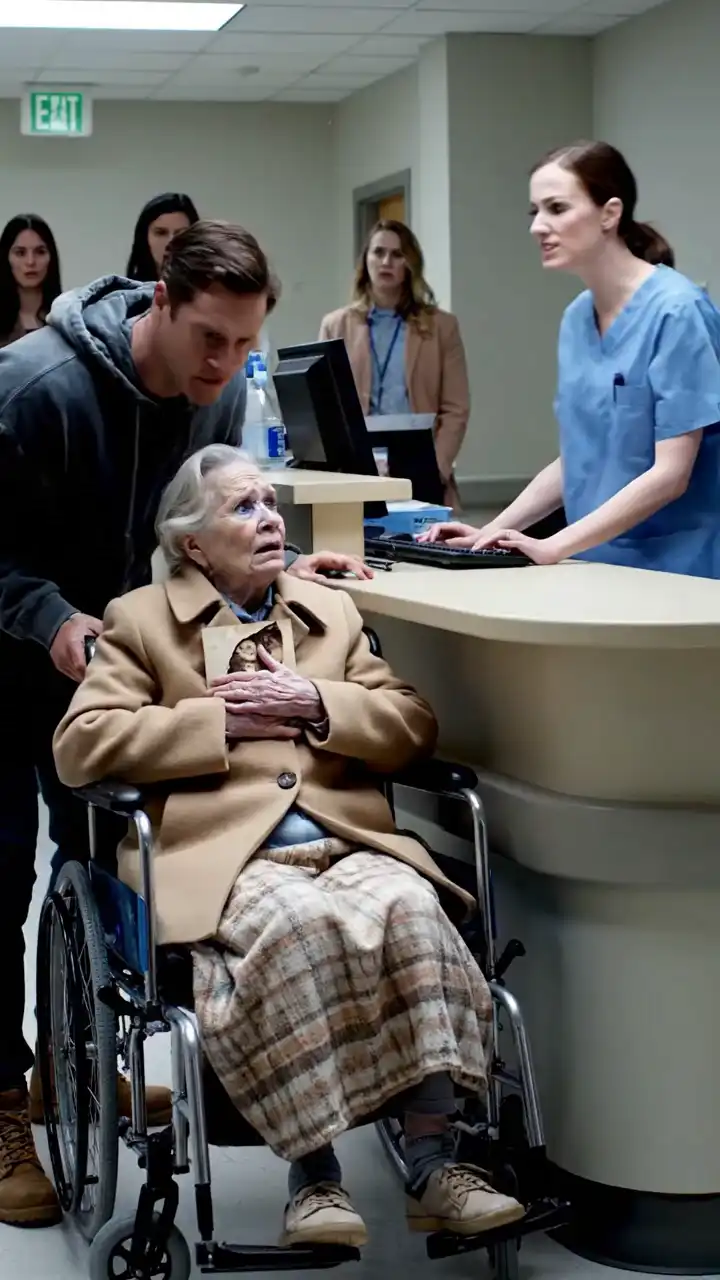
THE NURSE WALKED PAST HER THREE TIMES WHILE SHE HELD THE CRACKED PHOTO AND WHISPERED MY NAME
Chapter 1
By the time Nurse Talia Mercer ignored me for the third time, half the emergency waiting area had stopped pretending not to watch.
I was standing beside my mother’s wheelchair with a plastic hospital blanket slipping off her knees and an old photograph shaking in her hand. The photo had been folded so many times a white crack ran straight through the middle of it, splitting one smiling face from another. My mother, Elin Weller, kept touching that crack with her thumb like it was a wound that still hurt.
“Please,” I said, stepping toward the nurses’ station again. “She can’t catch her breath.”
Talia didn’t even lift her eyes. She kept typing, long pale nails clicking against the keyboard. “She was triaged. She needs to wait.”
“My mother’s lips are turning blue.”
“That’s not accurate.”
I looked back at my mother and wished it wasn’t.
The waiting room at Mercy Ridge Medical Center smelled like burnt coffee and sanitizer. A child cried in short exhausted bursts near the vending machines. A television mounted in the corner played a daytime court show with the volume too low to follow, just enough to add to the noise. My mother sat tucked into herself in the wheelchair I’d pulled from the hall, still wearing her thin beige coat because she refused to take it off in public. Her gray hair was pinned back badly. One side had come loose in the ambulance ride from Pine Vale Towers.
She didn’t belong in a crowded room under fluorescent lights. She belonged by the window in her apartment with her tea mug and her old radio and the little box of photographs she never let anyone touch.
“Ma,” I whispered, crouching in front of her. “Look at me.”
Her eyes moved slowly to mine, cloudy with fear and embarrassment.
“I’m sorry,” she breathed.
That broke me a little.
“You didn’t do anything wrong.”
She held up the photograph with trembling fingers. “He was here.”
I glanced at it again, though I’d already seen it three times since we left home. In the picture, a younger version of my mother stood beside a narrow man in a dark church suit. A little boy was between them, maybe five years old, holding both their hands. The crack split right through the man’s face.
I had never seen that photo before that afternoon.
When I’d come to her apartment after my shift at Dunlow Feed & Grain, I found her on the kitchen floor beside an overturned chair. She wasn’t unconscious, but she was pale and gasping, clutching the picture to her chest. At first I thought she’d had a stroke. Then she grabbed my wrist and said, “Don’t let him near me.”
There was no one there. Just the open window over the sink, the curtain moving in the spring air, and the photo on the floor where a corner of the frame had snapped off.
At the hospital, after triage, they parked us in the waiting room and left us there.
“He’s dead, Ma,” I said softly, because that was the only “he” I could think she meant. My father, Nolan Weller, had been dead twelve years. A heart attack in the yard behind our old trailer in Cresswell County. Buried in Lark Hill Cemetery with a stone too small for the kind of man he pretended to be.
Her hand tightened around the photograph.
“No,” she whispered. “Not him.”
A chill moved over my skin.
Before I could ask anything else, my mother started coughing hard, the kind that seemed to scrape her hollow from the inside. The blanket slid to the floor. I stood so fast the wheelchair rattled.
“Help!” I shouted. “Somebody help me!”
People turned. A heavyset man with a bandaged hand half-rose from his chair. A teenage girl pulled one earbud out. An older woman near the wall clutched her purse with both hands.
Talia glanced over, annoyed more than alarmed. “Sir, lower your voice.”
“Lower my—” I looked at my mother folding in on herself, trying to breathe. “She needs oxygen. Now.”
“We called back the higher acuity patients first.”
“She is a higher acuity patient.”
Talia gave me the kind of look reserved for people in stained work boots and cheap jackets, people who sounded too desperate and didn’t know the right words. “If you continue disrupting the waiting area, security will escort you out.”
Something hot and humiliating climbed my neck. It wasn’t just anger. It was the familiar shame of knowing exactly what she saw when she looked at me. Thirty-eight, tired, grease under my nails from unloading feed pallets, Walmart hoodie over a work shirt, no insurance card ready because the ambulance had come too fast. The son who looked like trouble before he opened his mouth.
A security guard near the sliding doors straightened but didn’t move.
My mother reached blindly and caught my sleeve. “Jonah.”
Her voice was so small I bent right down to hear it.
“Don’t leave me.”
“I won’t.”
She lifted the broken photograph again, staring past me at the hallway behind the nurses’ station. “He walked there.”
I turned. A doctor in green scrubs passed by. Two transport aides pushed a man on a gurney. No one looked familiar.
“Who?” I asked.
But she only shook her head.
Then a little girl from two rows over slipped out of her mother’s hand and came closer, maybe six years old, with one braid half undone. She looked at my mother, not scared, just curious in that direct way children are.
“Why is grandma crying?” she asked.
The room went quieter.
My mother stared at the child as if she had been asked something impossible. Then she said, almost soundlessly, “Because they don’t see me.”
The little girl turned and looked up at Talia behind the desk.
“She’s right there,” she said.
A few people let out awkward breaths. One man muttered, “Damn.”
Talia’s face hardened. “Ma’am, please return to your seat,” she told the girl’s mother, as if the child had caused the scene.
The girl’s mother rushed over, apologizing, pulling her back. My mother bowed her head, ashamed now of being visible at all.
That was the moment the room changed. It wasn’t just me asking anymore. People had seen enough to know something was off, but not enough to intervene. They watched with that uneasy expression strangers get when they’re close enough to witness cruelty but still hoping someone else will stop it.
I picked up the blanket, tucked it around my mother’s knees, and tried one last time to keep my voice steady.
“She had chest pain. She collapsed. She’s disoriented and scared. Please.”
Talia finally looked directly at me. “Your mother’s vitals were stable at intake. We are doing the best we can.”
Then she turned to the next window and said brightly, “I can help whoever’s checking in next.”
Just like that.
I felt something inside me drop cold and heavy.
My mother’s breathing eased a little, but she was shivering now. I took off my hoodie and draped it around her shoulders. In the pocket was the envelope I had grabbed from her kitchen table without thinking. It had split open on the way here, and some papers had bent inside. I tucked it deeper so it wouldn’t fall.
When I crouched again, she was looking at the photograph with tears slipping quietly down the sides of her face.
“Ma,” I said. “Who is in that picture?”
She looked at me for a long time.
Then she whispered, “The man who worked here.”
Chapter 2
For the next hour, the waiting room became its own kind of punishment.
Every few minutes a nurse came out and called a name that wasn’t ours. A toddler threw crackers under the chairs. Rain started against the front glass in thin gray lines. The security guard changed shifts. My mother sat in the wheelchair with my hoodie around her shoulders, clutching the cracked photo and staring at the hallway as if someone might step out of it at any second.
I kept thinking about what she had said.
The man who worked here.
Mercy Ridge had been here forever, though not always under that name. Before the expansion, before the polished lobby and gift shop and donor wall, it had been St. Bartholomew County Hospital, a brick building with narrow windows and a reputation older people still spoke about in lowered voices. My mother had worked there briefly in housekeeping when I was a boy. She almost never talked about it. I remembered only pieces: bleach on her clothes, sore feet, a white paper cap she brought home one Halloween because she said I could use it as a boat.
“Ma,” I said quietly, “did you know him from when you worked here?”
Her fingers worried the edge of the picture. “I shouldn’t have come.”
“You collapsed.”
“I shouldn’t have come here.”
I followed her gaze again. A thin man in a maintenance uniform was replacing a light panel near the corridor. Not him. A volunteer with a rolling cart passed out tiny cups of water. Not him. No one seemed to notice that my mother looked less like a difficult patient than a cornered one.
“Was he a doctor?” I asked.
She shut her eyes.
That was answer enough to unsettle me.
A woman across from us, maybe in her fifties, leaned forward. She had red-rimmed eyes and a grocery-store bouquet in her lap wrapped in crackling plastic. “You need me to get somebody?” she asked.
I almost said yes. Then I looked at the desk, at Talia’s stiff back, and something in me bristled against begging one more time in public.
“They know,” I said.
The woman looked at my mother for a moment longer. “Knowing and caring aren’t always the same.”
It was such a plain sentence that it landed harder than anything dramatic could have.
A little after seven, my sister arrived.
Maren had come straight from her shift at Bellrow Cleaners. She still had the name tag clipped to her sweater and rain darkening her curls. She stopped in the doorway when she saw us, her face changing all at once from annoyance at being called in to raw concern.
“Oh my God,” she said, dropping to one knee beside the wheelchair. “Mama.”
My mother reached for her hand immediately. That alone told me how frightened she was. Our mother didn’t reach for help unless she was already falling.
Maren looked up at me. “How long has she been sitting here?”
“Almost two hours.”
“What?”
“I know.”
Maren stood and marched to the nurses’ station with a speed I recognized from childhood, the speed that meant someone was about to regret underestimating her.
“My mother can barely breathe,” she said. “Why is she still in that chair?”
Talia gave her the same controlled expression. “We are treating patients based on severity.”
Maren pointed. “Then look at her.”
“We have.”
“No, you checked boxes.”
The security guard drifted closer again.
I got up because I knew how this could go. My sister’s anger was cleaner than mine. Mine came out sounding like threat even when I begged. Hers sounded like truth, which made certain people dislike her faster.
“Ma says she recognized someone,” I murmured to Maren.
She turned sharply. “What do you mean?”
Before I could answer, my mother spoke from the wheelchair.
“The picture,” she said.
Maren went still.
I’d forgotten, in the chaos, that she might recognize it too.
“What picture?” I asked.
Maren’s eyes met mine and then slid away. “Nothing.”
“Maren.”
She pressed her lips together.
I pulled the envelope from my hoodie pocket and opened it. A few papers spilled into my hands: an old utility bill, a church bulletin, and the cardboard frame backing from the broken photograph. Maren saw it and her face drained.
“You brought that?”
“It was on the floor.”
My mother made a small distressed sound, and I immediately crouched to gather the papers before they scattered. A folded note slipped free, yellowed with age, but I barely noticed because on the back of the frame, in my mother’s cramped handwriting, there were three words I’d never seen before.
Do not forget.
Maren saw them too.
“Jonah,” she whispered. “Put it away.”
“No.”
The red-eyed woman across from us looked politely down at her bouquet, pretending not to listen and failing.
I turned the cracked photo over. On the front was the younger version of my mother, the little boy, and the thin man in the dark suit. On the back, faded almost to nothing, were words written in blue ink:
Spring Fair 1989 Eli age 5
The little boy in the picture looked enough like Maren around the eyes to make me catch my breath.
“That’s Eli?” I said.
My mother had three children. Me. Maren. And Eli, the middle one, dead at six after what everyone in town had always called a “bad fever that turned too fast.” I had been too young to remember much beyond casseroles and my mother screaming once behind a closed bedroom door.
Maren took the photo from my hands carefully, as if it could cut. “Not here,” she said.
“What is this?”
“Not here.”
But my mother began to tremble harder. Her breath came shallow again. She was staring not at the photo now but at the far end of the corridor, beyond the station, where an older physician in a white coat had just come through the double doors speaking to a resident.
The moment she saw him, she tried to shrink into the wheelchair.
“No,” she whispered. “No no.”
I spun around.
The doctor was in his late seventies, maybe older, with silver hair combed flat and the measured walk of someone who had spent decades being obeyed. He wore a white coat over civilian clothes, not scrubs, and a hospital board pin glinted on the lapel. He looked like the kind of man whose portrait might be hanging somewhere upstairs.
Talia straightened when she saw him. “Dr. Vale.”
He nodded once and kept walking.
My mother raised the cracked photograph with both hands like a shield.
“That’s him,” she said.
Chapter 3
What happened next would have looked ugly no matter how you told it.
To the people in the waiting room, I was just a tired man in work boots stepping into the path of an elderly doctor while my mother shook in a wheelchair behind me. To Nurse Talia, I was already the problem patient’s son who didn’t understand how hospitals worked. To the security guard, I was a body moving too fast toward someone important.
But to me, there was only the sound of my mother saying, “That’s him,” in a voice I had never heard from her before.
I moved before I had a plan.
“Doctor,” I said, too loud. “You stop right there.”
Everything froze for one beat.
Dr. Vale turned with visible annoyance, as though I had interrupted a private inconvenience, not a public emergency. Up close he looked polished and preserved, his skin tight over sharp cheekbones, his gaze cool and practiced.
“Sir?”
My mother made a sound behind me that was almost a whimper. The cracked photo fluttered in her hand.
“You know her,” I said.
Talia was already out from behind the desk. “Mr. Weller, step back.”
Dr. Vale glanced toward my mother. His expression did not change. If he recognized her, he hid it well.
“I’m afraid you’re mistaken,” he said.
My sister was beside the wheelchair now, gripping the handles. “Mama, look at me,” she whispered. “You’re okay. Don’t look at him.”
But my mother couldn’t stop staring.
The waiting room was fully watching now. Even the television noise seemed to recede.
“He worked here before,” my mother said, each word snagging on breath. “He was here then.”
Talia put herself half between me and the doctor. “If this continues, security will intervene.”
“Then let them,” Maren snapped. “You left our mother gasping in a chair while this man walked right in front of her.”
Dr. Vale’s eyes settled on the photograph in my mother’s hands, and for the first time I saw something flicker. Not guilt exactly. Irritation. Caution. Memory.
He spoke gently, but too gently, the way professionals do when they want witnesses on their side. “I have been affiliated with this hospital for many years. Elderly patients sometimes become confused under stress.”
My mother flinched like he had touched her.
I took one step closer. Security moved in.
“Don’t call her confused,” I said.
The guard, a broad man named Luis according to his badge, lifted a hand. “Sir. Back up.”
My mother suddenly tried to stand from the wheelchair. She was too weak. The blanket tangled around her knees and she nearly pitched forward. Maren caught her with a cry.
“Wait,” my mother said. “Ask him where the basement ward went.”
The room went still again.
Dr. Vale’s face flattened in a way I’ll never forget. It was not surprise. It was recognition finding no safe place to hide.
“What basement ward?” I asked.
Talia shot Dr. Vale a quick look, then turned coldly to us. “Enough. This is a medical facility, not a courtroom. Mrs. Weller needs to calm down.”
“Don’t tell her to calm down,” said the woman with the bouquet from across the room.
A few heads turned toward her. She sat straighter, bouquet crinkling in her lap. “I’ve been sitting here an hour. That old woman’s been asking for help and all you’ve done is shush her.”
Talia stiffened. “Ma’am, I’m going to ask you not to interfere.”
The little girl from before peered around her mother’s coat again.
My mother’s breathing had become ragged. “He said Eli had a fever,” she whispered. “He said not to go downstairs anymore.”
The name hit me like a dropped pan.
Maren closed her eyes for one second, just one, and when she opened them I knew she had been carrying something alone for years.
“Jonah,” she said. “Take the note.”
“What note?”
“The one in the envelope.”
My hands were clumsy now. I unfolded the yellowed paper while Talia called for another guard and Dr. Vale began to turn away.
“Don’t you walk away,” I said.
Luis grabbed my arm, not hard but firm. “Sir.”
I looked at the paper.
The handwriting was my mother’s, but younger, more rushed.
If anything happens to Eli it was not the fever Dr Vale told me not to ask questions He said poor women lose children every day He said I should be grateful they tried
I could hear my own pulse.
Maren’s hand flew to her mouth. She had clearly seen the note before, maybe years ago, maybe only once, but seeing me read it in that room broke something open in her face.
“No,” I said, but I was reading it. “No.”
My mother was crying openly now, not loud, just helplessly. “They took him from me,” she said. “I heard him crying downstairs.”
The doctor spoke at last, sharper now. “This is a delusion rooted in grief. I will not stand here and indulge it.”
That was when half the room turned against him.
Not fully, not yet. But I felt it shift. People know the sound of rehearsed authority. They know when someone reaches for a tone instead of the truth.
The red-eyed woman stood up. “Did he say poor women lose children every day?”
“No,” Talia snapped. “You are not involved.”
Luis looked from me to the note to my mother. “Maybe somebody should bring a patient advocate,” he muttered.
Talia stared at him.
A younger nurse had come from the hallway, a dark-haired woman with tired eyes and a badge that read RINA PATEL RN. She took in the scene quickly, saw my mother’s condition first, and crossed straight to the wheelchair.
“She needs a bed now,” Rina said.
Talia hissed under her breath, “We are handling this.”
“No, we’re not.” Rina touched my mother’s wrist, then looked up at Luis. “Get transport.”
Dr. Vale drew himself taller. “I’m sure this can be managed quietly.”
My sister laughed once, without humor. “Quiet is how people like you survive.”
Talia’s face hardened further. “Mrs. Weller is making serious allegations based on events from decades ago. This is not the place.”
My mother spoke before anyone else could.
“This is exactly the place.”
Her voice was thin, but every person in that room heard it.
She held up the cracked photograph again. Her hand was shaking so badly the image fluttered. “That was the day he told me my boy was improving. He smiled for that picture with us at the church fair. Two days later my son was dead and I was told not to ask why his arms had bruises.”
A sound ran through the room that wasn’t quite speech.
I felt the floor leave me.
Bruises.
I remembered none of this. I had been four. But memory is strange. Sometimes a word opens a dark room and suddenly you can smell it. Metal bed rails. Wet wool coat. My mother crying in a stairwell. Someone carrying me while she shouted Eli’s name.
Dr. Vale’s jaw tightened. “I’m done with this.”
He turned again.
This time Luis moved not me, but him.
“Doctor,” the guard said carefully, “maybe you should wait a minute.”
Talia looked horrified. “You cannot detain Dr. Vale.”
“No one said detain,” Luis replied, though his stance said otherwise.
Rina was already wheeling my mother toward the treatment corridor. “Maren, come with me. Jonah, bring that note.”
My mother reached for my hand as they moved. Her fingers were ice cold.
“Don’t let them lose it again,” she whispered.
I looked down at the paper in my hand and realized she wasn’t talking only about evidence.
She was talking about Eli.
Chapter 4
They put my mother in a curtained treatment bay in observation, close enough to the nurses’ desk that I could hear phones ringing and drawers opening, but private enough for the truth to start breathing.
Rina got oxygen on her, started labs, ordered a chest x-ray after a resident finally examined her, and did all of it with the quiet fury of someone correcting a wrong she had not committed but still recognized. Within thirty minutes, my mother looked less gray. Her breathing steadied. The trembling in her hands eased just enough for her to hold a cup of water without spilling it.
Maren sat on one side of the bed. I stood on the other, the old note folded in my pocket, the cracked photograph on the tray table between us like an accusation.
Outside the curtain, the hospital had woken up to itself.
Someone from administration had arrived. Then a patient relations officer named Celeste Bannon, wearing a navy blazer and the careful expression of a woman trained to absorb panic without displaying her own. Talia’s voice came and went, clipped and defensive. Dr. Vale had not left the building. That much I knew because I heard his name twice in hushed tones.
Inside the bay, there was only us.
“Mama,” Maren said softly, “tell him.”
My mother looked at me with shame so old it had almost become part of her face. “I tried once.”
“Tried what?”
“To tell you when you were grown.”
I pulled up a chair and sat because my legs no longer felt trustworthy. “Tell me now.”
She glanced toward the curtain as if expecting someone to be listening. Maybe all her life she had expected exactly that.
“When Eli got sick,” she said, “it started like a fever. Nothing strange. He was hot, sleepy, not eating. I brought him here because it was the only hospital close enough and we had no car after your father sold it. Dr. Vale saw him first. He said there was an infection and they needed to keep him.”
Her fingers moved restlessly over the blanket, folding and unfolding the edge.
“I slept in a chair for two nights. The third night a nurse told me I should go home and wash and rest. I didn’t want to. Dr. Vale came himself. He said I was upsetting the child. He said if I loved my son, I’d let them work.”
Maren was already crying soundlessly. She had heard some of this before, maybe not all.
“When I came back the next morning,” my mother said, “they told me he had taken a bad turn overnight. They didn’t let me see him right away. I heard him crying. I know I did. It was from downstairs.”
“The basement ward,” I said.
She nodded.
“What was downstairs?”
“I don’t know.” Her eyes filled again. “That was the horror of it. Poor people don’t get explanations. We get instructions.”
I looked down.
She went on in a hoarse whisper. “When they finally let me see him, he was barely awake. His arm had marks on it. Not like one needle. Like many. He looked… frightened. Not just sick. Frightened.”
I could not speak.
“By evening, he was gone.”
The curtain rustled and Celeste Bannon stepped partly in. “Mrs. Weller? I’m so sorry to interrupt. I wanted to ask if now is an okay time—”
“No,” I said.
Celeste looked at me, then at my mother. “There are records we may need to review tonight if you’re making a formal complaint.”
At that phrase, complaint, my mother almost retreated into herself again. Complaint sounded too small. Too administrative. Something you filed about parking or billing.
Rina appeared behind Celeste with a chart in hand. “Maybe start with asking what she needs,” she said.
Celeste nodded, chastened. “You’re right. Mrs. Weller, what do you need from us?”
My mother stared at the tray table for a long moment. Then she touched the cracked photograph.
“I need someone to say my boy mattered.”
No one in that space moved.
Celeste swallowed. “He mattered.”
My mother shook her head. “Not because you are sorry now. Because he did.”
Celeste’s eyes softened with something less professional and more human. “Yes,” she said. “Because he did.”
That was the first useful thing anyone from the institution had said all night.
Maren reached into her purse then, surprising me. She took out a small envelope, worn at the corners from being carried too long.
“I didn’t know if I should bring this,” she said.
I stared. “You knew?”
“Not all of it.”
She looked at our mother before continuing. “When I cleaned out the hall closet at Pine Vale last winter, I found a tin sewing box behind the towels. This was inside with the photo. I read one letter and put it back because I thought… I thought maybe she hid it because she wanted it buried.”
Our mother shut her eyes. “I hid it because nobody believed poor women in 1989.”
Maren handed me the envelope. Inside was another photograph, smaller, black and white. In it, a young nurse stood beside a rolling bassinet or treatment cart, one hand partly obscuring the frame. The image was blurry, as if taken quickly. At the far edge, almost cut off, was a door with a sign above it:
RESEARCH ACCESS ONLY
My stomach twisted.
On the back, in a different handwriting, were the words:
Taken before they made me stop bringing my camera Ask for June Halpern if you ever need truth
“Who is June Halpern?” I asked.
My mother gave a tired blink. “Night nurse. She was kind to Eli. She told me once not to let them move him without me. Then she disappeared.”
“Disappeared how?”
“Gone from the next shift. No one would tell me where.”
Celeste took a slow breath. “Do you mind if I copy those? And the note?”
“Not without us present,” Maren said immediately.
Celeste gave a small nod. “Fair.”
Rina looked from the photo to my mother. “There were research wards in old county hospitals,” she said quietly. “Not always legal. Not always well documented. Especially when oversight was weak.”
I stared at her. “Are you saying they experimented on him?”
She didn’t answer directly. “I’m saying older records can hide behind words families were never meant to understand.”
The resident returned then with preliminary results. My mother had early pneumonia layered over heart strain and dehydration. She needed admission. Medical urgency had finally caught up to what was obvious in the waiting room.
As he spoke, Celeste stepped aside to take a call. Her face changed during it. When she hung up, she came back differently.
“There’s one more thing,” she said. “Hospital archives found a death review request connected to Elias Weller. It was opened and then closed within forty-eight hours.”
“Closed by who?” I asked.
She hesitated.
“By Dr. Martin Vale.”
The room seemed to tilt.
Maren whispered, “Of course.”
Our mother let out a sound I can only describe as exhaustion finally finding proof.
“But there’s more,” Celeste said. “The request wasn’t filed by Mrs. Weller. It was filed by an employee.”
“June?” I asked.
Celeste looked at the photo in my hand. “June Halpern.”
Rina leaned against the counter slowly, like she needed the support. “Do you have a forwarding record?”
Celeste nodded. “A retirement address from years ago in Blackwater Run.”
My mother’s eyes widened. “Alive?”
“We don’t know,” Celeste said. “But there’s an address.”
Everything sharpened then. All night I had been reacting, stumbling from humiliation to fear to rage. Now, for the first time, there was direction.
I stood up too quickly and the chair skidded.
“I’m going.”
Maren looked at the clock. “It’s almost ten.”
“I don’t care.”
My mother gripped my wrist. Her strength startled me. “No anger,” she said. “Bring back truth. Not anger.”
I bent and kissed her forehead, something I had not done since I was a teenager and thought tenderness made a man look weak.
“I’ll bring back both if I have to,” I said.
She gave the faintest shake of her head. “Truth first.”
Behind the curtain, the corridor buzzed with new caution. Administrators moved faster. Voices lowered when they passed our bay. One old story in one poor family had suddenly become dangerous to ignore.
And all because my mother had clutched a cracked photo in a waiting room until somebody finally looked at her long enough to see she was not confused.
She was remembering.
Chapter 5
Blackwater Run sat forty minutes north of Bell County, past the feed silos, past two closed gas stations and a church with a collapsing white steeple. By then the rain had stopped, and the roads shone black under the headlights.
Maren drove because my hands were too tight on the wheel when I tried. Neither of us spoke much. The old note lay in my lap. The small black-and-white photo sat between us in the console. Every mile seemed to stretch the years backward, as if we were driving not toward a woman but toward a door our family had nailed shut and painted over.
The address belonged to a narrow house at the end of a dead-end lane, with one porch light on and wind chimes ticking in the damp dark.
I knocked once. No answer.
I knocked again.
A voice from inside, old and sharp: “If you’re selling religion, go home.”
Maren almost laughed from nerves.
“We’re looking for June Halpern,” I called.
There was a pause, then the click of three locks.
The woman who opened the door had to be in her eighties. Her hair was white and thin, her shoulders slight, but her eyes were steady and startlingly alert. She looked first at me, then at Maren, then at the photograph in my hand.
Her face emptied.
“Oh,” she said. “Those children.”
She let us in before we asked.
The house smelled like cedar, old paper, and soup cooked earlier in the day. Framed bird prints lined the wall. A walker stood beside the sofa. On the coffee table were crossword books, reading glasses, and a ceramic bowl full of wrapped peppermints.
June Halpern sat slowly in an armchair and motioned for us to take the couch.
“You’re Elin’s children,” she said.
I nodded. “Jonah and Maren Weller.”
She looked at us for a long moment that felt close to grief. “I wondered if one of you would come someday. I also prayed you never had to.”
Maren pulled the cracked photograph from her bag. “She saw Dr. Vale tonight.”
June shut her eyes. “Then he’s still walking around free.”
The room seemed to shrink.
“You knew,” I said.
“Yes.”
“Then why didn’t anybody stop him?”
Her stare sharpened. “Do you think nobody tried?”
That silenced me.
June reached toward a side table and took out a flat document case, the kind lawyers carry. The leather was cracked with age. She placed it in her lap but did not open it yet.
“I was a night nurse at St. Bartholomew in the late eighties,” she said. “County hospitals then had corners nobody inspected if the right men said not to. Dr. Vale was beloved in public. Clean voice. Beautiful handwriting. Church donor. Board favorite. He liked poor families because they had less power and fewer lawyers.”
My skin crawled.
“What did he do to Eli?” Maren whispered.
June’s mouth trembled once before she mastered it. “There was an unofficial pediatric trial. They called it a treatment protocol. Experimental dosing for children with severe infections. Some parents signed papers they could not read. Some were never properly informed. Some children were moved downstairs to be monitored away from the main floor.”
“The basement ward,” I said.
She nodded.
I could barely keep my voice level. “And my mother?”
“Elin did not consent.” June looked directly at me. “That’s why they wanted her tired, compliant, and out of the room.”
My hands went numb.
June opened the document case.
Inside were copies. Memos. A typed roster. Handwritten notes. Carbon paper duplicates browned with age. A photograph of a corridor with cinder block walls and a swinging door. And one page clipped on top with a child’s name typed in all caps.
ELIAS WELLER
Maren made a choking sound.
I took the page with both hands.
Patient transferred for observational intervention under revised authority. Maternal distress interfering with care. Verbal approval obtained.
“That’s a lie,” I said.
“Yes,” June replied. “And I wrote that in the margin before I made my copy.”
There it was, in slanted blue ink: Mother never approved.
My vision blurred.
June continued. “I reported irregularities to the internal review office. The review was opened, then closed. Dr. Vale said I had misread records and was emotionally overinvolved. I was removed from pediatrics within the week.”
“Why didn’t you go to police?”
Her laugh was small and bitter. “In 1989? In Bell County? Against the hospital’s golden physician? I was a divorced nurse with a mortgage and two sons. They threatened my license. Then one of the orderlies who talked too much lost his job. Another woman recanted. Everyone got frightened.”
Maren was crying openly now. “Mama wrote a note,” she said. “She knew.”
“She knew enough to be haunted,” June said. “Not enough to prove it.”
I looked at the file in my lap and understood something awful. For thirty-seven years, my mother had been carrying a memory that everyone around her had reduced to grief, nerves, confusion, poverty, maybe even hysteria. She had lived inside the aftershock of being correct in a world that treated her as disposable.
June reached for another paper. “There’s one more thing you need.”
It was a death summary, signed by Dr. Vale, citing sudden septic collapse. But attached to it was a lab discrepancy flagged by initials I didn’t know. Drug levels. Dosage irregularity. A notation later crossed out.
“The dosage was wrong?” I asked.
June looked at me with old sorrow. “The dosage was not approved for a child his age.”
Silence filled the room like water.
Maren folded over, elbows on knees, face in her hands.
I sat absolutely still because if I moved I thought I might break the table, the lamp, the whole thin house. I saw my brother as a boy in a hospital gown I could no longer remember. I saw my mother hearing him cry from a locked floor below. I saw her being told to be grateful.
“Why keep this all these years?” I asked.
June’s answer came instantly. “Because one day somebody might be brave enough, or desperate enough, to ask.”
I stood and walked to the small front window because I couldn’t breathe. Outside, the lane was empty, rainwater silver in the ditch.
After a moment June spoke again, softer.
“Your mother came to me once, a week after the funeral. She had bruises on her own wrist.”
I turned.
“What?”
June nodded slowly. “She said Nolan grabbed her when she wouldn’t stop asking questions. Said she was making a fool of him. Said dead was dead and she had two living children left to think about. She told me if she kept pushing, she was afraid she’d lose those children too.”
Hidden suffering. There it was, larger than I’d imagined. Not one silencing, but two. The hospital. Then home.
Maren looked up in shock. “Daddy hit her?”
June didn’t soften it. “He hurt her, yes. Maybe not every day. Women in those years learned to rank their danger. Sometimes the quietest house held the most fear.”
I felt sick. My father had died with neighbors calling him hardworking. Church men had carried his casket. I had mourned him honestly for years because children love with missing information.
June closed the file. “Elin chose survival. That doesn’t make what happened smaller.”
I swallowed hard. “No. It makes it lonelier.”
When we returned to Mercy Ridge just after midnight, everything had changed.
There were two administrators waiting in a conference room, Celeste from patient relations, a legal representative, Rina still in scrubs, and to my surprise, Luis the security guard standing near the back wall because he had apparently insisted on giving a statement about what he heard in the waiting room.
My mother had been moved to a proper room upstairs. She was awake when we entered, the oxygen line under her nose, her face drawn but clearer than before.
I put the file on her bed.
For a second she only stared.
Then her fingers touched the top page where Eli’s name was typed, and something passed over her face that was not relief exactly. Relief was too small. It was the terrible easing that comes when pain you carried alone finally becomes visible to others.
“I told the truth,” she whispered.
“You did,” I said.
Maren climbed onto the side of the bed carefully and held her. I stood there like a man who had reached the edge of one life and could already see another starting whether he was ready or not.
Celeste spoke gently from the doorway. “Mrs. Weller, Dr. Vale has been asked to leave the premises pending immediate review. Law enforcement has been contacted. State medical oversight will be notified by morning.”
My mother looked at her without triumph. “That won’t bring him back.”
“No,” Celeste said. “It won’t.”
My mother rested her hand over Eli’s name. “Then don’t protect yourselves first.”
No one in the room answered, because there was no honorable answer except the one she had already given them.
Chapter 6
The story broke three days later.
Not because the hospital wanted it to. Because a receptionist’s cousin had been in the waiting room, because the woman with the grocery-store bouquet posted about the old lady nobody would help, because someone remembered the little girl saying, She’s right there, and because once one person speaks, silence loses some of its power.
By Friday, reporters were outside Mercy Ridge Medical Center under a cold bright sky. By Saturday, two more families had contacted the state hotline about pediatric deaths at St. Bartholomew in the late eighties. By Sunday, Dr. Martin Vale’s smiling donor portrait had been removed from the hospital corridor, leaving a pale square on the wall.
My mother stayed admitted for four days. Pneumonia, heart strain, exhaustion. Rina checked on her even when she wasn’t assigned. Luis came upstairs once on his break just to say, awkwardly, “I’m glad I didn’t make you leave.” The little girl’s mother sent a card through the desk with a crayon flower on it and a note that read, My daughter says she hopes the grandma is seen now.
My mother cried over that longer than over the reporters.
During those days, more pieces surfaced. June Halpern gave a formal statement. The hospital located sealed maintenance records confirming the basement pediatric area had operated beyond listed capacity during the year Eli died. Old staff members remembered rumors they had once buried under mortgages, marriages, and time. The official language was careful. Investigation. Irregularities. Historic review. Possible misconduct.
None of those words were strong enough.
I learned, too, how deep neglect can cut even before the truth arrives. Everyone wanted to talk once there was scandal. Far fewer cared about the two hours in the waiting room when my mother had been scared, short of breath, and treated like she was not worth urgency. That part angered me almost more. People understand monsters. They struggle more with everyday coldness, because it looks ordinary enough to excuse.
On the afternoon she was discharged, I wheeled my mother through the front lobby myself. She insisted on wearing her good blue cardigan and pinning back her hair properly. The cracked photograph was tucked in her bag. The file about Eli was with Maren. Outside the sliding doors, cameras waited beyond the curb, but the hospital had arranged a side exit.
My mother stopped me before we reached it.
“No,” she said.
“You don’t have to face them.”
“I know.” She folded her thin hands in her lap. “But I spent too long leaving through side doors.”
So I turned the wheelchair toward the front.
The reporters straightened when they saw us. Microphones rose. Someone called her name.
She did not give them a speech. That was never her way. She looked smaller than all of them, and somehow steadier.
One reporter asked, “Mrs. Weller, what do you want people to understand about what happened to your son?”
My mother looked past the cameras to the hospital doors, to the glass where our reflections trembled faintly together.
Then she said, “Poor is hard. But being treated like you don’t matter is worse.”
The microphones dipped closer.
She went on, voice quiet, almost tired. “If they had been cruel only once, I might have survived it sooner. But they were careless first. That is what made room for everything else.”
No one interrupted her.
I stood behind the wheelchair with both hands on the grips and felt those words settle into me like a final instruction.
Careless first.
That was the shape of it. The waiting room. The old ward. The closed review. My father telling her to stop. Whole lives are wrecked not only by dramatic evil but by the daily permission people give themselves not to care enough.
At home, Maren moved into my mother’s apartment for a while. I fixed the broken kitchen chair and the window latch. We boxed up old papers slowly, only when she was ready. The cracked photograph stayed on the table in a new frame, crack and all. She said the break was part of the truth now.
A month later, on a windy Sunday, we took flowers to Lark Hill Cemetery. Not to my father’s grave. To Eli’s small stone three rows over, the one weather had nearly worn flat. My mother knelt with Maren on one side and me on the other. For a while none of us spoke.
Then my mother touched the stone and said, “I didn’t leave you.”
The wind moved through the weeds. Somewhere far off, a dog barked.
I looked at the date carved there, at how little space one life takes up in granite, and how enormous it remains inside the people who loved it.
“We know,” I said.
She bowed her head. Maren took her hand. We stayed until the light began to thin.
On the way back to the truck, my mother leaned on my arm, lighter than she used to be but less bent somehow. Not healed. There are things too old and too cruel for that word. But no longer carrying them alone.
That was the new order, if there was one.
Not justice, not yet. Not peace, not fully.
Just this:
She had been right. He had mattered. And at last, when she said his name, people listened.
Disclaimer: Mention of any brand or trademark is for identification only and does not imply partnership or endorsement
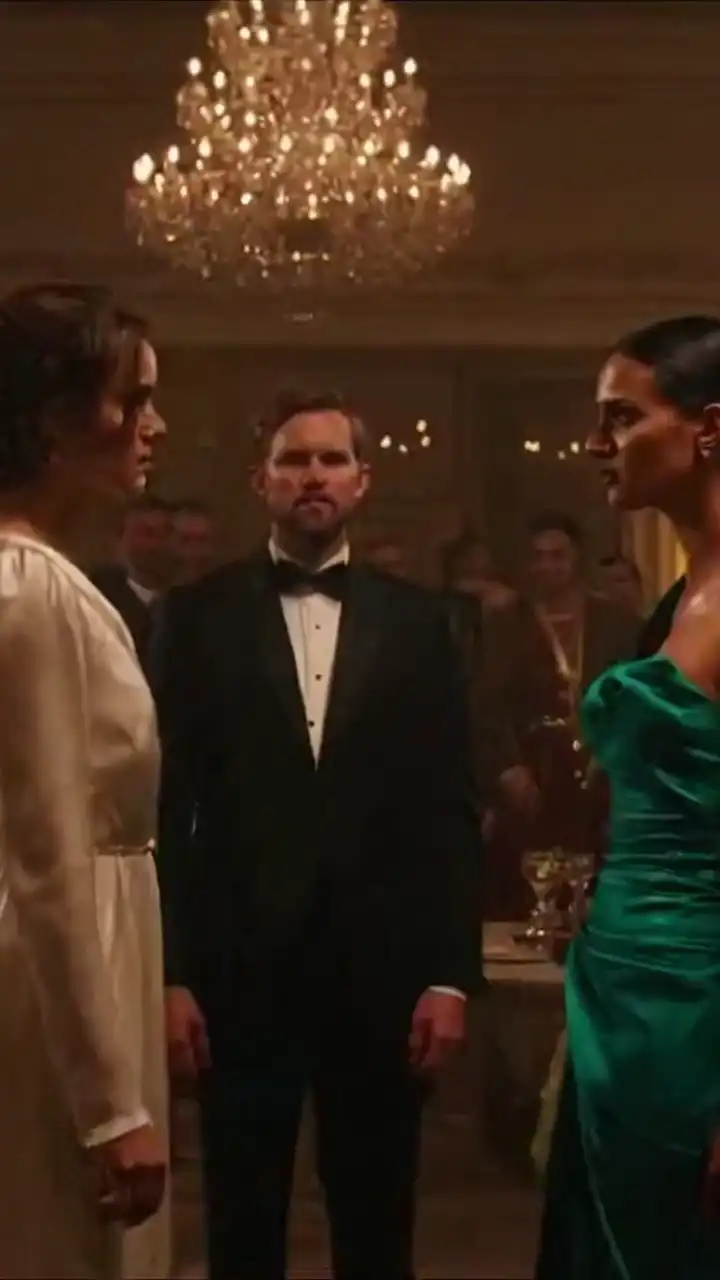
MY HUSBAND USED MY MONEY, GOT ENGAGED TO HIS MISTRESS, AND STOOD THERE WHILE SHE SLAPPED ME

THE MAID OF HONOR POURED WINE ON ME AT MY BRIDAL SHOWER AFTER STEALING MY FIANCÉ. SHE DIDN'T KNOW THE ROOM WAS ABOUT TO HEAR WHAT HE'D BEEN SAYING TO BOTH OF US.

THE MAID OF HONOR POURED WINE ON ME AT MY WEDDING AND CALLED ME CRAZY. SHE FORGOT I STILL HAD THE VOICE NOTE SHE SENT MY FIANCÉ.